| Local Area Network (LAN) Service | Customer Facing | Infrastructure Services | Available | SCS01 - REACH Client Services, SCS06 - Client Device Services, EAS20 - Network Infrastructure Services | Service Cost / Price: The unit of measure for the Service is Per Port, with 24 ports being the minimum orderable quantity. The number of ports required for a customer is in accordance with the quantity of devices requested through WPS001, WPS006 and WPS016 (For WPS016, only Tablet and Smart Phone quantities) multiplied by 2.
Please see Service Delivery Lifecycle Stages section for more information about the general overview of the type of deliverables involved in each stage and the scope of corresponding service rate. Please see Service Rates document for standard rates applicable to the service.
The 2025 Service
Rates v9.1 below are valid for all NCI Agency customers, with
exception of the NHQ, which has a specific arrangement in place
| Service ID | Service
Name | Service
Flavour/Option | Service
Unit | Service
Rate 9.1
O&M only
(EUR) | | INF001 | Local
Area Network (LAN) Service | | Per
Port | 143 |
| Andreas Hutzenlaub | Steffen Broecker | Pikul Ryszard | NSII | | 05/12/2024 14:10 |
The LAN service provides users with local network connectivity. The LAN
service is crucial to enable collaboration and communication. The LAN service
is provided as a cabled infrastructure for all networks and as a wireless
infrastructure for accessing only the unclassified and restricted networks. | LAN Service is available on the NATO Security domains in wired and, in selected locations, as Wireless (Wi-Fi) configurations. The LAN Service will be capacity sized to support the number of connected devices and Users. This is with the understanding that all equipment is located within the same building and that the cabling system is available. The service does not cover the cabling through the building walls, as this is considered part of the building infrastructure. | |
Service Flavours: The LAN Service is available in the following flavours: Wired – This service flavour provides a physical connection to terminate and connect devices to one of the NATO networks. By utilising NCIA deployed LAN Service, users are able to operate on all wired NATO networks including, but not limited to: NATO Unclassified NATO Restricted NATO Secret Mission Secret (when invoked) Wireless - This service flavour provides the ability to connect a specific client device to a network wirelessly. By utilising NCIA deployed LAN Service, users are able to operate on all wireless NATO networks including: NATO Unclassified NATO Restricted
| |
| Enterprise Identity Access Management Service (Former User Access Service) | Customer Facing | Workplace Services | Available | UAS01 - User Account Services |
Service Cost / Price: The unit of measure for the service varies depending on the flavour. For the flavour “Accounts" the unit of measure is “per User Account", for the two other flavours the unit of measure is “per Connection". Please see Service Rates document for standard rates applicable to the service. 1- Accounts Lifecycle Management User Account (On-premises or Off-premises): Per account 2- Web Federation: Per connection 3- Data Directory Synchronization (GAL-Sync): Per connection 4- DNS Federation: Per connection
The 2025 Service Rates v9.1 below are valid for all NCI Agency customers, with exception of the NHQ, which has a specific arrangement in place. | Service ID | Service
Name | Service
Flavour/Option | Service
Unit | Service
Rate 9.1
O&M only
(EUR) |
WPS002
|
Entreprise Identity Access Management Service (Former User Access Service)
| WPS002-1 User Account
| Per User Account | 85 | WPS002-2 Web Federation*
| Per Connection | 4,536
| WPS002-3: Data Directory
Synchronization | Per Connection
| 3,315
|
WPS002-4 DNS
Federation*
| Per Connection
| 3,882
|
* Service available only to External NCI Agency Customers
| Pierre Pradier | Ilker Aygun | Claudiu Grigorut (acting) | CES | | 25/07/2024 13:18 |
The Enterprise Identity Access Management Service (E-IDAM) provides identities (including provisioning and de-provisioning of User Accounts, Privileged Accounts, Service Accounts, Computer Accounts), and the capability to share trusted identity information between different domains and to Enterprise users. The information on identities retrieved from different authoritative sources. Additionally, the service includes the provisioning of personal storage space (minimum 20 GB ) for storing personal information and documents (only for WPS002-1A: User Account on-premises).[1] The Service allows controlled access based services. The access services can be available across domains utilising AD-Federation. It offers a Single Sign On experience for users with a valid NATO Enterprise Identity. The service also provides Directory Synchronization enabling Global Address List synchronisation to the NCI Agency External Customers, Mission environments, and Allied Nations. The Service provisions, operates, maintains, retires authentication subsystems like LDAP, Domain Controllers, Active Directory, ADFS, MIM, SSO. The service can delegate limited authority to the supporting elements.
[1] The NCI Agency is assessing this statement as it is not aligned with the current capability of the underlying central storage service and might be subject to modification in the following catalogue releases.
|
Identity Management shared information across multiple identity stores, improving data quality and reducing overhead for connected systems. Identity information can be synchronised between different affiliates, supported by automated workflows and enables account provisioning and de-provisioning. Data sources/consumers can use native interface of E-IDAM to retrieve or modify it through industry standard protocols and mechanism (like LDAPs). Moreover, Lifecycle management (from provisioning to de-provisioning) of Identity and its attributes is being provided with E-IDAM. Access Management is available for the compatible services requiring authentication for users and/or resources. The access management (authentication/control/validation) is provided by credential management, security group memberships, and policies (like GPO), also through integration with NATO PKI.
Account Lifecycle Management provisioned and managed on-premises and off-premises (cloud) by WPS002 including the secure and sanitized environment. The accounts on the cloud requires additional licenses to reach and consume cloud resources, as well as security & safety requirements dedicated to the cloud provider, also it brings efficiency with automation by nature of cloud.
Web Federation provides cross-domain authentication to reach web-based resources seamlessly (SSO) to increase the user experience and to enable the secure service on Windows based ADFS.
DNS Federation - distribution of domain name system (DNS) authority across multiple, independent entities or organizations (i.e. nations, partners) to enhance resiliency, scalability and diversity within the DNS ecosystem, reducing the risk of single points of failure and promoting decentralization.
Data Directory Synchronization (DDS) is provided through a number of directory synchronisation servers, which are inter-connected to identity directories of the participating NATO organisations and Nations. The DDS allows the exchange of shared identity information (such as Display Name, Organisation Name, E-Mail Addresses and other relevant contact information) between service subscribers. GAL Sync is a flavour of the Data Directory Synchronization.
| |
Service Flavours: The Service is available in multiple flavours, with the following options: 1. WPS002-1 User Account (On-premises or Off-premises): Per account Personal Data Protection deliverables below are included within this flavour (Accounts Lifecycle Management). - Service Support
- Inventorying personal data.
- Data Catalogue expansion to include PDP identification and Stakeholder data with PD elements.
- Support Stakeholder PD information requests and solutions.
- Incident management.
- Coordination of response preparations with Stakeholder PDPOs, Cyber, etc.
- Dispute resolution and mediation process.
- Legal on implementation, incident management and dispute resolution.
- Training
- SME support to NATO training sponsored by OCIO and developed by Agency/Academy.
- PDPO training coordination.
- Additional PD Training time required for PDPO office, Data Processers, Controllers, Owners and Stewards.
- Training support sessions from PDPO to same audience (e.g. SDMs for systems with Stakeholder data).
- Capabilities: Personal Data Inventory and Dependent Catalogues
- Implement and maintain Personal Data Inventory of Stakeholder and NCIA PD.
- Acquire or build capabilities, including increased developer ours for inbuilt solutions.
- Implement and maintain Data Catalogue that includes Stakeholder and NCIA* PI Data elements.
- Implement and maintain Process Inventory that includes Stakeholder and NCIA* PI Data elements.
- Implement and maintain ICT Privileged User List s Inventory that includes Stakeholder and NCIA* PI Data elements.
2. WPS002-2 Web Federation: Per connection. 3. WPS002-3 Data Directory Synchronization: Per connection. 4. WPS002-4 DNS Federation: Per connection.
| |
| NATO General Purpose Communication System (NGCS) Point of Presence (POP) Service | Customer Facing | Infrastructure Services | Available | EAS20 - Network Infrastructure Services | The unit of measure for the service is per PoP. Please see Service Delivery Lifecycle Stages section for more information about the general overview of the type of deliverables involved in each stage and the scope of corresponding service rate. For the price details, see the Service Rate document. The 2025 Service Rates v9.1 below are valid for all NCI Agency customers, with exception of the NHQ, which has a specific arrangement in place.
|
| Service Name | Service Flavour/Option | Service Unit | Service Rate 9.1 | | O&M
only | | (EUR) | | INF002 | NATO General Purpose Communication System (NGCS)
Point of Presence (PoP) Service | AirC2ISPOP (1) | Per PoP | - | INF002P - Pico POP | Per PoP | 50,601 | INF002L - Legacy PoP* (incl. NNCCRS non-collocated) | Per PoP | 21,025 | INF002NNG - NATO - Nations Gateway Option | Per Gateway | 4,386 | INF002LVAR - Local V2 Aggregation Router | Per Router | 5,760 | INF002NCI - NCI Point of Presence
| Per PoP
| 119,092 | INF002NLI - NGCS Legacy Infrastructure
| 1
| 1,319,200 |
1 - To be determined under AMDC2 POW.
* Service available only to External NCI Agency Customers
| Andreas Hutzenlaub | Steffen Broecker | Muhlis Ozturk | NSII | | 25/07/2024 14:11 | The NGCS PoP Service primarily provides the infrastructure at points between communicating entities, where a connection is required. The NATO Network POP Service is defined as the provision of the infrastructure assets, capacity provisioning, and cyber security management elements that enable the user to establish any-to-any connectivity at supported sites and between connected networks. It has a dependency on INF014, which provides the connection between sites. At each security domain classification, this service is a direct enabler of other customer facing services like: INF001, INF035, as well as 3rd party customers serviced via Point to Point EVCs or PCN type interfaces. | The Service is available across all NATO Security Domains. It features the WAN Infrastructure Assets (Protected Core Access equipment in line with the valid Technical Architecture) and Cyber Security Management (layered security present at connectivity access points).
| | NGCS Service Flavours: The exact specification of each service flavour may vary subject to equipment and suppliers but can be described as follows: - INF002NLI - NGCS Legacy Infrastructure PoP: this flavour provides the termination of medium bandwidth transmission services with links from 100 Mbit/s up to 10 Gbit/s. PoP flavour is required to support user communities larger than 100. These PoPs are generally Common Funded and include a Network Edge Device (NED) e.g. HQ SHAPE. This service flavour is to be made available only for the duration of migration of services between the legacy NGCS POP service and the NCI service flavour described below.
- INF002P - Pico PoP: this flavour provides the termination of medium bandwidth transmission services with links up to 100 Mbit/s. Pico PoP flavour supports user communities up to 100 users. PicoPoPs are generally customer (SSP) funded and include a Customer Edge Device (CED) e.g. NFIUs. They also provide dedicated or shared services to support NNCCRS.
- INF002L - Legacy PoP (Remote extension): this flavour provides the termination of small bandwidth transmission services (less than 100Mbit/s links). Remote extension services are also required to support up to 100 users. Considered as a legacy connection for existing services that do not meet the NGCS target architecture requirements; it is no longer offered as a new service. It does not include a NED or CED. This service flavour is marked to be discontinued, with service delivery being migrated to the INF002 – NNG service flavour, in line with AFS concepts.
NGCS Service Flavour Enhancements: NGCS PoPs may be extended or enhanced with the following: - INF002NNG - NATO to Nation Gateway (NNG): The NNG is an agreed hand over point between NATO and a Nation to allow information exchange for AIS (static) services. NATO is responsible to deliver the services to that point, whereas the Nation is responsible to provide connectivity and services from the NNG to the required location within the Nation. The NNG can be used for NS (future NR) and offers the option to include NS V2 services (SBC required). Additional security (i.e. firewalls on both sides) is required.
- INF002NP - Network Interconnection Point (NIP): A NIP is an agreed hand over take over point (Federated Mission Network compliant) between NATO and a Nation to allow information exchange for NRF, Exercises and Missions (this includes ships). NATO is responsible to deliver the services to that point, whereas the Nation is responsible to provide connectivity and services from the NIP to the required location within the Nation. The NIP can be used for (NRF) NU, (NRF) NR and (NRF) NS and offers the option to include V2 services (SBC required).
- INF002LVAR - Local V2 Aggregation Router (LVAR): An LVAR is deployed to enable delegated NMRs at the highest level of national command (e.g. CHOD / MOD) to access Secure Voice services. LVAR devices will be located within national NS infrastructures und national IT management. IPSEC tunnels will be created to connect to the NGCS. Nations are responsible for Level 1 support with Level 2 and 3 support from NCIA at best effort due to the services dependence on National Defence Network infrastructure.
NCI Service Flavours: The exact specification of this service is still under development but is likely to include: - INF002NCI – NCI Point of Presence[2]– Core 40G, Enhanced 40G, Standard 40G and 5G.This flavour provides the latest service evolution for the POP service, and is a direct replacement for INF002 NLI, in regards to termination capabilities of medium bandwidth transmission services with links from 100 Mbit/s up to 40 Gbit/s. These PoPs are generally Common Funded and include multiple subsystems for Protected Core Access (PCA), Coloured Cloud Access (CCA) of multiple sercurity domains: NU, NS,NR as wel las Multi Media Access (MMA) for NU voice and video services.
| |
| Managed Device Service | Customer Facing | Workplace Services | Available | SCS06 - Client Device Services | The unit of measure for the service is per
device. Price details available on request. The service rate currently
published in the CCSC reflects the service in support rate (O&M rate)
which does not represent the full end to end cost of the service. For customers
who are procuring new quantities of the service the service initiation
(procurement and deployment of
the service components) shall apply, also for components which reaches the
end of life phase the service lifecycle refresh rate shall apply. Both
the service initiation and service lifecycle refresh rates are not standard
rates (except for NATO HQ). As a pilot phase, the obsolescence refresh option
is now made available for WPS001-C Portable (Laptop/Tablet)
Device. The 2025 Service Rates v9.1 below are valid for all NCI Agency customers, with exception of the NHQ, which has a specific arrangement in place.
| Service ID | Service
Name | Service
Flavour/Option | Service
Unit | Service
Rate 9.1
O&M only
(EUR) |
WPS001
| Managed
Device Service
|
| Per
Device | 839 |
| Jean-Paul Massart | Antonio Galiero | David Wright | NDW | | 25/07/2024 13:59 | The Managed Device Service provides the users with a client device[1] (of various form factors) that allows them to secure a connection to NATO networks (in a specific security domain). The service includes full office automation software[2] (Microsoft Office Professional Suite), Windows operating system and NATO mandatory security tools. The service also includes a flavour for non-NATO network attached (i.e. standalone) devices.
[1] Please see Service Cost/Price paragraph and Service Delivery Lifecycle Stages section for the lifecycle stages of a service along with the corresponding deliverables and the service rates applicable in each stage. [2] Please note that the license component of MS Office Professional should be acquired through the WPS003 Enterprise User License service, hence WPS003 is listed as a prerequisite to this service. A license can serve multiple managed devices, therefore it is not integrated into scope of this service.
| The software baseline includes a Windows operating system, primary and secondary internet browser, a PDF reader, NATO recommended security tools (including controlled access to peripherals). For fully approved (A2SL tested) COTS applications the labour element of packaging, patching and deploying such applications is included. The service excludes the procurement of new hardware devices (laptops, desktops, thin clients, monitors, mouse, keyboard, webcam and headset, KVM or any other accessories). This service equally excludes the life-cycle replacement of obsolete equipment as well excludes the testing and approval efforts for COTS applications.
| | Service Flavours: WPS001-A Static Desktop (Workstation) Device - This device is a workstation that needs to be connected to a wired network. It features an external monitor (minimum 24"), keyboard and mouse. In exceptional cases, a thick client may be provided as a standalone device as long as all security requirements are met. As option (subject to a separate funding agreement), an additional Monitor, a VTC camera, a headset and a KVM can be provided. Static Desktop Devices are no longer used at NATO Unclassified level unless required by specific performance based applications. For standard NATO Unclassified usage, please see Portal (Laptop) Device service flavour. WPS001-B Thin Client Device - This device is a computer that runs from resources available on a central server instead of a local workstations. Thin clients work by connecting remotely to a server-based computing environment where most applications, sensitive data and memory are stored with the need to be connected to a wired network. It features an external monitor (minimum 24") keyboard and mouse. As an optional extra (subject to a separate funding agreement), an additional Monitor VTC camera, a headset and a KVM can be provided. WPS001-C Portable (Laptop/Tablet[1]) Device - This device can be connected to a wired network or to a wireless network. It comes with an external power adaptor, external mouse and a USB-C docking station. In exceptional cases, a Portable client may be provided as a standalone (NU, NR, NS) device as long as all security requirements are met. Note: The WPS001-C Portable (Laptop/Tablet) Device, can connect to NCI Agency supported CIS (NU/NR) through various connectivity: - Static connection, i.e. cabled connection to an existing NU network(Wifi or cellular disabled)
- Remotely through either WiFi or cellular connectivity .
If connected only via static connection to NU network port, the laptop device will be considered equivalent to the WPS001-A Static Desktop (Workstation) Device service flavour and hence the WPS016 C (Enterprise Managed Mobility Service NU/NR) service charge is not applicable. In case the WPS001-C Portable (Laptop/Tablet) Device has its WiFi or cellular capabilities enabled, the device is enabled for remote connectivity and hence the WPS016-C (Enterprise Managed Mobility Service NU/NR) service charge applies. For this device type there is an optional rate to include the service lifecycle (obsolescence) refresh.
[1] Tablet with Windows OS only.
| |
| Enterprise User License Service | Customer Facing | Workplace Services | Available | | The unit of measure for the Service is Per User or Per Device, depending on the flavour. Please see Service Delivery Lifecycle Stages section for more information about the general overview of the type of deliverables involved in each stage and the scope of corresponding service rate. Please see Service Rates document for standard rates applicable to the service.
The 2025 Service Rates v9.1 below are valid for all NCI Agency customers, with exception of the NHQ, which has a specific arrangement in place. | Service ID | Service Name | Service Flavour/Option | Service Unit | Service Rate 9.1
O&M only
(EUR) | WPS003 | Enterprise User License Service | WPS003-1: Standard User
| Per User | 580
| WPS003-2: Light User | Per User | Retired. All former Light Users become Standard User
| WPS003-3: NATO Delegation User*1
| Per Device | 434
|
* Service available only to External NCI Agency Customers
1 - Up to 8 users per device. | Pierre Pradier | Paolo Da Conceicao Silva | Justice Ege | CES | | 25/07/2024 13:18 | The Enterprise User License
Service provides a Microsoft Enterprise User License based on NATO User Profile
which comes in three pre-packaged profiles (NATO light,NATO Standard and NATO
Delegation User) of which all three contain the same licensing components and
the same functionality to the user, however with different number of qualified
devices that the licenses are allowed to run on.
| | | | |
| E-Mail Service | Retired | Workplace Services | Available | | Service Retired and consolidated under WPS012 – Workstream Collaboration Service. | Jean-Paul Massart | Frank Mikla | Christian Sieche | NDW | | 21/04/2023 11:11 | Service Retired and consolidated under WPS012 – Workstream Collaboration Service. | | | | |
| Instant Messaging and Collaboration Service | Retired | Workplace Services | Available | EAS06 - Collaboration Services |
Service Retired and consolidated under WPS012 – Workstream Collaboration Service | Jean-Paul Massart | Frank Mikla | Christian Sieche | NDW | | 21/04/2023 11:12 | Service
Retired and consolidated under WPS012 – Workstream Collaboration Service | | | | |
| REACH Mobile Workplace Service | Customer Facing | Workplace Services | Available | SCS01 - REACH Client Services, EAS6 - Collaboration Services | Unit of measure used for service quantification is Per Device. Please see Service Delivery Lifecycle Stages section for the lifecycle stages of a service along with the corresponding deliverables and the service rates applicable in each stage. Please see Service Rates document for standard rates applicable to the service.
The 2025 Service Rates v9.1 below are valid for all NCI Agency customers, with exception of the NHQ, which has a specific arrangement in place.
| Service ID | Service
Name | Service
Flavour/Option | Service
Unit | Service
Rate 9.1
O&M only
(EUR) | | WPS006 | REACH
Mobile Workplace Service | | Per
Device | 2,194 |
| Jean-Paul Massart | Antonio Galiero | Ingeborg Savooy | NDW | | 25/07/2024 14:21 | The REACH Mobile workplace Service provides client devices (Laptops) that allow to connect to the NATO Restricted network. Additionally, the Service includes: - A User Account, Password and PKI token to access the NR.AIS Network (WPS002);
- A mailbox on the Restricted network (WPS012); and
- An IM Collaboration Account (WPS012).
The Laptop Client device is loaded with the office automation software (MS Office Professional Suite), Windows operating system, VPN client software, and security and management tools.
| Same as the four individual services comprised in this service offer.
There is an additional option for a Static work position which consists of a
docking station, dual LCD Monitor, VTC camera, Keyboard and mouse. (This option
is only applicable for the Portable Client Device service flavour).
| | Service Flavours: Portable Client Device (Laptop) – provides a Laptop device that needs to be connected to a wired or wireless network. The laptop comes with a power supply, a carrying case, a headset, and an external mouse. Optional Static Work position – only applicable for a portable client device service flavour; provides a docking station for the portable device, dual LCD monitors, a VTC camera, a keyboard, and a mouse.
| |
| Print/Scan/Copy Service | Customer Facing | Workplace Services | Available | SCS02 - REACH Network Based Printing and Scanning Services, SCS07 - Network Based Printing and Scanning Services | The unit of measure, used for service costing is per Multi-Functional Device[1] and per type of printed page. The exact service rate is not yet calculated, but is estimated due to ongoing renewal of the active contract with current supplier. For 2024 budgetary purposes the following annual service rates are recommended to be used***: *** The service rate is based on a full five-year service commitment. In case of shorter service commitment, the investment cost of the MFDs will be borne at service instantiation. The annual service rate will equally be lower depending on the length of the service commitment decided. Exact service rate calculation will be provided at price proposal stage. Please see Service Rates document for standard rates applicable to the service.
[1] For new entities, not already consuming the WPS007 Print/Copy/Scan Service, there is a one-time cost of EUR 7,200. This covers the instantiation of the backend required plus socialization efforts enabling an effective use of the service. The 2025 Service Rates v9.1 below are valid for all NCI Agency customers, with exception of the NHQ, which has a specific arrangement in place.
| Service ID | Service
Name | Service
Flavour/Option | Service
Unit | Service
Rate 9.1
O&M only
(EUR) | WPS007 |
Print/
Scan/ Copy Service
| WPS007-1-A: A3 Large Print Volume MFD
| Per
Device | 2,090
|
WPS007-1-B: A3 MFD (CANON ImageRUNNER ADVANCE DX C3830i)
| Per
Device | 1,428
|
WPS007-1-C A4 MFD (CANON imageRUNNER ADVANCE DX C357i)
| Per Device
| 1,228
| | WPS007-1-D: A4 Desktop-sized MFD (CANON i-SENSYS X C1333i)
| Per Device
| 878
| WPS007-2: NONO Device (NATO Owned NATO Operated) Printer
| Per Device | 837
|
Black & White paper
| Per Page
| 0.0077
|
Colour paper
| Per Page
| 0.0238
|
Stapler finisher
| 1 | 250
|
Booklet finisher
| 1 | 475
| High volume document feeder
| 1
| 100 |
Hole puncher
| 1
| 75
|
| Jean-Paul Massart | Antonio Galiero | Jose Loureiro | NDW | | 25/07/2024 13:18 | The Print/Scan/Copy Service includes the management of multifunctional devices (MFDs), i.e. devices with combined print, scan and copy functionality, as well as document management and workflow solutions to improve an organization's printing environment. The Print/Scan/Copy service enables the user to create hardcopies of digital content or to digitise hardcopies. Under this service, NCI Agency uses a large framework contract with a global supplier of multifunctional devices to ensure standardization, and service reliability across the Alliance at the most efficient price. These multifunctional devices are by default enabled with badge-controlled authentication and can be acquired in various TEMPEST tested variants. Depending on the service flavour selected, lifecycle replacement after five (5) years is included at no additional cost to the customer[1]. [1] One-time cost related to TEMPEST testing is not including in the five (5) year service rate.
| Standard Service Features: The Print/Scan/Copy Service provides the following minimum features: - Grey-scale and Colour printing
- Singe and Double-sided printing (paper size various according to service flavour selected)
- Document feeder for scanning of multiple documents
- Scan directly to user's email address
- Paper Input Trays supporting multiple paper sizes
- Copy functionality, single and duplex sided
- Toner and toner electronic advanced notification for replacement
- User authentication through scanning of RFID card (typically AMIS badge)
| | Service Types: The Print/Scan/Copy service includes four service flavours[1]: WPS007-1 – A: A3 Large Print Volume MFD (ImageRunner Advance DX C5840) This printer comes with the following technical specifications: - 40 ppm
- Optimum print volume: 5.000 – 30.000 per month
- Lifetime 2.000.000 prints
- Color & B&W Printing/Scanning/Copying
- Double-sided Printing/Scanning/Copying
- Document Feeder for scanning of multiple documents
- Scan directly to users' email address
- Multiple paper sizes possible: A3-A4-A5-A6-Envellopes
- User Identification through RFID card
WPS007-1 – B: A3 MFD (CANON ImageRUNNER ADVANCE DX C3830i)
This printer comes with the following technical specifications:
- 30 ppm
- Optimum print volume: 5.000 – 10.000 per month
- Lifetime 1.000.000 prints
- Color & B&W Printing/Scanning/Copying
- Double-sided Printing/Scanning/Copying
- Document Feeder for scanning of multiple documents
- Scan directly to users' email address
- Multiple paper sizes possible : A3-A4-A5-A6-Envellopes
- User Identification through RFID card
WPS007-1 – C: A4 MFD (CANON imageRUNNER ADVANCE DX C357i)
This printer comes with the following technical specifications:
- 35ppm
- Color & B&W Printing/Scanning/Copying
- Double-sided Printing/Scanning/Copying
- Document Feeder for scanning of multiple documents
- Scan directly to users' email address
- Multiple paper sizes possible : A4-A5-A6-Envellopes
- User Identification through RFID card
WPS007-1 – D: A4 Desktop-sized MFD (CANON i-SENSYS X C1333i)
This printer comes with the following technical specifications:
- 33ppm
- Color & B&W Printing/Scanning/Copying
- Double-sided Printing/Scanning/Copying
- Document Feeder for scanning of multiple documents
- Scan directly to users' email address
- Multiple paper sizes possible : A4-A5-A6-Envellopes
- User Identification through RFID card
WPS007-1 – E: Plotter (Large Format Printer)
Traceability with previous service flavours (CCSC 7.1): | Old flavour (CCSC 7.1) | Old flavour name (CCSC 7.1) | Mapping to new flavour | | WPS007-1 | COCO MFD (Contractor Owned Contractor Operated Multifunctional Device) | WPS007-1 - A: Large Print Volume MFD WPS007-1 - B: A3 MFD WPS007-1 - C: A4 MFD WPS007-1 - D: A4 Desktop-sized MFD | | WPS007-2 | NONO (NATO Owned NATO Operated) Printer | Service Flavour is not available for new quantities ordering Existing quantities listed in 2022 SLAs/SSPs will be supported until device has reached its supported life expectancy age (4 years) | | WPS007-3 | Plotter (Large Format Printer) | WPS007-E: Plotter* | | WPS007N-1 | Division Printer (MFD) | WPS007-B: A3 MFD | | WPS007N-2 | Workgroup Printer | WPS007-C: A4 MFD |
* Note: Due to the limited quantities of plotters within NATO, and their specific usage, this service flavour is not available as part of the large framework contract. The service is offered with a Service Initiation cost and annual service rate calculated upon request.
Additional (optional) Service Features (Applies to Service Flavour A and B only)**:
- Stapler finisher
- Booklet finisher
- High-volume document feeder
- Hole Puncher – 2 or 4 hole
Please note, that any optional features needs to be selected up front at service initiation stage and cannot be deselected throughout the duration of the service commitment.
** Note: For MFDs used on high-side (NS/MS), any optional features need to be requested at the service initiation stage, and it is not possible to have optional features retrofitted due to the mandatory requirement for TEMPEST testing of the MFDs.
[1] Exact MFD device models can change without prior notification due to contractual changes and/or end of service notifications from current supplier. | |
| Information Sharing and Collaboration Platform Services | Customer Facing | Platform Services | Available | EAS03 - Web and Portal Hosting, SCOI70 - Information Management Tools | The unit of measure for the Service is “per URL", and more specifically:
- In the case of the NATO Enterprise Collaboration Platform / Customer-specific SharePoint Collaboration Platform, the unit of measure is per each SharePoint “Site Collection"
- In the case of the Communities of Interests (COI) Collaboration Platform, the unit of measure is per each Community of Interest “Site".
The price depends on the type of “Service Plan" chosen by the customer, as per the following table: | Service Plan | Number of registered users | Number of Service Requests/Year[1] | | Basic | Maximum 100 | Up to 6 | | Advanced | Unlimited | Up to 12 |
The table above shows that every Service Plan enables the customers to have a maximum number of registered users and to ask for a maximum number of Service Requests per year. The cost of the Service does not include the cost of all the underlying Service prerequisites.The total amount of the Service delivery price is charged in accordance with specifically arranged conditions of the Service delivery.
[1] Service Requests are “Category 1" changes available on ITSM. Service Requests do not include other types of changes [e.g. changes that require Change Advisory Board (CAB) approval: these changes will be requested via a Customer Request Form (CRF)].
The 2025 Service
Rates v9.1 below are valid for all NCI Agency customers, with
exception of the NHQ, which has a specific arrangement in place.
| Service ID | Service Name | Service Flavour/Option | Service Unit | Service Rate 9.1 | | O&M
only | (EUR) | | PLT001 | Information Sharing and Collaboration Platform
Services |
PLT001-4: NATO Enterprise Collaboration Platform - Basic Plan
| Per Portal URL | 3,944 | | PLT001-5: NATO Enterprise Collaboration Platform - Advanced Plan | Per Portal URL | 15,231 | | PLT001-6: COI
Portal Service - Basic Plan | Per Portal URL | 3,945 | | PLT001-7: COI
Portal Service - Advanced Plan | Per Portal URL | 10,508 |
| Jean-Paul Massart | Angelo D'Agnano | Ani Dervishi | NDW | | 16/10/2024 14:30 | The Service provides a platform for NATO entities to create, collaborate and share information internally within the Alliance and/or externally between NATO and External Partners. The Service provides a secure, online portal/website for users to create, capture, store, manage, broadcast, publish, view, and search all types of digital content. It allows organizational elements to establish a rich collaboration environment by utilising and combining web information publishing and portal feature options. The Service enables collaboration and social capabilities in the context of team, community, NATO Enterprise, NATO Nations, PfP Nations, Industry, and Academia. | Service Features: The Service provides the following features (subject to the specific Service Flavours):
1. Content Management: • Sites is where all collaboration happens. Sites contain many features, including the capability to create, store, and retrieve data, and manage, tag and search for content and information.
2. Document Management: • Allows document collaboration with rich document experience on co-authoring, version control and secure sharing. • Connectivity with Microsoft Office client applications through lists and document libraries. • Apps for SharePoint, workflows, Word or Excel Services.
3. Social: • Provides social networking capabilities, newsfeeds, and profile searching and tagging, along with the capability to search, locate and interact with people through their skills, organizational location, relationships. • Blogs, wikis, surveys, metadata tags and other.
4. Search: the ability to search content from multiple sources, fine-tuned with facets, filters and autocomplete.
5. Staging environment to assist with capturing customer functional requirements or executing User Acceptance Tests (available on request).
| | Service Flavours: The Service is available in four flavours: NATO Enterprise Collaboration Platform: A site with a dedicated URL address based on the “NATO Enterprise Portal Templates" as building blocks, enabling customers to manage and design the site by combining available building blocks (Landing, Exercise, Document Collaboration, Project, Events and more). These templates provide the NATO Visual Identity, a set of NATO purposed web parts and standard document metadata compliant with the “NATO Core Metadata Specification" (NCMS), easing the learning curve and fostering its usability. They can scale up to the full storage limit of SharePoint, requires no downtime for updates and are responsive (available for mobiles and tablets). Default storage size is 10 GB [1]. Best for: customers who require sites with publishing or/and collaboration features with a high degree of autonomy for designing and content authoring while aligning with the NATO metadata and look and feel standards. Customer-specific SharePoint Collaboration Platform: A site with a dedicated URL address and selected SharePoint features specifically tailored to customer requirements. Default storage size is 10 GB [2]. Best for: customers who require a standard SharePoint “out of the box" implementation in combination with specific functionalities not available in the “out of the box" SharePoint offering, such as custom metadata, custom look and feel and content management features, or that require sophisticated workflows, fine-tuned security (by user, documents or shared spaces) or integration with other applications. Communities of Interests (COI) Collaboration Platform: Quick delivery[3] Information management site that addresses the need for enhanced collaboration within and between NATO Communities of Interests (e.g. Electronic Warfare, Space, Cyber Security, CIS, Exercises and more). Information architecture and tools have been designed to strengthen teamwork within the subject-focused collaboration sites and enable exchange of information between different communities. COI is accessible to NATO and Non-NATO entities, including Nations, Industry and Academia to support cooperation between NATO Enterprise and its External Partners. COI-templated sites follow the predefined NATO Visual Identity and are compliant with “NATO Core Metadata Specification" (NCMS). Default storage size is 4 GB[4]. Best for: customers who require quick delivery collaboration environment focused on common professional interest (Communities of Interests) or/and those who wish to work together with NATO External Partners.
[1] Can be increased, based on customer requirements and subject to an additional cost of the underlying prerequisite services for the additional storage. [2] Can be increased, based on customer requirements and subject to an additional cost of the underlying prerequisite services for the additional storage. [3] Quick Service Instantiation applies to the case of the Internet or the NS network, were the COI is already instantiated. [4] Can be increased, based on customer requirements and subject to an additional cost of the underlying prerequisite services for the additional storage.
| |
| Video (VTC) Collaboration Service | Customer Facing | Workplace Services | Available | EAS10 - VTC Services, EAS06 - Collaboration Services | The unit of measure for the Service is Per Client Device, except for the VTC B2B flavour, where the unit of measure is Per VTC B2B Package. A VTC B2B Package includes up to 300 calls per year, limited to up to 5 simultaneous calls.
Please see Service Delivery Lifecycle Stages section for the lifecycle stages of a service along with the corresponding deliverables and the service rates applicable in each stage. Please see Service Rates document for standard rates applicable to the service. In special cases there are discounts offered: | | | | | Case | Discount | | 1 | The customer has its own local support contract for equipment maintenance | 10% | | 2 | The customer provides the L1 support | 20% | | 3 | Combination of 1 and 2 | 30%
|
The 2025 Service Rates v9.1 below are valid for all NCI Agency customers, with exception of the NHQ, which has a specific arrangement in place.
| Service ID | Service
Name | Service
Flavour/Option | Service
Unit | Service
Rate 9.1
O&M only
(EUR) | | WPS010 | Video
(VTC) Collaboration Service | WPS010-1: Soft
Client * | Per Client Device | 293 | | WPS010-2: VTC
System Only | 15,327 | | WPS010-3: Desktop
Dedicated Terminal | 5,013 | | WPS010-4: VTC
Room - Roll About SDS* | 16,731 | | WPS010-5: VTC
Room - Roll About DDS | 22,654 | | WPS010-6: VTC
Room - 15 person | 25,601 | | WPS010-7: VTC
Room - 25 person | 27,813 | | WPS010-8: VTC
Room - 50 person | 35,233 | | WPS010-9: VTC
Room - 175 person | 43,141 | | WPS010-10: Immersive
Telepresence Meeting (ITP) Room | 44,147 | | WPS010-11: B2B
connection | Per B2B Package | 23,152 |
* Service available only to External NCI Agency Customers | Jean-Paul Massart | Frank Mikla | Lidia Baginska | NDW | | 25/07/2024 14:06 | The Video (VTC) Collaboration Service provides users the ability to
collaborate and communicate through video and audio. It allows users from different geographical
location to have face-to-face like collaboration as well as it supports
multi-user, multi-location collaboration. | The Service features include scheduling, VIP monitoring, conferencing,
recording, playback and streaming, and connectivity of third parties. | |
Service Flavours: WPS010-1 VTC Soft Client: provides users with an application (Polycom RealPresence Desktop) installed on the managed/qualified device. The flavour requires a camera and a microphone (in-built or as addition). This is a best-effort service and HD quality is not guaranteed due to infrastructure limitations. Please also note that the infrastructure has a limitation for 500 concurrent calls. WPS010-2 VTC System Only: consists of a VTC CODEC, which is integrated in a non-NATO Studio Wide VTC Room (a conference room with audio/video assets which belong to the local site and is therefore not part of the VTC Service). WPS010-3 Desktop Dedicated Terminal: provides users with a dedicated VTC terminal (Polycom) connected to the network, which can be either: - Desktop VTC Terminal, or
- Huddle/small room based system.
Conference room VTC: integrates with Conference room setups that become VTC enabled – it's provided with a camera and microphone and can be integrated with Conference room projection and presentation devices. The flavour has a range of room systems depending on their size, number supported participants, and the need for mobility, as follows: - Roll About VTC system:
- WPS010-4 VTC Room - Roll About SDS (Single Domain);
- WPS010-5 VTC Room - Roll About DDS (Dual Domain);
- WPS010-6 15-man room VTC system (dual domain system);
- WPS010-7 25-man room VTC system (dual domain system);
- WPS010-8 50-man room VTC system (dual domain system);
- WPS010-9 175-man room VTC system (dual domain system).
WPS010-10 Immersive Telepresence Meeting (ITP) Room VTC: This service flavour uses enhanced conference room technologies and provides the illusion of an in person meeting through the use of multiple screens in an `across the table` setup. Available only as single domain system. WPS010-11 VTC B2B (Business to Business) Connection: provides a possibility to communicate through audio and video between NATO users and external VTC networks such as Nations, Missions, Deployed CIS, NGO's and GO's.
| |
| IP Television (IPTV) Service | Customer Facing | Workplace Services | Available | SCS04 - Television Services, IPTV | The unit of measure for the Service is Per Device. Please see Service Delivery Lifecycle Stages section for more information about the general overview of the type of deliverables involved in each stage and the scope of corresponding service rate. Please see Service Rates document for standard rates applicable to the service.
| CSU Commander | N/A | N/A | CSU | | 19/04/2023 10:01 | IP Television Service provides the user with commercial cable television
service as well as NATO specific channels. This service provides numerous
channels, primarily focused on news and informational events, and offered in a
variety of languages used in NATO.
| The IP Television Service includes a fully managed and operated commercial capability augmented with NATO information. IP Television can be a full service providing the television, trolley and channels or as small as offering the channels and a connection SetTopBox (STB). Business users can access three of the main news channels on their NATO managed mobile device. Nations and staff can request additional channels that offer specific programming or national specific content. These channels can be ordered separately and the price is based on the requested licensing.
| # | Channel Name | # | Channel Name | | 1 | La Une | 23 | CNBC-E | | 2 | La deux | 24 | Sky news | | 3 | La trois | 25 | Channel 5 | | 4 | France24 | 26 | ITV 1 | | 5 | TV5Monde | 27 | ITV 2 | | 6 | BBC World | 28 | ITV 4 | | 7 | MTV | 29 | BBC News | | 8 | CNN | 30 | ITV 3 | | 9 | Euronews | 31 | RTP-International | | 10 | Nederland 1 | 32 | RAI News24 | | 11 | Nederland 2 | 33 | TVR International | | 12 | Nederland 3 | 34 | ARD | | 13 | BBC1 | 35 | TV-8 | | 14 | BBC2 | 36 | ATV | | 15 | National Geographic Channel HD | 37 | TRT 1 | | 16 | RAI 1 | 38 | TRT 2 (Haber) | | 17 | RAI 2 | 39 | TRT Turk | | 18 | RAI 3 | 40 | CNN Turk | | 19 | Animal Planet | 41 | Haber Turk | | 20 | Aljazeera | 42 | TGRT | | 21 | Discovery Channel | 43 | TA3 | | 22 | Eurosport | 44 | PRO TV International |
| |
Service Flavours: IP Television – This service supports the office environment. The 55" television is mounted on a trolley and connected to the floor box plug in a specific office or meeting room Soft client – This service flavour allows the users to access the IPTV channels from their devices, provided through the managed device services. | |
| Unclassified Voice Collaboration Service | Customer Facing | Workplace Services | Available | SCS03 - Global Satellite Phones, SCS9 - Voice Services | The unit of measure for the Voice Collaboration (Calling) Service is per the telephone number assigned. The unit for the Business-to-Business Federation (B2B) service is per instance implemented. Please see Service Rates document for standard rates applicable to the service.
The 2025 Service Rates v9.1 below are valid for all NCI Agency customers, with exception of the NHQ, which has a specific arrangement in place. | Service ID | Service Name | Service Flavour/Option | Service Unit | Service Rate 9.1
O&M only
(EUR) | WPS009 | Unclassified Voice Collaboration Service | WPS009-1: Voice Collaboration (Calling) Service | Per Telephone Number (1) | 238 | WPS009-2: Business-to-Business Federation (B2B) | Per instance | 8,540 |
1 - For 2023 quantities customers will use previous unit of measure (Device). The NCI Agency will do the mapping to the new unit of measure (telephone numbers). | Jean-Paul Massart | Frank Mikla | Lidia Baginska | NDW | | 25/07/2024 14:23 | The Voice Collaboration Service provides the ability to collaborate and communicate through audio with the telephony subscribers on NATO and National military unclassified networks, as well as commercial fixed and mobile telephony networks. | The different device modalities (analogue phone, Voice over IP phone, Software Client, etc.) as well as service features are highly dependent of the specific location where the service is provided. Same applies for the various features and functions such as conferencing capabilities, hunt groups, voice mail, pickup-groups, call forwarding, etc. With each instance of the service, either a static desk phone or a Software Client will be provided with an assigned telephone number, consisting of an internal 4-digit extension and a location-based prefix. With the assigned telephone number, the user can place and receive calls to/from NDN, NCN and commercial networks. To be able to call from softphone a local national breakout connection to commercial networks is required Service covers in-service support of end-to-end telephony services including the replacement of hardware and software in case of an incident. Default calling permissions (flat-rate contract) includes calls to all NATO subscribers, National Military networks and Europe (including US, Canada, Turkey) telephony networks. Other calling permissions can be provided but they are subject to customized configuration. The procurement of software and hardware (including end-user devices) and lifecycle replacement is excluded from the service support cost (O&M) and must be procured separately.
| | Service Flavours: Available flavours are the following: Voice Collaboration (Calling) Service: Provided as a telephone number and assigned to a Desk Phone or a Softphone (via Skype for business). The user can place and receive calls from/to the assigned telephone number. Business-to-Business Federation (B2B)[1]: Provides NATO users the possibility to communicate through audio with external Voice networks such as Nations, Missions, Deployed CIS, NGO's.
[1] B2B is not applicable to common-funded Customers
| |
| Enterprise Internet Access Service | Customer Facing | Infrastructure Services | Available | EAS09 - Internet Services Gateway | The unit of measure for the service is 1, meaning that the cost/price of
the service is calculated on the enterprise total cost basis. The 2025 Service Rates v9.1 below are valid for all NCI Agency customers, with exception of the NHQ, which has a specific arrangement in place.
| Service ID | Service Name | Service Flavour/Option | Service Unit | Service Rate 9.1
O&M only
(EUR) | | INF003 | Enterprise Internet Access Service |
| 1 | 6,226,988 |
| Pierre Pradier | Rob Esposito | Michael Jones | CES | | 25/07/2024 15:30 | Enterprise Internet Access Service comprises of the provision and supply of secure web browsing connectivity to the internet, mail relay and mail security sanitation. Additionally this service supports collaboration and interoperability amongst any dependent NATO resources.
| - Downstream bit rates
- Upstream bit rates
- Monitoring from our Network Operations Centre
- High-speed access
- Secure access
- Corporate Web Proxying
- Corporate Internet DNS Service
| | Service Flavours: The service is available in the following flavours: Standard Internet Access: is the standard internet provided across the enterprise based on the following principles: - Access is controlled based on appropriate site categorisation, blocked for unappropriated site categories (Porn, Gambling, Storage on line, Etc.)
- Traffic of any kind is subject to inspection including SSL decryption as appropriate (exclusion for Banking, Health and Governmental institution)
- Exception to the above are organised by means of policy on user request approved by the local SSA
Anonymized Internet Access: is an internet access organised in a way that browsing result sourced from IP addresses are not attributable to NATO. Anonymisation is a data processing technique that removes or modifies personally identifiable information; it results in anonymised data that cannot be associated with any one individual or organisation (NATO in this case).
| |
| Infrastructure Virtualization Service | Customer Facing | Infrastructure Services | Available | EAS04 - Infrastructure as a Service | The unit of measure is infrastructure unit (composed of Infrastructure Virtualization, Infrastructure Storage, Infrastructure Backup and Infrastructure Integration Services). The rate included in the service rate is for an average sized infrastructure unit (4 vCPU, 20GB vMemory and 850GB vStorage). The 2025 Service Rates v9.1 below are valid for all NCI Agency customers, with exception of the NHQ, which has a specific arrangement in place.
| Service ID | Service
Name | Service
Flavour/Option | Service
Unit | Service
Rate 9.1
O&M only
(EUR) |
INF004
| Infrastructure
Virtualization Service | INF004 Infrastructure Virtualization Service
| Per Infrastructure Unit | 5,233 | | INF004-2 SMC Discovery and Truesight
| 1
| 422,000 | | INF004-3 Packaging
| 1
| 452,423
|
| Pierre Pradier | Lothar Meinel | Claudio Manes | CES | | 25/07/2024 15:31 | The Infrastructure Virtualization Service is a flexible, scalable and redundant Infrastructure as a Service (IaaS) offering. It provides computing capabilities to provision and maintain virtual machines (VMs) in order to host databases, application and other services running on top of the operating systems to meet Customer's specific requirements. | The Infrastructure Virtualization Service offers the user the following: - Based on proven, best-in-class enterprise hardware and software
- Enterprise compute hardware and software procurement
- VMware Hypervisor administration including hypervisor level security hardening per NATO NOS standards, hypervisor and firmware upgrades and hypervisor patching
- Resource pool architecture, consisting of vCPU, vMemory, and shared SAN or software-defined storage
- Generally configured for high availability and dynamic resource allocation
- Flexibility to modify resource pools generally without VM downtime
- Dynamic scalability of resources to meet evolving requirements
- Guest Operating System for quick provisioning:
- Windows Server (versions in A2SL only)
- RedHat (RHEL) Linux (versions in A2SL only)
- Oracle Linux (versions in A2SL only)
- Guest Operating System upgrades and patching:
- Deploying Microsoft Security Patches to Windows Server virtual machines
- Deploying RHEL / OEL OS Security patches to RHEL / OEL virtual machines
- Deploying Emergency Patches / Battle Short to virtual machines
- Patch Installation Types:
- Auto-patching : Applied to VMs automatically during maintenance windows scheduled period without any specific databases and applications
- Manual patching: The INF004 deploys and makes guest operating system patches available only. Application owners for VMs with specific database and applications install available patches themselves.
Note: Infrastructure Virtualization Service provide 'Virtualization' services on different data center levels in NCIA; Data Centers (DC), Enhanced Nodes (EN), Standard Nodes (SN), and Remote Nodes (RN) which depends on geographic location, network classification and capacity requirements. Not all features mentioned above are available in the four data center levels so during the requirements gathering the agency and customers shall mutually agree on the required features and hence the datacenter level is selected.
| | | |
| Infrastructure Integration Service | Customer Facing | Infrastructure Services | Available | EAS04 - Infrastructure as a Service, UAS03 - Directory Services | The service rate for this service is included under the service rate of INF004 Infrastructure Virtualization Service. No separate charges apply for this service specifically.
The unit of measure for INF004 is infrastructure unit (composed of Infrastructure Virtualization, Infrastructure Storage , Infrastructure Backup and Infrastructure Integration Services). The rate included in the INF004 service rate is for an average sized infrastructure unit (4 vCPU, 20GB vMemory and 850GB vStorage).
The 2025 Service Rates v9.1 below are valid for all NCI Agency customers, with exception of the NHQ, which has a specific arrangement in place.
| Service ID | Service
Name | Service
Flavour/Option | Service
Unit | Service
Rate 9.1
O&M only
(EUR) | | INF005 | Infrastructure
Integration Service | | 1 | Under INF004 Pricing |
| Pierre Pradier | Lothar Meinel | Artur Dietrich | CES | | 25/07/2024 15:43 | The Infrastructure Integration Service provides the underlying infrastructure network services that are required to have a working IT environment. It ensures the availability and capacity of the Data Centres at several locations. It ensures the availability and capacity of the Data Centres at several locations. As a part of IaaS (Infrastructure as a Service) INF005 builds the basement for the centralized IT Infrastructure and create the hardware level for other centralized services. The fields of activity of Infrastructure Integration Service are Space, Cooling and Power inside the centralized NCIA IT Infrastructure. Also Network Time Protocol (NTP) is part of the service flavour provided by Infrastructure Integration Service. INF005 is a non-customer-facing service and is a prerequisite for Infrastructure Virtualization Service (INF004) and Storage Service (INF007) and Backup Service (INF016).
| - Space:
- Physical Security
- Classifications Security
- Space Optimization
- Space Utilization
- Sustainability
- Integration (Rack and Stack)
- Migration
- Cabling
| - Power:
- Distribution/Modernization
- Redundancy
- Control and Monitoring
- Assessment
| - Cooling
- Air Distribution
- Efficiency Assessment
- Control and Monitoring
- Assessment
|
| | The
Service is available as a single flavour. | |
| NATO Enterprise Directory Service (NEDS) | Customer Facing | Infrastructure Services | Available | UAS03 - Directory Services | The unit of measure for the Service is 1. The total of the Service delivery cost is charged in accordance with specifically arranged conditions of the Service delivery. The 2025 Service Rates v9.1 below are valid for all NCI Agency customers, with exception of the NHQ, which has a specific arrangement in place.
| Service ID | Service
Name | Service
Flavour/Option | Service
Unit | Service
Rate 9.1
O&M only
(EUR) | | INF006 | NATO
Enterprise Directory Service (NEDS) | | 1 | 1,354,493 |
| Pierre Pradier | Ilker Aygun | Claudiu Grigorut | CES | | 25/07/2024 15:44 | NEDSprovides the capability to share trusted identity information between different systems and to Enterprise users. The information on identities (e.g. people, organizations, and devices) is retrieved from different, authoritative sources (e.g. APMS). NEDS covers the whole enterprise (including NATO HQ) and will become the standard way to exchange identity information across NATO. Information can be synchronised between different affiliate systems and automated workflows can be created, including provisioning and de-provisioning of User Accounts. NEDS service information can be made available through either the NEDS native interface or through customized interfaces such as Web Access, file based interface or SQL access.
| Service Features: Identity Management – through shared information across multiple identity stores, improving data quality and reducing the administrative burden for connected systems. Information can be synchronised between different affiliates, and automated workflows can be created, including provisioning and de-provisioning of User Accounts. This increases the security posture of the NATO Enterprise, while ensuring a coherent set of identity data from authoritative sources. Data sources/consumers can make use of the NEDS native interface for retrieving or updating identity information using LDAP(S). Otherwise tailored interfaces can be developed based on for instance SQL or file based connectivity. Currently Affiliated Systems: - Automated Personnel Management System (APMS) - provides a manpower and personnel database for all users at every level within the NATO Command Structure (Bi-SC).
- Bi-SC AIS Active Directory – provides existing NS accounts and receives NEDS automatically created accounts for new NATO Staff users (originating from APMS) and updated existing NS accounts when APMS information changes for a NATO Staff user.
- NATO Network Control System (NNCS) Database – provides Formal Military Messaging (ACP 127) information related to Address Indicator Groups (AIGs), Signal Message Addressee (SMAs) / Plain Language Addressee (PLAs) and Routing Indicators (RIs) as well as NATO Subject Indicator Codes (SICs).
The affiliate administrator (AA) (customer of the identity management feature) of a subscribing affiliate can choose from available authoritative attributes what he / she can receive. If the AA needs additional attributes currently not contained in NEDS than NEDS can connect to an additional authoritative affiliate (if identified and available) and the AA can subscribe to these new attributes. White and Yellow pages - For an end-user, NEDS provides search and browse functions through a web browser to access information (e.g. name, telephone number, email-address, and room number). As the functionality of the application is increased, this interface will also provide additional features, such as access request submission/approval and self-service updates. Access to Web Portal by NATO Staff users is provided using HTTPS.
| |
Service Flavours: The Service is available as a single flavour, with the following options: White and Yellow pages - This web application provides the capability to search and browse for published information on identities from affiliated systems. It is accessed through a standard web browser and available to all customer staff. Identity Management: On the identity management side, the affiliate administrator (AA) (customer of the identity management feature) of a subscribing affiliate can choose from available authoritative attributes what he / she can receive. If the AA needs additional attributes currently not contained in NEDS than NEDS can connect to an additional authoritative affiliate (if identified and available) and the AA can subscribe to these new attributes.
| |
| Infrastructure Storage Service | Customer Facing | Infrastructure Services | Available | EAS04 - Infrastructure as a Service | The service rate for this service is included under the service rate of INF004 Infrastructure Virtualization Service. No separate charges apply for this service specifically.
The unit of measure for INF004 is infrastructure unit (composed of Infrastructure Virtualization, Infrastructure Storage , Infrastructure Backup and Infrastructure Integration Services). The rate included in the INF004 service rate is for an average sized infrastructure unit (4 vCPU, 20GB vMemory and 850GB vStorage).
The 2025 Service Rates v9.1 below are valid for all NCI Agency customers, with exception of the NHQ, which has a specific arrangement in place. | Service ID | Service Name | Service Flavour/Option | Service Unit | Service Rate 9.1
O&M only
(EUR) | | INF007 | Infrastructure Storage Service | | 1 | Under INF004 Pricing |
| Pierre Pradier | Lothar Meinel | Koray Kayisli | CES | | 25/07/2024 15:44 | The Infrastructure Storage Service is a flexible, scalable, efficient and secure Infrastructure as a Service (IaaS) offering to store virtual machines and file shares (only on conventional storage devices) running on NCIA's Enterprise on-prem and private cloud infrastructure. The Infrastructure Storage Service is provided through three main different storage types: block, backup, and object in order to best meeting business requirements to host virtual machines (VMs); shared-file systems like CIFS or NFS; backup data; long-time retention backups on conventional storage devices. These storage devices in the scope of this service description are only limited with conventional storage devices (or purpose-built storage hardware) along with its custom-made operating systems. None of end-user storage devices included internal and external hard drives, flash memory-like devices are provided by this service. | Service Features: The Infrastructure Storage Service is comprised of the following features: • Enterprise-class , high performance, highly available, redundant conventional storage infrastructure with optional long-term retention storage if/when requested by the Customers. • Provisioning Logical Unit Numbers (LUNs) for Infrastructure Virtualization Service (INF004). • Provisioning NFS and CIFS file shares (Access rights are managed by IKM officers and/or data owners). • Enterprise storage & backup hardware and software procurement. • Generally configured for high availability and dynamic resource allocation. • Redundant SAN architecture via Dual-Fabric design. Note: The Infrastructure Storage Services is provided through different data center levels in NCIA; Data Centers (DC), Enhanced Nodes (EN), Standard Nodes (SN), and Remote Nodes (RN) which depends on geographic location, network classification and capacity requirements. Not all features mentioned above are available in the four datacentre levels so during the requirements gathering the agency and customers shall mutually agree on the required features and hence the datacenter level is selected
| | Service Flavours: The Service is available as a single flavour.
| |
| DCIS - DragonFly Service | Customer Facing | Infrastructure Services | Available | EAS22 - CP149 IFB1 (Dragon Fly) Service | The Service has been consolidated under the INF035 DCIS - Deployable Nodes Service. | Andreas Hutzenlaub | Ian Walton | Graeme Birnie | NSII | | 15/07/2022 10:04 | The Service has been consolidated under the INF035 DCIS - Deployable Nodes Service. | | | | |
| SATCOM Service | Customer Facing | Infrastructure Services | Available | EAS11 - SATCOM | The unit of measure for the Service is 1. The total of the Service delivery cost is charged in accordance with specifically arranged conditions of the Service delivery.
The 2025 Service Rates v9.1 below are valid for all NCI Agency customers, with exception of the NHQ, which has a specific arrangement in place.
| Service ID | Service
Name | Service
Flavour/Option | Service
Unit | Service
Rate 9.1
O&M only
(EUR) | | INF012 | SATCOM
Service | | 1 | 26,053,520 |
| Andreas Hutzenlaub | Richard Griffiths | Giovanni Durando | NSII | | 25/07/2024 15:45 | The SATCOM Service provides bandwidth to remote customers unable to be supplied by terrestrial infrastructure. The SATCOM infrastructure provides state-of-the-art communications supporting deployed operations anywhere within NATO’s area of responsibility. It does this with its own ground equipment and control systems, operating with satellite capacity leased from the national governments of Great Britain, France, Italy and the United States. | Service Features: - Redundant anchoring using dispersed locations: provides greater resilience and availability, plus space diversity.
- Dynamic bandwidth allocation using global QoS to set priorities. Links are transparent to NGCS network.
- Hardened satellites at X-band: increased ability to work in a hostile electromagnetic environment.
- Beam-nulling and beam-steering satellite antennas at X-band: increased ability to work in a hostile electromagnetic environment.
- Anti-jam modems: increased ability to work in a hostile electromagnetic environment.
- Voice and data services: Links are transparent to NGCS.
- Inherently secure communications through the use of closed networks and the ability to integrate with VPN, COMSEC and TRANSSEC services. Increases security and integrity of information.
- One-stop-shop for all satellite queries and issues: NATO's centre of excellence for all SATCOM matters.
- Fully managed communications suite from an organization that understands the needs of the military. Centralised management ensures continuity, efficiency and full systems visibility.
- Anchor station manning: minimum one person on shift at all times to ensure timely response to faults, events and changing situations.
- Ability to react quickly to new requirements and changing circumstances: SATCOM is set up to process requirements within the SLA agreed with ACO.
| | Service Flavours: Individual deployment: Small, commercial handheld and portable voice and low-speed data communications Individual operational deployment: hand-held, vehicle and ship-mounted UHF systems providing secure, narrow-band voice and data. (Please note that the TACSAT UHF devices are separately captured under the INF040 UHF TACSAT Radio Services) Wideband deployment: transportable systems providing voice, video and data to deployed formations, complete with intra-theatre and backhaul SATCOM networks using X- or Ku-band satellites Wideband secure deployment: transportable systems providing voice, video and data to deployed formations, complete with intra-theatre and backhaul SATCOM networks using anti-jam modems and hardened X-band satellites Additionally the table below provides infrastructure or support options available under each flavour, which cater to a variety of deployment requirements. | Service Flavour | Options under the Flavour | Description | in units | Support level available | Individual deployment | Inmarsat | Small, highly portable secure and insecure voice and data communications for initial deployments | | 2nd, 3rd line | | | Iridium | Handheld telephone-type communications | | 2nd, 3rd line | Individual operational deployment | NUCC controller maintenance | This is the hub of the TACSAT system, providing DAMA and IW capabilities to improve bandwidth efficiency | | 2nd, 3rd line | | Wideband Secure deployment | X-band anchoring | 4 sites with 10 antennas to anchor all of NATO's broadband satellite communications, including anti-jam. Includes EMP assets | 332MHz SAL-2 and 84MHz SAL-3 | SAA production, 3rd line | | | DCIS TSGT support | 3rd-line maintenance, repair and upgrade management | As requested | 3rd line | | | DCIS DSGT support | 3rd-line maintenance, repair and upgrade management | As requested | 3rd line | | Wideband deployment | SkyWAN operation and maintenance | Hub and spoke VSAT system, provided as VNC by LUX, currently used for NC2 | 2MHz, 8 terminals | 2nd, 3rd line | | | Melusina 2 administration | Administration of the LUX Ku-band VNC contribution | 42MHz | 3rd line | | | DCIS TSGT support | 3rd-line maintenance, repair and upgrade management | As requested | 3rd line | | | DCIS DSGT support | 3rd-line maintenance, repair and upgrade management | As requested | 3rd line
|
| |
| Very Low Frequency (VLF) Broadcast Service | Customer Facing | Infrastructure Services | Available | EAS19 - NATO VLF MSK | The unit of measure for the Service is 1. The total of the Service delivery cost is charged in accordance with specifically arranged conditions of the Service delivery. The 2025 Service Rates v9.1 below are valid for all NCI Agency customers, with exception of the NHQ, which has a specific arrangement in place.
| Service ID | Service
Name | Service
Flavour/Option | Service
Unit | Service
Rate 9.1
O&M only
(EUR) | | INF013 | Very
Low Frequency (VLF) Broadcast Service | | 1 | 5,000,683 |
| Andreas Hutzenlaub | Paulo Calinas | Trevor Blagg | NSII | | 25/07/2024 15:46 | Very Low Frequency (VLF) Broadcast services provide Submarine Operating Authorities (SUBOPAUTH’s) with robust, secure and timely message delivery within the NATO Area of Responsibility in order to ensure effective Command and Control of sub-surface forces.
| Service Features:
- Broadcast Control Authority (BCA)
- Provides broadcast traffic at Mission Secret
- System Management
- Hardware and Software solutions
- Interfaces with crypto for secure communications
- Interfaces with Message Handling Systems (MHS)
- Broadcast Control Station (BCS)
- Live connectivity picture
- Broadcast Traffic Table management
- Connection to NATO provided Broadcast Radiating Station (BRS) via the VLF network or to national transmitters via external lines.
- Fully Redundant
- Swap and replace solution
- Facility to pass remote OTAM between sites
- Group CHAT facility
- Minimum operator involvement
- Broadcast Radiating Station (BRS)
- Passes broadcast traffic to national transmitters
- Utilises same hardware and software as BCS
- Fully Redundant
- Swap and replace solution
- Minimum operator involvement
- NATO VLF WAN
- NCI Agency managed dedicated IP network for VLF BCS
- Broadcast Support Site (BSS)
- Provides test bed for system changes
- Training facility
| | Service Flavours: The Service is available as a single flavour, with the following options: - Complete end to end provision of VLF services (i.e. MHS to end user) or
- Individual or a mixture of the features listed.
| |
| Infrastructure Backup Service | Customer Facing | Infrastructure Services | Available | EAS04 - Infrastructure as a Service | The service rate for this service is included under the service rate of INF004 Infrastructure Virtualization Service. No separate charges apply for this service specifically.
The unit of measure for INF004 is infrastructure unit (composed of Infrastructure Virtualization, Infrastructure Storage , Infrastructure Backup and Infrastructure Integration Services). The rate included in the INF004 service rate is for an average sized infrastructure unit (4 vCPU, 20GB vMemory and 850GB vStorage).
The 2025 Service Rates v9.1 below are valid for all NCI Agency customers, with exception of the NHQ, which has a specific arrangement in place.
| Service ID | Service
Name | Service
Flavour/Option | Service
Unit | Service
Rate 9.1
O&M only
(EUR) | | INF016 | Infrastructure
Backup Service | | 1 | Under INF004 Pricing |
| Pierre Pradier | Lothar Meinel | Robert Thomsen | CES | | 25/07/2024 15:48 | The Infrastructure Backup Service is an underlying technical service that backs-up and restores (B&R) virtual machines (VMs) and server hosted files. This functionality offers automated and fully managed backup storage tenancy to customers (so that they can restore their data to active and inactive backup targets in case of technical or human caused failures, excluding disastrous events). This service provides the means to effectively manage backup data retention, long-term access and retrieval.
The service also delivers the functionality to restore data from previous copies in order to minimise the risk and impact of data loss caused by failures, human errors or data corruption. Retention period is specific to the different services and thus dependent on their specificities in terms of back-up requirements. The backup strategy for Customer Facing Services including retention time, backup type (full, differential), frequency/schedule (for transaction log backups), recovery model, restore time objective (RTO),recovery point objective (RPO) and other requirements can only be defined after in-depth coordination with the Customer regarding recovery objectives, acceptable risk, mission critical core services.
| - Fully managed and automated data protection.
- Fully secured data access.
- In place or alternate location data restore capabilities.
- Flexible backup strategies.
- Crash-consistent backups.
| | The Service is available as a single flavour. | |
| Approved Commercial-off-the-shelf Products Procurement Service | Customer Facing | Application Services | Available | | Please note that this service offering is for the provisioning of Commercial-off-the-shelf (COTS) software licenses and software support renewals. The products requested must be in the pool of the NCI Agency Approved Fielded Products List* (AFPL). The costs for these products under this service are solely for the license procurement and/or annual software support renewal costs of the software license requested. It does not include any manpower support to package/install/maintain the application. *If the product is not in AFPL, customers can choose to submit a separate CRF (Customer Request Form) in order to request the addition of this application to AFPL. The Agency applies a series of AFPL testing procedures before it can confirm that the application can be added to AFPL or not, thus separate costs apply to such requests and are not considered within the scope of APP001.
| Pierre Pradier | Paolo Da Conceicao Silva | Justice Ege | CES | | 13/04/2023 08:45 | Please note that this service offering is for the provisioning of Commercial-off-the-shelf (COTS) software licenses and software support renewals. The products requested must be in the pool of the NCI Agency Approved Fielded Products List* (AFPL). The costs for these products under this service are solely for the license procurement and/or annual software support renewal costs of the software license requested. It does not include any manpower support to package/install/maintain the application. *If the product is not in AFPL, customers can choose to submit a separate CRF (Customer Request Form) in order to request the addition of this application to AFPL. The Agency applies a series of AFPL testing procedures before it can confirm that the application can be added to AFPL or not, thus separate costs apply to such requests and are not considered within the scope of APP001. | | | | |
| NCOP Application Service | Customer Facing | Application Services | Available | SCOI14 - Situational Awareness Service | Service Cost / Price: The unit of measure for the Service is 1 for the centralised flavour. The total of the Service delivery cost is charged in accordance with specifically arranged conditions of the Service delivery. For the Federated flavour the unit of measure for the Service is per connection.
The 2025 Service Rates v9.1 below are valid for all NCI Agency customers, with exception of the NHQ, which has a specific arrangement in place.
| Service ID | Service
Name | Service
Flavour/Option | Service
Unit | Service
Rate 9.1
O&M only
(EUR) | APP022
| NCOP
Application Service | APP022 Centralised | 1 | 3,448,488 | | APP022F* Federated | Connection
| 44,082
|
* Service available only to External NCI Agency Customers | Paul Howland | Bruce MacLennan | Eray Esengin | C2 | | 26/07/2024 08:50 | The NCOP (NATO Common Operational Picture) application provides operational user with a common view of the battle space. NCOP is interoperable with a large set of NATO and National Systems, collating and harmonizing authoritative information into Common Operational Pictures (COP) tailored for a mission or an area of interest, thus enabling a timely execution of operational users' processes (Battlespace Management, Logistics, Targeting, MEDEVAC, etc). Furthermore, the NCOP Application Service also contributes to the Ballistic Missile Defense capability through integration of specific functions and interfaces for BMD.
| Service Features: - Access to NATO Common Operational Picture application and related resources through the NCI Agency DML (under license agreement) and to technical and functional Knowledge base for self-support (requires access to the Agency managed Operational Network)
- Service Delivery Point (SDP) activation provides on-site installation of one NCOP instance and connection to all compatible and pre-configured local sources at time of installation. Includes training of up to 3 COP managers (see NCI Academy ref. A9047 for details) and access for users through the Activation of Service Access Point feature (1 unit is included) for a maximum of 3 SAP for the same SDP.
- SDP Remote Support provides centralised assistance and advice to local Support Engineers who maintain the NCOP SDP and includes up to one on-site upgrade in line with the approved baseline. By default, includes 12 tickets with a maximum response time of 5 business days. No remote administrator access required.
- SDP Management includes “SD Remote Support" and complements with a local footprint for technical support. Remote administrator access required.
- Service Access Point (SAP) activation provides configuration of on-site user access to an existing NCOP SDP for up to 24 users to consume a shared COP. It includes combined training from COP User through to COP Contributor for up to 24 users (see NCI Academy ref. A9054 for details), as well as knowledge transfer for 2 Support Engineers to act as first responder for Incidents and Service Requests and interface with the Agency Support.
- SAP Remote Support provides centralised assistance and advice to resolve incidents and/or address service requests via NATO/NCIA ITSM ticketing system to log, categorize and escalate if applicable. By default, includes 12 tickets per SAP. No remote power-user access required.
- SAP Management includes “SAP Remote Support" and complement with a local footprint for Functional/technical advice as well as technical liaison with the SDP management and assistance in recording and handling incidents and/or service requests via NATO/NCIA ITSM ticketing system. Remote power-user access required.
| | Service Flavours: The service is available with the following flavours: APP022 Centralised APP022 Federated: This service flavour provides federation support to NFS and Nations for authorization, configuration and troubleshooting of their connections to an NCOP Service Delivery Point (identified as centralized NCS CoI servers).
This flavour also encompasses Application changes triggered by federation requests and compensation for capacity increase required by the increasing demand on corresponding centralized infrastructure. This service flavour ensures initialization and continuity of the COI interconnections between Nations & NFS with NCS. Troubleshooting beyond NATO Interconnection Point on the national or NFS side is not included in this service flavour. The service flavour offers: - Management of technical connectivity to centralized NCS COI servers given the requester has authorization from SHAPE and the corresponding NCS party
- Troubleshooting on configuration of the connection to centralized NCS COI servers
- Application service delivery monitoring & corrective actions
- Application changes triggered by this federation request
- Compensation for capacity increase as per the increasing demand on corresponding NCS CoI servers
SME007 service is recommended to complement this flavour, would the Customer have connectivity in B2B mode. This is recommended for support beyond NIP.
| |
| Shared Early Warning (SEW) Application Service | Customer Facing | Application Services | Available | SCOI11 - Missile Defence C2 Service | Service Cost / Price: The unit of measure for the Centralised flavour of the Service is 1. The total of the Service delivery cost is charged in accordance with specifically arranged conditions of the Service delivery. For the Federated flavour the unit of measure for the Service is per connection.
The 2025 Service Rates v9.1 below are valid for all NCI Agency customers, with exception of the NHQ, which has a specific arrangement in place.
| Service ID | Service
Name | Service
Flavour/Option | Service
Unit | Service
Rate 9.1
O&M only
(EUR) | APP002
| Shared
Early Warning (SEW) Application Service | APP002 | 1 | 468,073 | | APP002F* Federated | Connection | 13,126
|
* Service available only to External NCI Agency Customers
| Paul Howland | Jean-Francois Cosse | Alex Buisman, Thomas Panagis | C2 | | 26/07/2024 08:40 | The Shared Early Warning (SEW) Application Service provides the user
with NATO’s 24/7 early warning capability to disseminate Tactical Ballistic
Missile (TBM), provided by US national capabilities, to NCS HQs, NATO HQ and
political representatives in NATO nations. | The SEW Application Service provides visual and audio alerts when each
ballistic missile launch is reported. Also,
the SEW application service visualizes the reported launch and predicted impact
points on map displays. Past missile
launches can be reviewed, including key data on threat characteristics. | | Service Flavours: The service is available as 2 flavours: APP002 Centralised Capability APP002F Federated Service: This service flavour provides federation support to NFS and Nations for authorization, configuration and troubleshooting of their connections to an SEW Service Delivery Point (identified as centralized NCS CoI servers).
This flavour also encompasses Application changes triggered by federation requests and compensation for capacity increase required by the increasing demand on corresponding centralized infrastructure. This service flavour ensures initialization and continuity of the COI interconnections between Nations & NFS with NCS. Troubleshooting beyond NATO Interconnection Point on the national or NFS side is not included in this service flavour. The service flavour includes: - Management of technical connectivity to centralized NCS COI servers given the requester has authorization from SHAPE and the corresponding NCS party
- Troubleshooting on configuration of the connection to centralized NCS COI servers
- Application service delivery monitoring & corrective actions
- Application changes triggered by this federation request
- Compensation for capacity increase as per the increasing demand on corresponding NCS CoI servers
SME007 service is recommended to complement this service flavour, would the Customer have connectivity in B2B mode. This is recommended for support beyond NIP.
| |
| Tools for Operations Planning Functional Services (TOPFAS) Application Service | Customer Facing | Application Services | Available | SCOI09 - C2 Planning Service | The unit of measure for the Service is 1. The total of the Service delivery cost is charged in accordance with specifically arranged conditions of the Service delivery. The 2025 Service Rates v9.1 below are valid for all NCI Agency customers, with exception of the NHQ, which has a specific arrangement in place.
| Service ID | Service
Name | Service
Flavour/Option | Service
Unit | Service
Rate 9.1
O&M only
(EUR) | | APP007 | TOPFAS
Application Service | | 1 | 3,664,867 |
| Paul Howland | Jean-Francois Cosse | Filip Hostiuc | C2 | | 26/07/2024 08:41 | TOPFAS (Tools for Operations Planning Functional Services) Application Service provides the user with integrated collaboration planning and decision support capabilities. This service is comprised of multiple modules that support Systems Analysis, Operational Planning, Order of Battle (ORBAT) management and Assessment of Operational Campaigns. This service also offers complete support for the NATO Force Generation Management process and Readiness Reporting as well as non-Intel Request For Information (RFI) Management. | The TOPFAS Application Service is comprised of the following applications: - TOPFAS Systems Analysis Tool (SAT) – Supports systems analysis of the engagement space for holistic situational awareness and understanding.
- TOPFAS Operations Planning Tool (OPT) – Campaign planning tool that supports the development and synchronization of strategic options, operational and tactical courses of action
- TOPFAS Campaign Assessment Tool (CAT) – Supports measuring progress towards the planned campaign end-state.
- TOPFAS ORBAT Management Tool (OMT) – Supports building and viewing order of battle (ORBAT) information and allows for management of national and NATO Response Force (NNRF) ORBATs.
- TOPFAS Web Portal and Applications (TWP) – Provides TOPFAS information content to be shared with wider communities of interest through an internet portal as well as dedicated applications for Wiki, RFI, Videos, etc.
- TOPFAS NATO Crisis Response System (NCRS) Applications – Web based tool – Supports the formal declaration and approval processes of Crises Responses Measures by SHAPE and Nations.
- TOPFAS enhanced Force Generation Management Tool (eFGMT) – Web based tool – Supports the complete NATO Force Generation cycle with nations
- TOPFAS Readiness Reporting Tool (RRT) – Web based tool – Supports the evaluation readiness of the NATO Response Forces or coalition forces
- TOPFAS Operational Capability Concept (OCC) Evaluation and Feedback (E&F) Tool – Supports partner efforts to develop forces that are fully interoperable and capable of operating with NATO
In addition, these services include the delivery and maintenance of support applications and portals: - TOPFAS User Management Tool (UMT) – Allows TOPFAS functional managers to manage user access and roles
- TOPFAS Data Management Tool (DMT) – Allows TOPFAS reference data and configuration management
- TOPFAS Support Portal – Information SharePoint portal;
- TOPFAS Help Centre - Online help, Computer Based Training and support portal.
| | Service Flavours: TOPFAS Application Service can be fully customised and provided with different components enabled/disabled. Some applications (e.g. OCC) can be used independently. | |
| NIRIS Application Service | Customer Facing | Application Services | Available | SCOI16 - C2 Interoperability Test and Assessment (IOTA) Service | The unit of measure for the Service is 1. The total of the Service delivery cost is charged in accordance with specifically arranged conditions of the Service delivery. The 2025 Service Rates v9.1 below are valid for all NCI Agency customers, with exception of the NHQ, which has a specific arrangement in place.
| Service ID | Service
Name | Service
Flavour/Option | Service
Unit | Service
Rate 9.1
O&M only
(EUR) | | APP010 | NIRIS
Application Service | |
| Please refer to the AMD2 PoW for the common funded cost for this service |
| Paul Howland | Dario Cadamuro | Jelle Van Zeijl | C2 | | 26/07/2024 08:42 | The NIRIS (Networked Interoperable Real-Time Information Service) Application Service provides situational information in support of automated (Air) C2 and information systems as well as BMD System of Systems within NATO. The NIRIS Application Service does this through the enablement of data collection, dissemination and transformation to information in an interoperable manner, based upon NATO and Commercial standards. | The NIRIS Application Service features the ability for data collection, dissemination and transformation of data in an interoperable manner based on NATO and commercial standards. Furthermore, it provides services to perform data format conversions, recording/replay and track augmentation. Management of NIRIS is offered by a modern, web-based user interface offering full, role-based access to the various capabilities. A key feature is the versatility of its interoperability while maintaining focus on standard's compliance.. The main supported interfaces for data collection and exchange are: - Link1 (STANAG 5501) – Air Picture
- Link 11B (STANAG 5511) – Maritime, Air Picture
- Link 16 (STANAG 5516) – Air, Ground, Maritime, BMD Picture
- JREAP (STANAG 5518) – Transport for Link 16
- VMF (STANAG 5519) – Ground Picture
- Link 22 (STANAG 5522) – Maritime, Air Picture
- OTH-Gold – Maritime, Ground, Air Picture
- NFFI (“D" Doc) – Friendly Force Tracking (Ground) Picture
- FFI-MTF-XML (STANAG 5527) – Friendly Force Tracking (Ground) Picture
- SIMPLE (STANAG 5602) – Transport for Link 11, Link 16, Link 22, DIS (for IO testing)
- ITV and VATS – Civilian Convoys
- Automatic Identification System (AIS) – Civilian Maritime Picture
- Eurocontrol ASTERIX (including ADSB) – Civilian Air Picture and Air Traffic Control
The collection and exchange is utilizing standard protocols where available (both IP and serial). The NIRIS Application Service offers full hub capabilities for e.g. Link16/JREAP, SIMPLE and FFT, including extensive filtering options. The main supported interfaces for data and information consumers are: - Trackstore integration (via API) – Provision of (near) real-time BSO information
- NVG (NATO Vector Graphics) – BSO overlays via web-services
- RESTful Track Service (JSON) – Provision of near real-time BSO information
- KML (Keyhole Mark-up Language) – BSO overlays via web-services
- SIP3 – Friendly Force Tracking information via web-service interface (NFFI, FFI)
- WSMP (Web Service Messaging Protocol)
| | Service Flavours: The service is available as a single flavour. | |
| OANT Application Service | Customer Facing | Application Services | Available | SCOI16 - C2 Interoperability Test and Assessment (IOTA) Service | The unit of measure for the Service is 1. The total of the Service delivery cost is charged in accordance with specifically arranged conditions of the Service delivery. The 2025 Service Rates v9.1 below are valid for all NCI Agency customers, with exception of the NHQ, which has a specific arrangement in place.
| Service ID | Service
Name | Service
Flavour/Option | Service
Unit | Service
Rate 9.1
O&M only
(EUR) | | APP011 | OANT
Application Service | | 1 | 291,888 |
| Paul Howland | Dario Cadamuro | Alex Buisman, Thomas Panagis | C2 | | 26/07/2024 08:42 | The OANT (Online Analyser for Networked Tactical-Data) Application Service provides the user with a quick and easy way to analyse C4ISR data flowing on operational, test and/or exercise networks. OANT Application Service provides compliancy reports to agreed NATO Standards, plus providing Revision, Extract and Report capabilities on the logical connectivity of the data flows. Furthermore the provision of capability in the checking of data quality. The OANT Application Service provides a both a thick client (OANT SWING) and a web-based net-enabled service (OANT WEB) interface for data monitoring, analysis and reporting, supporting various operational data exchange formats and protocols, such as: JREAP, GMTI, Link 16, Link 11, Link 1, NFFI, FFI, DIS and OTH-G.
| The OANT Application service is comprised of the following features: - Enablement of one-to-one mapping between Standard Specifications and the way OANT interprets messages, words and fields
- Interpretation of received messages from bits and bytes into human readable information
- Assessments of received message contents against applicable standards leveraging on XML generated metadata and data specifications captured in-line with the STANAG/Standards Transformation Framework (STF) Design Rules (NISP, 2014)
- Collection and reporting of statistics on received data (including but not limited to breakdown per payload format, message originator, message label and encountered error type)
- Provision of further insight in to derived message information (e.g. track information)
- Interface for data monitoring, analysis and reporting, supporting various operational data exchange formats and protocols, such as JREAP, GMTI, Link 16, Link 11, Link 1, Link 22, VMF, SIMPLE, NFFI, FFI, DIS and OTH-G.
In addition, the OANT-WEB service flavour offers the following features: provision of analysis and verification of a data forwarding process; comparing both the input the stream and the forwarded data stream; and providing an assessment of whether the forwarding occurred in accordance with the applicable data forwarding standard.
| | Service Flavours: OANT SWING – a thick client application run on a workstation OANT WEB – designed to be deployed in a distributed environment OANT Web flavour is required in order to be able to provide data to the SMACQ Application Service for further analysis of data connectivity, timeliness and quality, to provide an aggregated and historical view on these measurements collected from various sources. SMACQ and OANT together form the C2 IOTA (C2 data Interoperability & Traffic Assessment) Services Suite.
| |
| SMACQ Application Service | Customer Facing | Application Services | Available | SCOI16 - C2 Interoperability Test and Assessment (IOTA) Service | The unit of measure for the Service is 1. The total of the Service delivery cost is charged in accordance with specifically arranged conditions of the Service delivery. The 2025 Service Rates v9.1 below are valid for all NCI Agency customers, with exception of the NHQ, which has a specific arrangement in place.
| Service ID | Service
Name | Service
Flavour/Option | Service
Unit | Service
Rate 9.1
O&M only
(EUR) | | APP012 | SMACQ
Application Service | | 1 | 291,743 |
| Paul Howland | Dario Cadamuro | Maarten Gerbrands | C2 | | 26/07/2024 08:43 | The SMACQ (Service to Monitor and Assess Connectivity and Quality) Application Service provides the user with capability to monitor data exchange of operational information dissemination networks to assess and report on its logical connectivity and quality based on Standards. SMACQ leverages and combines information obtained from OANT (APP011) and/or NIRIS (APP010 Application Services, to provide further analysis of data quality KPIs, such as connectivity, timeliness, activity and compliancy, insights on historical trends and changes of these KPIs via statistical reports and an overall aggregated graphical view via simple traffic colour-coded indicators. | According to the Bi-SC Operational Requirements for the NATO Common Operational Picture (COP), if the source quality of information data is available, then this shall be accessible to COP users. SMACQ Application Service provides the following three enhancements to the NATO Common Operational Picture (COP) and Recognized Pictures (RPs) through a toggle-able geo-graphical overlay to the COP/RPs accessible via standardized interfaces (e.g. NVG, KML): - Source Quality – SMACQ provides knowledge about the source quality, based on Standards-compliance, and potential degradation of the quality for various data flows. For example, the quality of tracks and/or messages generated by a source could be indicated by traffic-light colour-coded dots overlaid on the reported tracks and sources.
- Source Activity – SMACQ provides knowledge about the source activity and how much time had elapsed since that source reported on particular tracks. This is indicated by traffic-light colour-coded lines linking the reported tracks to the sources.
- Source Connectivity – from analysing the data flows from multiple points, the information about a source's logical connectivity, from source to consumer(s), can be inferred and/or extracted, and this information made available to the COP. The source connectivity per source are provided as lines connecting the monitored points from source to consumer(s).
Data Timeliness – by analysing the data flow activity at each monitored point, the information about data timeliness is also made available to the COP. The data timeliness per connection are indicated by traffic-light colour-coded lines connecting each of the monitored points from source to consumer(s).
| | Service Flavours: The SMACQ Application Service can be offered as a single stand-alone decentralized application service or as a centralized hosted service. - A centralized hosted SMACQ service can provide insight into an enterprise-level operational network, such as NATO Static Command, to monitor and assess data flows.
- A separate SMACQ application service may provide run-time support during missions and exercises or in a federated-environment, providing localized assessment of those networks, as needed.
| |
| Combined Federated Battle Laboratory Network (CFBLNet) Service for NATO Organisations | Customer Facing | Platform Services | Available | EAS16 - Test Verification and Validation Collaboration Service | The unit of measure for the Service is 1. The total of the Service delivery cost is charged in accordance with specifically arranged conditions of the Service delivery.
Nations and non-NATO organisations which would like to subscribe to “national" CFBLNet services are handled through a CRF and subsequent FFP quotation. PLT002 is not applicable to Nations and non-NATO organisations.
The 2025 Service Rates v9.1 below are valid for all NCI Agency customers, with exception of the NHQ, which has a specific arrangement in place
| Service ID | Service Name | Service Flavour/Option | Service Unit | Service Rate 9.1
O&M only
(EUR) | PLT002
| CFBLNet | PLT002-1: CFBLNet for NATO organisations only - Base | Per Organization | 70,618 | | PLT002-2: CFBLNet services for NATO organisations only (Extra NKIT) | 9,346 |
| Brian Christiansen | Edgar Harmsen | tbd | IV&V | | 25/07/2024 16:10 | The Combined Federated Battle Laboratories Network is a multinational, research, development, training, trials and assessment infrastructure for C4ISR, based on a multinational IP backbone with managed enclaves on top in support of the initiatives. Infrastructure reuse for multiple multinational and concurrent initiatives is a key element for the CFBLNet mission partners. CFBLNet operates as a true federation; no single nation owns the CFBLNet, where each member is responsible for provisioning and operation of its own sites and systems. CFBLNet fulfils the need for persistent joint multinational and cost effective infrastructure. The capability allows for various partnerships; CCEB, NATO, bilateral and multilateral. CFBLNet was established in 2001 and is continuously improving its services to provide the best and most cost effective federated infrastructure in support of its mission. Currently its scope consists of 38 mission partners: all 30 NATO Nations and Austria, Australia, Finland, New Zealand, Sweden, Switzerland, European Union External Action Service EEAS (EUMS) and the NATO organization. CFBLNet is open through sponsorship to additional partner nations. As a prerequisite, customers are asked for valid security accreditation and related MSAB Site and Initiative National/NATO accreditation endorsement certificates (S-, I- NAEC’s).
| The Combined Federated Battle Laboratory Network (CFBLNet) Service offers the following features: - Access points (connection to Core up to 50Mbps)
- Network Services (Routing, encryption, switching, DNS, NTP, network management, testing)
- Service Desk (3hrs/month)
- Coordination with Nations
- Coordination for NATO
- Initiative / CIIP support
- Limited email (<20 accounts)
- Chat in standing enclaves (Chat server)
- Web Services for initiatives (Microsoft Web server)
- VOIP (Cisco Voice server)
- VTC in standing enclaves (VTC MCU in RED, Pink and CUE enclaves (Acano/Cisco or other))
- SharePoint in standing enclaves (Sharepoint server)
- Data Diodes ( Low-> High file transfer)
- Anti-virus / WSUS (Antivirus and Windows update servers for automatic updates (AFPL approved and regular versions)
- Simulation of CFBLNet (optional) (simulation of nation/organisational node for testing)
- Flow audit in standing enclaves
- Additional access bandwidth (optional)
| | Service Flavours: - PLT002-1: CFBLNet for NATO organizations only – BASE
- PLT002-2: CFBLNet for NATO organizations only – Extra NKIT
- During initiatives
- Outside initiatives
| Features | Flavour 1 | | | NATO Organisations Subscribers | | Core Access Points | | | NATO Access points | ● | | Network Services | ● | | Service Desk | ● | | Coordination with Nations | ● | | Representation for sponsored nations | | | Coordination for NATO | ● | | Initiative / CIIP support | ● | | Limited email | ● | | Chat in standing enclaves | ● | | Initiative Web Services | ● | | VOIP | ● | | VTC in standing enclaves | ● | | SharePoint in standing enclaves | ● | | Data Diodes | ● | | Anti-virus / WSUS | ● | | Simulation of CFBLNet (opt) | ● | | Flow audit in standing enclaves | ● | | Full local access node provisioning and operation | ● | | Additional access bandwidth | ●
|
| |
| Web Hosting Platform Service | Customer Facing | Platform Services | Available | EAS03 - Web and Portal Hosting |
Service cost is calculated based on the data size requirement. Service Unit (SU) is GB. Please see Service Rates document for standard rates applicable to the service
The 2025 Service
Rates v9.1 below are valid for all NCI Agency customers, with
exception of the NHQ, which has a specific arrangement in place.
| Service ID | Service
Name | Service
Flavour/Option | Service
Unit | Service
Rate 9.1
O&M only
(EUR) |
PLT003
| Web
Hosting Service
| PLT003-1: Dedicated
Standalone | Per GB | 51 | | PLT003-2: Dedicated with DR | Per GB
| 70
| PLT003-3:Dedicated with HA
| Per GB
| 85 | | PLT003-4: Dedicated with HA and DR | Per GB
| 115 | | PLT003-5: Shared Platform on-Prem | Per GB
| 42 | | PLT003-6-A: Shared Platform Cloud - 10 GB | Per GB
| 1,065
| | PLT003-6-B: Shared Platform Cloud Beyond 10GB+ | Per GB
| 586
|
| Pierre Pradier | Ilker Aygun | Elona Dervishi | CES | | 25/07/2024 16:11 | Web Hosting Platform Service enables fully managed and scalable hosting platforms (on-premises /off-premises) for web based solutions. The service also provides high availability, and a disaster recovery mode for customers seeking greater performance and reliability. General features of the service include: scalability, security, availability, interoperability and performance monitoring. The service is delivered as shared or dedicated flavours on one of the following supported web hosting platforms: Microsoft Internet Information Services (IIS), Apache, Oracle Web Logic and Microsoft SharePoint as a foundation in an internet/extranet environment.
| Web Hosting Platform Service has the following features: - Fully managed platform –dedicated or shared- , allows application owners to focus only on their application, and no need to wory about underlying environments;
- Operational support, including performance monitoring and expertise support but not limited to;
- Optional high availability and disaster recovery capabilities ensures availability and resiliency;
- Secure Web Application Services through Access Management (within the available standard options in Microsoft Internet Information Services (IIS), Apache, SharePoint, Web Logic);
- Support for standard web protocols, included but not limited to HTTPS (SSL);
- Three-tier architecture, separating presentation layer, application layer and database;
- Server side frameworks and supported middlewares, among others: Java, .NET, PHP, Ruby,
- NATO required security features and tools.
- Web/application servers: Apache and IIS;
- Provisioning of SharePoint as a foundation platform to support hosting of SharePoint based portals and applications on Intranet and Extranet.
| | Service Flavours: - Shared Web Hosting Platform : A web hosting platform shared between different web sites to reduce the cost of underlying backend. Isolation and high availability is to be provided on platform level on premises and off premises (cloud). It is best for standard web sites that do not require high volumes of information, transaction, and when platform level privileges are not required.
- On Premises : It is requested by amount of data size (minimum 10 GB). After the first 10 GB quota, it can be extended with 1 GB increments. High Availability is provided by default, but without disaster recovery. It is best for the web sites publishing sensitive data to NATO Enterprise.
- Off Premises (cloud): It is requested by amount of data size (minimum 10 GB). After the first 10 GB quota, it can be extended with 1 GB increments with reduced rates. High Availability and Disaster Recovery are provided by default. The service rate includes underlying infra and security costs. It is best for the web sites publisihing to public on internet.
- Dedicated Web Hosting Platform: A dedicated web hosting platform on isolated backend is to be provided to customer to make them able to design and manage the web sites on the platform with High Availability and/or Disaster Recovery option on premises. It is best for tailored web site that requires high volumes of information, transaction, or specific administrative privileges on the platform.
- Stand Alone: It is requested by amount of data size (minimum 200 GB). There is no High Availability and Disaster Recovery provided. It is best for the non business critical web sites those not requires high performance and availability
- With HA only: It is requested by amount of data size (minimum 200 GB). There is High Availability implemented, but no Disaster Recovery. It is best for the web sites sensitive to performance and requires high availability.
- With DR only: It is requested by amount of data size (minimum 500 GB). There is Disaster Recovery implemented, but no High Availability. It is best for the web sites that do not require high performance nor high level availability, but require quick recovery in case of loss of the service.
- With HA/DR It is requested by amount of data size (minimum 500 GB). There is Disaster Recovery and High Availability implemented. It is best for the mission/business critical web sites that require high performance, high level availability, as well as quick recovery in case of loss of the service.
| |
| Database Platform Service | Customer Facing | Platform Services | Available | |
Service Cost / Price: The unit of measure for the Service flavours PLT006-1 and PLT006-2 is per GB. The unit of measure for PLT006-3 is 1.
The 2025 Service
Rates v9.1 below are valid for all NCI Agency customers, with
exception of the NHQ, which has a specific arrangement in place | Service ID | Service
Name | Service
Flavour/Option | Service
Unit | Service
Rate 9.1
O&M only
(EUR) |
PLT006
| Database
Platform Service | PLT006-1 Shared Database Platform
| GB | 35 | | PLT006-2A Dedicated Standalone
| GB
| 36
| PLT006-2B Dedicated with High Availability
| GB | 44 | PLT006-2C Dedicated with Disaster Recovery
| GB
| 41
| PLT006-2D Dedicated with High Availability and Disaster Recovery
| GB | 49
| | PLT006-3 Oracle Technology Product Licenses
| 1
| 1,536,577
|
| Pierre Pradier | Ilker Aygun | Yilmaz Demirci (acting) | CES | | 25/07/2024 16:13 | Database Platform Service provides a fully managed database platform for
use as an integral part of a production, testing, and/or development environment.
The service provides flexible, scalable, and demand based platform, which is
oriented toward central monitoring and management where underlying complexities
of Database technologies (Oracle, MS SQL, MySQL and PostgreSQL) are
encapsulated as a combined generic service. | | |
Service Flavours: PLT006-1 Shared Database Platform : Database platform shared between different database owners to reduce the cost of underlying backend. Isolation and high availability is to be provided on platform level on premises and off premises (cloud). It is best for basic requirements that do not need high volumes of information, transaction, and when platform level privileges are not required (like sysadmin). Minimum 10 GB is provisioned.
Dedicated Database Platform: A dedicated database hosting platform on isolated backend is to be provided to customer to make them able to design and manage the data on the platform with High Availability and/or Disaster Recovery option on premises and off premises (cloud). The dedicated platform can be enabled on top of. It is best for tailored applications that requires high volumes of information, transaction, or specific administrative privileges on the platform. PLT006-2A Stand Alone: There is no High Availability and Disaster Recovery provided. It is best for the non business critical applications those not require high performance and availability. Minimum 250 GB is provisioned PLT006-2B with High Availability only: There is High Availability implemented, but no Disaster Recovery. It is best for the applications sensitive to performance and requires high availability. Minimum 500 GB is provisioned. PLT006-2C With Disaster Recovery only: There is Disaster Recovery implemented, but no High Availability. It is best for the applications that do not require high performance nor high level availability, but require quick recovery in case of loss of the service. The implementation of the DR is guaranteed that not in the same data center. Minimum 750 GB is provisioned. PLT006-2D With High Availability and Disaster Recovery: There is Disaster Recovery and High Availability implemented. It is best for the mission/business critical applicaitons that require high performance, high level availability, as well as quick recovery in case of loss of the service. Minimum 1000 GB is provisioned.
PLT006-3 Oracle Technology Product Licenses: Depending on Oracle's licensing policy, all physical processors connected to network is to be licensed. The unit of measure for this flavour is 1. The products covered are listed below. Formal request (via ITSM) is required for use. - Oracle Database Enterprise Edition
- Oracle Real Application Clusters
- Oracle Diagnostics Pack
- Oracle Tuning Pack
- Oracle Analytics Server
- Oracle Data Integrator Enterprise Edition
- Oracle Active Data Guard
- Oracle WebLogic Server Enterprise Edition
- Oracle Database Lifecycle Management pack
| |
| JCHAT Application Service | Customer Facing | Application Services | Available | SCOI17 - JCHAT Application Service | The unit of measure for the Service is 1. The total of the Service delivery cost is charged in accordance with specifically arranged conditions of the Service delivery. The 2025 Service Rates v9.1 below are valid for all NCI Agency customers, with exception of the NHQ, which has a specific arrangement in place.
| Service ID | Service
Name | Service
Flavour/Option | Service
Unit | Service
Rate 9.1
O&M only
(EUR) | | APP015 | JCHAT
Application Service | |
| Please refer to the AMD2 PoW for the common funded cost for this service |
| Paul Howland | Dario Cadamuro | Michael Laukner | C2 | | 26/07/2024 08:46 | The JChat (Secure Joint Tactical Chat) Application Service provides the user with a federated chat network to allow near real-time communication, or semi-synchronously via text messages, between two users, ad-hoc groups and within persistent chat rooms. | The JChat Application Service key features, include but are not limited to: - Multi-party messaging service (ad-hoc and persistent chat rooms)
- Within a mission network, chat applications are used in a similar manner to Combat Net Radio, allowing all-informed exchange of information within specific groups or chat rooms.
- Chat rooms are used both informally, for staff level coordination and collaboration, and formally, for rapid all-informed reporting and tasking.
- One-to-one messaging service (chat sessions)
- Presence and instant messaging (IM) defines a method by which a client or user can formally request establishment of a presence and instant messaging session.
- The functionality of the JChat Application Services follow open standards and are set in conformance with the requirements in RFC 2779 (“Instant Messaging / Presence Protocol Requirements").
- Roster service (contact list)
- In JChat, a user's roster contains any number of specific contacts. A user's roster is stored by the user's server on the user's behalf so that the user can access roster information from any device.
- Because the user's roster can contain confidential data, the JChat server restricts access to this data so that only authorized entities (typically limited to the account owner) are able to retrieve, modify, or delete it.
- Presence service (logged-on users)
- The concept of presence refers to an entity's availability for communication over a network. At the most basic level, presence is a boolean "on/off" variable that signals whether an entity is available or unavailable for communication (the terms "online" and "offline" are also used).
- In JChat, presence typically follows a "publish-subscribe" or "observer" pattern, wherein an entity sends presence to its server, and its server then broadcasts that information to all of the entity's contacts who have a subscription to the entity's presence. A client can establish a "presence session" at its server by sending initial presence, and where the presence session is terminated by sending unavailable presence.
| | Service Flavours: - Single, standard version based on NCI Agency prototypes
- Single, standard version based on Commercial Off the Shelf (COTS) software
- Clustered dual-node multi IM domain version based on COTS software
- Single, deployable version for mobile units based on COTS software
- Cross-domain chat version based on NCI Agency prototypes
| |
| JTS/FAST Application Service | Customer Facing | Application Services | Available | SCOI19 - Joint Targeting Service | The unit of measure for the Service is 1. The total of the Service delivery cost is charged in accordance with specifically arranged conditions of the Service delivery. The 2025 Service Rates v9.1 below are valid for all NCI Agency customers, with exception of the NHQ, which has a specific arrangement in place.
| Service ID | Service
Name | Service
Flavour/Option | Service
Unit | Service
Rate 9.1
O&M only
(EUR) | | APP016 | JTS/FAST
Application Service | |
| Please refer to the AMD2 PoW for the common funded cost for this service |
| Paul Howland | Bruce MacLennan | Henry Simmons | C2 | | 26/07/2024 08:46 | The JTS/FAST (Joint Targeting System/Flexible, Advanced C2 Services for NATO Time-Sensitive Targeting) Application Service provides the user with capabilities to provide integrated joint objective and effects-based targeting, campaign synchronisation, target development, target list management, target folder preparation, target imagery management and battle damage assessment. | The JTS/FAST Application Service contains two main end user modules, with distinct features: - JTS features:
- Deliberate Targeting
- Kinetic and Non-Kinetic Targeting
- Effects-Based Targeting (JFX)
- High Value Individual (HVI)
- Target Development
- Target Folder Preparation
- Objective Management
- Target List Management
- Target Nomination Process
- Target Media Management
- Weaponing Solutions
- Battle Damage Assessment (BDA)
- Campaign Synchronization
- ATO Planning Cycle
- FAST features:
- Dynamic Targeting (DT)
- Time-Sensitive Targeting (TST)
- Integrated Chat capability
- Integrated Map functions
- Network-enabled, real-time coordination
| | Service Flavours: The service is available as the following flavours. JTS/FAST Software – includes all JTS/FAST software components and documentation to have either a full JTS/FAST site (server and clients) or JTS/FAST client workstations which would be able to remotely connect to a full JTS/FAST site. JTS/FAST Capability – includes the JTS/FAST software, documentation, platform and database binaries for building a full JTS/FAST system with the full set of functionality provided by the JTS/FAST server and client.
| |
| Land C2 Application Service | Customer Facing | Application Services | Available | SCOI20 - Land C2 Information Service | Service Cost / Price: The unit of measure for the service is 1. The total of the service delivery cost is charged in accordance with specifically arranged conditions of the service delivery. The 2025 Service Rates v9.1 below are valid for all NCI Agency customers, with exception of the NHQ, which has a specific arrangement in place.
| Service ID | Service
Name | Service
Flavour/Option | Service
Unit | Service
Rate 9.1
O&M only
(EUR) | | APP017 | Land C2 Application Service | | 1 | 1,970,103 |
| Paul Howland | Bruce MacLennan | Atilla Malas | C2 | | 26/07/2024 08:47 | The Land C2 (Command and Control) Application Service provides a suite of land command and control applications that support operational land staff in decision making and execution of missions, processes and tasks. The Land C2 Application Service, through LC2IS (Land C2 Information System), delivers comprehensive situational awareness, battlespace management, sharing of information and interoperability within the land C2 domain and between other NATO functional services and national land C2 capabilities.
| Service Features: The main service consists in the provision of the following service features: - Access to Land C2 Application Service and related resources on selected networks and to the technical and functional knowledge base for self-support (requires access to the NCI Agency managed Operational Network).
- Service Delivery Point (SDP) activation provides on-site installation of one Land C2 Application Service instance and connection to all compatible and pre-configured local sources at time of installation.
- SDP Centralised Management and Support provides centralised management and maintenance of a SDP including assistance and advice to local support engineers. It includes routine upgrades and patches, as become available, in line with the approved baseline. For centralised management, remote administrator access is required.
- SDP Remote Support provides centralised assistance and advice to local support engineers who maintain the Land C2 Application Service SDP. It includes routine upgrades and patches, as become available in line with the approved baseline. This option is available when no remote administrator access is feasible or required
Incidents and Service Requests Management provides centralised support to resolve incidents and/or address service requests via ITMS ticketing system to log, categorize and escalate if applicable. Response time and level of response in accordance with defined service level agreement.
| | Service Flavours: The service is available in multiple flavours: APP017.1 LC2IS Single Node APP017.2 LC2IS High Availability APP017.3 SitaWare HQ Single Node APP017.4 SitaWare HQ High Availability LC2IS is nearing end-of-life, flavours APP017.1 and APP017.2 may be discontinued from 2026 Q1 onwards. SitaWare HQ is the emerging capability for land C2; in 2025 flavours APP017.3 and APP017.4 will only be available for specific NCS entities.
| |
| Maritime C2 Application Service | Customer Facing | Application Services | Available | SCOI22 - Maritime C2 Information Service | Service Cost / Price: The unit of measure for the Service is 1. The total of the Service delivery cost is charged in accordance with specifically arranged conditions of the Service delivery. The 2025 Service Rates v9.1 below are valid for all NCI Agency customers, with exception of the NHQ, which has a specific arrangement in place.
| Service ID | Service
Name | Service
Flavour/Option | Service
Unit | Service
Rate 9.1
O&M only
(EUR) | | APP018 | MCCIS Application Service | | 1 | 1,750,343 |
| Paul Howland | Bruce MacLennan | Marc Atkins | C2 | | 26/07/2024 08:48 | Maritime C2 Application Service is provided by utilising Maritime
Command and Control Information System (MCCIS) , which processes maritime data received
from multiple sources (e.g. Nations), builds the NATO Recognized Maritime
Picture (RMP), and displays the RMP on map, and disseminates the RMP to
Nations, NATO Commands and other command
and control applications. The Maritime C2 Application Service provides the
operational users with maritime operational data, exchanged in a multi-national
environment through Over the Horizon Targeting (OTH-T)-GOLD and Allied Data
Publication No 3 (ADatP-3) messages. The service provides the Waterspace
Management (WSM) and Prevention of Mutual Interference capabilities for subsurface
mission space management. The system is built around a dedicated hardware server,
which runs a legacy operating system. Static and afloat NATO Commands as well
as Nations who contribute to the RMP building and sharing process utilize MCCIS
on the NSWAN. | Service Features: The Maritime C2 Application Service provides the user with network services (managing communication channels, integrated chat), Web Information Service Environment capabilities (WISE), access to maritime databases. The Maritime C2 Application Service features maritime operational data, including but not limited to, naval mission reporting, situational awareness, resource management and intelligence. | | Service Flavours: The service is available as a single flavour. | |
| JOCWatch Application Service | Customer Facing | Application Services | Available | SCOI18 - Operational Reporting Service | Service Cost / Price: The unit of measure for the Service is 1 for the centralised flavour. The total of the Service delivery cost is charged in accordance with specifically arranged conditions of the Service delivery. For the Federated flavour the unit of measure for the Service is per connection.
The 2025 Service Rates v9.1 below are valid for all NCI Agency customers, with exception of the NHQ, which has a specific arrangement in place.
| Service ID | Service
Name | Service
Flavour/Option | Service
Unit | Service
Rate 9.1
O&M only
(EUR) | APP021
| JOCWatch
Application Service | APP021 Centralised | 1 | 779,337 | APP021F* Federated
| Connection
| 28,082
|
* Service available only to External NCI Agency Customers | Paul Howland | Jean-Francois Cosse | Karol Nekanovic | C2 | | 26/07/2024 08:49 | The JOCWatch (Joint Operations Centre Watch) Application Service
provides the user with a web-based electronic event log. The JOCWatch Application Service provides
support to Watch Keepers and Shift Directors within Operation Centres (CJOC,
JOCs, etc.) to record and disseminate incident information in a standardised
and structured manner. It also provides
an audit trail (a legal log) of all incidents related to an operation. | | |
Service Flavours: The JOCWatch Application Service is in the following flavours: APP021 Centralised offering APP021F Federated offering: This service flavour provides federation support to NFS and Nations for authorization, configuration and troubleshooting of their connections to an JOCWATCH Service Delivery Point (identified as centralized NCS CoI servers). This flavour also encompasses Application changes triggered by federation requests and compensation for capacity increase required by the increasing demand on corresponding centralized infrastructure. This service flavour ensures initialization and continuity of the COI interconnections between Nations & NFS with NCS. Troubleshooting beyond NATO Interconnection Point on the national or NFS side is not included in this service flavour. - Management of technical connectivity to centralized NCS COI servers given the requester has authorization from SHAPE and the corresponding NCS party
- Troubleshooting on configuration of the connection to centralized NCS COI servers
- Application service delivery monitoring & corrective actions
- Application changes triggered by this federation request
- Compensation for capacity increase as per the increasing demand on corresponding NCS CoI servers
SME007 service is recommended to complement this flavour, would the Customer have connectivity in B2B mode. This is recommended for support beyond NIP.
| |
| NAMIS Application Service | Customer Facing | Application Services | Available | SCOI23 - Environmental Information Service | The unit of measure for the Service is 1. The total of the Service delivery cost is charged in accordance with specifically arranged conditions of the Service delivery. The 2025 Service Rates v9.1 below are valid for all NCI Agency customers, with exception of the NHQ, which has a specific arrangement in place.
| Service ID | Service
Name | Service
Flavour/Option | Service
Unit | Service
Rate 9.1
O&M only
(EUR) | | APP023 | NAMIS
Application Service | | 1 | 2,102,278 |
| Matt Roper | John Teufert | Ozgur Biyik | JISR | | 26/07/2024 08:50 | NATO Automated Meteorological Information System (NAMIS) Application Service provides a sustained NATO Meteorological and Oceanographic (METOC) application functionality for the NATO. NAMIS Application Service provides direct weather support to NATO-led operations by providing coherent, comprehensive, and harmonised weather information and products throughout ACO activities. | The NAMIS Application Service provides below listed features: - Provision of Environmental Information Products,
- MetOc Data Distribution System
- Meteorological Assessment,
- visualization of forecasts,
- visualization of observations,
- visualization of value added products such as satellite images,
- management of information on meteorological stations
- Tactical Specialist Tools,
- Meteorological messages for CBRN (EDM and CDM),
- Ballistic Wind Messages,
- Color state and forecast trend for user selected airfields (METWATCH),
- Products supporting parachute operations Mean Effective Dropping Wind (MEDW), Surface Wind and Gusts (SFG),
- Theatre Crosswind Monitor, to monitor selected airfield for crosswind threshold,
- Density Altitude calculator to verify conditions for use of air assets on the specific areas,
- Graphical depiction of "Human Exposure", including Temperature-Humidity index (Heat Stress), Wind-Chill, Cold-Water Survival,
- Night Illumination.
- Operational Planning Support (meteorological briefs in support of operations);
- Meteorological briefs in support of operations.
| | | |
| Enterprise Document Management Application Service (EDMS) | Customer Facing | Application Services | Available | SCOI70 - Information Management Tools | The unit of measure for the Service is “per user". Since the Service is designed for the general use by all the users of each customer, the number of user will be assumed to be equal to the sum of the “NATO Peacetime Establishment (PE)" users plus the “NATO Non-Peacetime Establishment (NPE)" users. Each instance of the Service should be counted separately (so for example, if the same user is using two different instances of the Service on two different networks, the user should be counted twice). The cost of the Service does not include the cost of all the underlying Service prerequisites. The total amount of the Service delivery price is charged in accordance with specifically arranged conditions of the Service delivery
The 2025 Service Rates v9.1 below are valid for all NCI Agency customers, with exception of the NHQ, which has a specific arrangement in place.
| Service ID | Service Name | Service Flavour/Option | Service Unit | Service Rate 9.1
O&M only
(EUR) | | APP031 | Enterprise
Document Management Application Service (EDMS) | | Per
User | 100 |
| Jean-Paul Massart | Marco Negri | Guray Demirtas | NDW | | 26/07/2024 08:53 | The Service provides the collaborative information management capability for Document and Records Management, with functionalities for standardised document creation, management, storage and retrieval. This Service is interoperable with an existing Tasker Tracker Application Service (APP030) and an existing NATO Information Portal Application Service (APP086), but also deployable as standalone Service. | | |
Service Flavours: The service is available as a single flavour. | |
| Integrated Engineering Management (IEMS) Application Service | Customer Facing | Application Services | Available | SCOI50 - Integrated Engineering Management System Support Service | The unit of measure for the Service is 1. The total of the Service delivery cost is charged in accordance with specifically arranged conditions of the Service delivery. The 2025 Service Rates v9.1 below are valid for all NCI Agency customers, with exception of the NHQ, which has a specific arrangement in place.
| Service ID | Service
Name | Service
Flavour/Option | Service
Unit | Service
Rate 9.1
O&M only
(EUR) | | APP034 | Integrated
Engineering Management (IEMS) Application Service | | 1 | 342,935 |
| Bert Tiems | Lukasz Pajak | Lukasz Pajak | SSBA | | 26/07/2024 08:58 | The Integrated Engineer Management System (IEMS) Application Service is an integrated asset management tool, which provides operation, support, maintenance and infrastructure management functionalities. | The IEMS Application Service offers a modular approach in support of the SHAPE Base Support Group within one single centralized database: - Project Management
- Buildings Management
- Warehouse Management
- Budget Management
- Budget Long Range
- Reimbursable Customers Management
- Bunker Management
- Capital Items Management
- Non-expendable Items Management
- Utilities Consumption Management
- PWL Personnel Management
- Timekeeping Management
- Fire Brigade Management
- Proposal Disposal Office Management
| | Service Flavours: The IEMS Application Service is available as a single offering. | |
| eLeave Application Service | Customer Facing | Application Services | Available | | The unit of measure for the Service is Per Database. | Bert Tiems | Suzana Aleksova | Marcin Goralski | SSBA | | 13/04/2023 11:59 | The eLeave Application Service provides an organisation with an online environment, which allows it to effectively and easily manage and administer all Human Resources leave related activities in an automated and standardized manner. | The eLeave Application Service allows users, i.e. staff members, to request all types of leave (Annual Leave, Home Leave, Special Leave for Private Reasons, Special Leave on Marriage, Special Leave for Maternity and Paternity, Long Service Leave, Leave for Training, Leave for Military Service or Training and Unpaid Leave). The Service can also be used to report absence for health reasons (Sick Leave). In addition the service provides: - Leave record for each staff member, including leave balances and home leave entitlements
- Automatic calculation of leave days (based on official holidays per duty location)
- Automatic e-mail notifications and tasks for approval
- Attachments (for sick leave certificates, etc.)
- Creation of calendar appointments from leave requests
- Personal detailed leave overviews for the staff members
- Reports for managers at various organizational levels
- Versioning of all leave data
- Archiving of previous years' requests
- Consideration of Annual leave cut-off dates in calculations
- Recording and parking of next year's leave to be processed by the end of the year
| | Service Flavours: The Service is available as a single flavour. | |
| Finance (FinS) Application Service | Customer Facing | Application Services | Available | SCOI44 - Finance, Procurement/Acquisition & Travel Application Services | The unit of measure for the Service is 1. The total of the Service delivery cost is charged in accordance with specifically arranged conditions of the Service delivery. The 2025 Service Rates v9.1 below are valid for all NCI Agency customers, with exception of the NHQ, which has a specific arrangement in place.
| Service ID | Service
Name | Service
Flavour/Option | Service
Unit | Service
Rate 9.1
O&M only
(EUR) | | APP036 | Finance
(FinS) Application Service | | 1 | 1,918,743 |
| Bert Tiems | Philip Declerck | Cathy van der Heyden | SSBA | | 26/07/2024 08:59 | FinS provides the user with an Enterprise Resource Planning (ERP) system (based on the Oracle E-Business Suite Commercial Off-The-Shelf software and some extensions (iTravel)) with capabilities to perform streamlined budget execution, accounting, procurement, payments, and travel processes. It allows the customer to be compliant with NATO Financial Regulations (NFRs), Procurement Directives and International Public Sector Accounting Standards (IPSAS). The FinS Application Service provides O&M support for existing FinS implementations.
| FinS provides the following functional features: - General Ledger;
- Accounts Payable;
- Accounts Receivable;
- Cash Management;
- Fixed Assets;
- Purchasing;
- Advanced Procurement (iProcurement, Procurement Contacts, Service Procurement);
- Travel Management (Travel Requests and Travel Claims);
FinS consists out of the following elements: - FinS Operations: Daily management of hardware and software;
- FinS Incident and Problem Management;
- FinS Change Management: Change management in coordination with concerned stakeholders;
- FinS Training.
| | Service Flavours: The service is available as a single flavour, with available specific configurations. | |
| NATO Talent Acquisition Application Service | Customer Facing | Application Services | Available | SCOI45 - Human Resources Application Service | The unit of measure for the Service is 1. The total of the Service delivery cost is charged in accordance with specifically arranged conditions of the Service delivery. | Bert Tiems | Suzana Aleksova | Marcin Goralski | SSBA | | 13/04/2023 12:50 | The NATO Talent Acquisition Application Service provides the customer with a modern, fully electronic capability to effectively and efficiently support recruitment campaign in line with NATO directives. This application supports the recruitment process from vacancy posting, video interviews, to successful candidate selection and onboarding for civilian personnel and various types of temporary workers at the NATO International Staff Centre, NATO International Military Staff, NCI Agency and NATO Alliance Ground Surveillance Management Agency. | The NATO Talent Acquisition Application Service offers the user recruitment campaigns; online job-boards; collection and management of applications; asynchronous video interviews, recruitment screening and evaluation tools, together supporting candidate selection and store and share of application histories. | | Service Flavours: The Service is available as a single flavour. | |
| P3SM and Workflow Application Service | Customer Facing | Application Services | Available | SCOI46 - Project Management Application Service | The unit of measure for the Service is 1. The total of the Service delivery cost is charged in accordance with specifically arranged conditions of the Service delivery. | Bert Tiems | Ludovic Dandois | Ludovic Dandois | SSBA | | 13/04/2023 12:57 | The P3SM Application Service provides the user with Portfolio, Program, Project and Service Management capabilities to support the creation and execution of related processes and activities. The P3SM Application Service provides project start-up/planning/baselining/execution/control/collaboration, resource management, time accounting and reporting. The Workflow Application Service provides the platform for all internal agency processes to be automated and digitised via web-based interfaces. The Workflow Application Service is responsible for automating and supporting a growing catalogue of core agency processes such as: Business Intake, Workforce Planning, Business Execution Planning and IIT Requirements Collection.
| - Project Execution and Control; Efficient execution of project controls towards effort and cost;
- Time Accounting System; allows project staff resources to report project/non-project activities and time spent;
- Project Collaboration; based upon SharePoint technology enables store/share/act on projected related information (documents, issues, risks).
- Automation of internal processes; Potential for any internal process, regardless of complexity, to be digitised.
- Workflow management; Allows process owners to administer and configure their own applications
- Data-Management; a bonus feature of the workflow platform is the ability to create web-based data-management tools
- Reporting; Configurable reporting functionality
| | Service Flavours: The Service is available in two flavours; The P3SM application flavour and the Workflow Application flavour. | |
| Enterprise Asset Management Application Service | Customer Facing | Application Services | Available | SCOI47 - Asset Management Application Service | The unit of measure for the Service is 1. The total of the Service delivery cost is charged in accordance with specifically arranged conditions of the Service delivery. | Bert Tiems | Geert Beyens | Ralf Lemoine | SSBA | | 13/04/2023 12:59 | The Enterprise Asset Management Application Service provides an ERP system based on Oracle E-Business Suite Commercial Off-The-Shelf Software, the capabilities of which are to collect, process, present and distribute consolidated information of assets, from a lifecycle perspective (acquisition to disposal). This service supports the centralized management of assets and is technically integrated within the centralized NATO Automated Financial System (CNAFS Application Service) to drive better visibility on reporting, decision-making, sustainable financial discipline, regulatory compliance (Inventory IPSAS 12), data integrity, optimized and efficient asset management processes. The Service provides the capabilities for operating Logistics in compliance with the Property Accounting Directives ACE 60-80 and the NCIA 'Under Construction Successor for the superseded NCSA OSI A-16-04. | The Enterprise Asset Management Application Service offers the following features: - Inventory Management (Warehouse Configuration Management, Asset Receiving, Creation and Labelling, Stock Availability Planning); Item management, asset movement, physical inventory and periodical cycle counting, inventory replenishment, reporting, quantity and value management.
- Order Management; customer account / CisPOC(MRAH) Assignment / custodian / shipping / delivery addresses management, internal/external.
- Asset Cost Accounting; asset valuation/weighted average cost (WAC) calculation, inventory accounting/reconciliation and auditing.
- Approval Hierarchy along with automatic notifications defined in the system also ensures control and visibility of Asset Procurement and movements.
- Auditing capabilities inherently present in the system can be used to fulfil internal/external checks and also for KPI's for any performance improvements.
| | Service Flavours: The Service is available as a single flavour. | |
| Logistics Functional Area Services (LOGFAS) Application Service | Customer Facing | Application Services | Available | SCOI48 - Logistics Functional Area Application Service, SCOI49 - Logistics Business Intelligence and Decision Support (LOGBIDS) Application Services | The unit of measure for the Service is 1. The total of the Service delivery cost is charged in accordance with specifically arranged conditions of the Service delivery. The 2025 Service Rates v9.1 below are valid for all NCI Agency customers, with exception of the NHQ, which has a specific arrangement in place.
| Service ID | Service
Name | Service
Flavour/Option | Service
Unit | Service
Rate 9.1
O&M only
(EUR) | | APP041 | Logistics
Functional Area Services (LOGFAS) Application Service | | 1 | 3,742,665 |
| Bert Tiems | Merve Dirim | Jan-Willem Goossens | SSBA | | 26/07/2024 09:00 | The LOGFAS Application Service enables the user to collect, store, manage, analyse, present and distribute deployment and sustainment, host nation support and military engineering information during NATO operational planning and execution. LOGFAS User Community includes Logistics, Movement and Transportation, Host Nation Support and Infrastructure & Engineering functional domains. | | |
Service Flavours: Server based application: two types of clients (Windows application and Web Client) and a PostgreSQL Database Server; Standalone application: Windows application using local PostgreSQL Database Collaboration web portal (LOGNET) on NS and on NU (accessible from the Internet).
| |
| Core Geographic Information System (GIS) Service | Customer Facing | Application Services | Available | SCOI39 - Core GIS Geospatial Services | The unit of measure for the Service is 1. The total of the Service delivery cost is charged in accordance with specifically arranged conditions of the Service delivery. The 2025 Service Rates v9.1 below are valid for all NCI Agency customers, with exception of the NHQ, which has a specific arrangement in place.
| Service ID | Service
Name | Service
Flavour/Option | Service
Unit | Service
Rate 9.1
O&M only
(EUR) | | APP055 | Core
Geographic Information System (GIS) Application Service | | 1 | 5,813,275 |
| Matt Roper | | Alexander Gruler | JISR | | 26/07/2024 09:07 | The Core Geographic Information System (GIS) Application Service is composed of subservices, which serve multiple purposes. The service is primarily based on the commercial off-the shelf ESRI software provides other Functional Services with a common set of geospatial information (Geospatial Service) to ensure that 'everyone is operating off the same map', thereby eliminating the need for other FSs to develop their own mapping solutions and maintaining their own set of geospatial information. In addition, the Core GIS enables anyone in the NATO Command Structure (NCS) to see available geospatial information like maps or imagery. Core GIS provides base maps/foundation Geospatial Information (GI)/geo location reference to all users and systems. The Core GIS also contains a functional area system (Geography Service) for dedicated geo professionals to enable the Core GIS Geospatial Services to be managed and administered. The Geography Services is implemented at each NCS site with high-end workstations and displays, large format plotting, and scanning infrastructure. | The current Core GIS Application Service consists of: Cartographic Workshop, which allows Geo-Technicians to create and maintain the Digital Geographic Information baselines, generate products, and publish and maintain geospatial services via the NATO Core GIS Server. The Cartographic Workshop comprises several high-end workstations for geo processing, and other peripherals such as an A0 plotter, A0 scanner, office printer, DVD production station, and infrastructure equipment The Core GIS Server, which is used to provide geographic products such as electronic maps or other geospatial information in digital form to Functional Services and FASs using international standards such as Web Map Service (WMS), Web Feature Service (WFS), Web Coverage Service (WCS), Web Processing Services (WP).
| | Service Flavours: The service is available as a single flavour. | |
| Interoperability Verification and Validation Service | Customer Facing | Subject Matter Expertise Services | Available | | Cost for each defined effort is individually calculated, in accordance with agreed scope and conditions of the service delivery, as well as valid NCI Agency Customer Rates. | Brian Christiansen | Marek Flis | Cristina Palacios | IV&V | | 12/04/2023 14:33 | Interoperability Verification and Validation Service (referred to as IO V&V Service) provides a consistent way of planning, executing, reporting and evaluating interoperability events. The service has four pillars: (1) Manpower: providing interoperability skills, experience and expertise to identify how to best verify and validate interoperability from a technical perspective. Several profiles are available, ranging from Interoperability Director, Test Directors, Test Management and IO Toolset support. (2) Process: providing a consistent and repeatable way to perform CIS planning for a mission or event and to plan, execute and report V&V. (3) Content: providing a common and baselined repository of V&V and CIS planning information that is reusable per mission and event (4) Technology: providing the IO Toolset that will support the above three pillars. As of today, the Interoperability Verification and Validation Service, with the four pillars, is managed by IV&V SL personnel and it encompasses the significant repository of knowledge gained through many years of interoperability testing which has been successfully proven in interoperability testing events.
| Foundation Package Every customer requires the foundation package that will give them access to the IO Toolset, the process, and the most up to date content ready to be used in the IO Toolset. This package will also include manpower for active toolset support during the execution of an event under the guidance of either the customer or the team contracted as part of the Execution and Reporting Service. On-demand Services The following on-demand services are foreseen, which will require as a precondition the foundation package. Planning Service : Manpower support for performing CIS and V&V planning. This will provide the customer support in planning the services for the mission which will lead to a service design including the necessary set of Joining Membership and Exiting Instruction (vol. IV) which are vital to manage the services in the network. It will also provide the customer with a detailed test plan to assure the service design and implementation can be verified and validated. Besides the test plan, all the test executions are planned in the IO Toolset, ready to be executed. Execution and Reporting Service: Manpower support for directing the execution by also implementing a complete testing organization which will lead the overall execution of all the tests. This will be done according to the needs of the customer. The customer will be assigned a complete event team consisting of an Interoperability Director and one or more Test Directors. After the event, all the results will be fully analysed and and C3 Interoperability assessment will be provided to the customer, both paper based and digitally within the Toolset. The reporting service also provides the option for an evaluation team to create, update manage and assess the exercise/ mission based on exercise objectives/ training objectives and evaluation criteria throughout the event. Continued support throughout the lifecycle of the Mission Network: This service will require, in addition to the foundation package, the planning service and the execution and reporting Service. This manpower will be able to continue to support changes to the network after the specific initial V&V has been completed. Training Service: This service provides options to get basic user training for participants on how to conduct testing. A part from basic training there is the option for advanced training which can be scheduled and tailored based on the individual needs of the customer. Topics are support for creating test plans, running events, creation of JMEI's and evaluation training.
| | Service Flavours: The Interoperability service is tailored to meet individual needs of a customer. Customization and a combination of the different packages will be possible. Foundation package is mandatory with every request. | |
| Chief Quality Office Subject Matter Expertise Service | Retired | Subject Matter Expertise Services | Not Available | | Service Retired as per BC decision.
| Brian Christiansen | Marek Flis | tbd | IV&V | | 25/07/2024 13:37 | Service Retired as per BC decision.
| | | | |
| Independent Verification and Validation for A2SL Service | Customer Facing | Subject Matter Expertise Services | Available | | Service Cost / Price: Funding of V&V activities for new releases of existing software on the A2SL are covered by this service according to the standard service support levels specified in this description. V&V activities for new software on the A2SL are out of scope for this service. They can be funded as follows: - For non-NCIA elements through a CRF
The unit of measure for the Service is 1. The total of the Service delivery cost is charged in accordance with specifically arranged conditions of the Service delivery.
The 2025 Service Rates v9.1 below are valid for all NCI Agency customers, with exception of the NHQ, which has a specific arrangement in place.
| Service ID | Service
Name | Service
Flavour/Option | Service
Unit | Service
Rate 9.1
O&M only
(EUR) | | SME002 | Independent Verification and Validation for A2SL Service | | 1 | 1,948,765 |
| Brian Christiansen | Marek Flis | tbd | IV&V | | 26/07/2024 08:27 | The Independent Verification and Validation Service for A2SL provides a consistent and independent way of verifying and validating products and systems. The trigger for this service is a Change Request (CRQ) submitted to the Change manager in the Service Management and Control (SMC) Functional Area. CRQs in scope for this service are only those concerning currently fielded software and systems already available on the NCI Agency Approved Software List (A2SL). The addition of new products and systems should be funded through: - Projects for those delivered as part of a capability for which a project exists
- CRF for external customers
- Agency funding for internal Agency customers
| - A2SL Service Management: This package is mandatory and contains the effort required to manage the IVV service, attend the relevant Change Management Boards (CAB), review all CRQs and evaluate the type of IVV Service required for the given CRQ.
- CRQ Reference Environment Operation and Maintenance: This package is mandatory and contains the effort required to maintain the environments to support all IVV activities. This includes regular maintenance and upgrades, including license management, patching, security configuration and continuous alignment of the IVV to the operational environments.
- Operating Systems Testing: This package will consist off the effort required to test new operating systems and new versions of approved operating systems in order to integrate it in the NATO Environment. The main effort is focused in compatibility with the existing NATO environment, and the correct function of the operating system under NATO security settings and security mechanisms. This does not include the effort needed for cyber security testing as this is in the remit of the NCSC business area.
- Patch Testing: This package will consist off the monthly effort required to cover the testing of patches, which submitted monthly by vendors, in order to integrate it in the NATO Environment. Testing will include:
- Patches applied to current baseline in A2SL of Windows client and server operating systems and their compatibility with the existing NATO environment under NATO security settings and established security mechanisms.
- Patches applied to current baseline in A2SL of Linux client and server operating systems and their compatibility with the existing NATO environment under NATO security settings and established security mechanisms.
Cyber security testing is not in scope of this service
Commercial of the Shelf (COTS) Application Testing - Small: This package will consist off the effort required to test a new version of an already approved COTS application in order to integrate it in the NATO Environment. Small COTS applications are simple applications without any interoperability with other COTS or NOTS systems. Testing will include: - Installation and configuration of the COTS
- Compatibility testing with the existing NATO environment, and the correct functioning under NATO security settings and security mechanisms.
- Compatibility testing with basic set of applications that will be utilized in the operating system
- Perform Test Readiness Review
- Drafting Test Report
- Perform Software Test Review
- Drafting System Administration Notes
- Any other activities to support the testing
Cyber security testing is not in scope of this service
- Commercial of the Shelf (COTS) Application Testing - Large: This package will consist off the effort required to test a new version of an already approved COTS application in order to integrate it in the NATO Environment. Large COTS applications are complex as they contain interoperability with COTS or NOTS systems or are complex in scope due to the functionality they provide. Testing will include:
- Installation and configuration of the COTS
- Compatibility testing with the existing NATO environment, and the correct function of the operating system under NATO security settings and security mechanisms.
- Compatibility testing with basic set of applications that will be utilized in the operating system
- Perform Test Readiness Review
- Drafting Test Report
- Perform Software Test Review
- Drafting System Administration Notes
- Any other activities to support the testing
Cyber security testing is not in scope of this service
- NATO of the Shelf (NOTS) Testing - Small: This package will consist off the effort required to test a new version of an already approved NOTS application in order to integrate it in the NATO Environment. Testing will include:
- Installation and configuration of the NOTS
- Compatibility testing with the existing NATO environment, and the correct functioning under NATO security settings and security mechanisms.
- No interoperability testing required
- Perform Test Readiness Review
- Drafting Test Report
- Perform Software Test Review
- Drafting System Administration Notes
- Any other activities to support the testing
Cyber security testing is not in scope of this service
- NATO of the Shelf (NOTS) Testing - Medium: This package will consist on effort required to test a new version of a NOTS system to be included in A2SL that will include:
- Installability and compatibility testing of the software as a whole with other systems inside the NATO environment (operating system with security settings and security mechanisms in place as published by NCIRC)
- Limited interoperability testing required based on scenarios as deployed in NATO UNCLASSIFIED or NATO SECRET.
Cyber security testing is not in scope of this service.
- NATO of the Shelf (NOTS) Testing - Large: This package will consist on effort required to test a new version of a NOTS system to be included in A2SL that will include:
- Installability and compatibility testing of the software as a whole with other systems inside NATO environment (operating system with security settings and security mechanisms in place as published by NCIRC)
- Expanded interoperability testing required based on scenarios as deployed in NATO UNCLASSIFIED or NATO SECRET.
- Compatibility with cross-domain services if required.
Cyber security testing is not in scope of this service.
| |
Service Flavours: see above
| |
| Transmission Service | Customer Facing | Infrastructure Services | Available | EAS21 - Transmission Services | The unit of measure for the Service is 1 for Service Flavour of NATO Enterprise Static CIS nodes. For the 3rd party CIS nodes flavour, the unit of measure depends on the customer requirements and is calculated on an ad-hoc basis. The respective service provision cost is subject to external Service Provider contracts. The 2025 Service Rates v9.1 below are valid for all NCI Agency customers, with exception of the NHQ, which has a specific arrangement in place.
| Service ID | Service
Name | Service
Flavour/Option | Service
Unit | Service
Rate 9.1
O&M only
(EUR) | | INF014 | Transmission
Service | | 1 | 13,857,973 |
| Andreas Hutzenlaub | Steffen Broecker | Dimitrios Chatziamanetoglou | NSII | | 25/07/2024 15:47 | The Transmission Service provides the network backbone infrastructure over wired or wireless transmissions bearers in order to connect all NATO Enterprise Static CIS nodes under a common Protected Core Community (PCC), underpinning the Network Enabled Capability of NATO. The Service is largely outsourced to 3rd parties (Commercial Service Providers and/or National Defence Networks NDNs). It includes full life-cycle service management like service design, capacity management, configuration and change management, operational support and continual improvement and optimization. | The Service provides high capacity and resilient transport network infrastructure, scaled to meet the data traffic needs for all NATO Enterprise CIS nodes and future-proofed for additional customer requirements. It ensures effective transport of services and data across NATO by means of a Protected Core Network. The Service is comprised of the following elements:
Wired: delivered by fibre optic cabling as part of contract with Telecommunications Service providers or National Defence Networks (NDNs) providers. Available bandwidths: - 100 Gbps
- 1 Gpbs or multiples
- 100 Mpbs or multiples
- Lower bandwidth based on requirements, costs and geographical constraints
Wireless: relatively short distance, where wired connectivity is not possible or efficient. Consists of links used to connect physically remote sites and come in the form of: - Direct Line of Sight (DLOS): Microwave radio transmission equipment with directional antennas (100-400 Mbit/s), including CIP-67;
| |
Service Flavours: NATO Enterprise Static CIS nodes: Wired and wireless service elements are designed and offered as a bundle 3rd Party CIS nodes: Selectable elements out of the existing Service Features
| |
| Broadcast, Maritime Rear Link and Ship-Shore (BRASS) System Test Integration and Verification and Reference Maintenance Diagnostic (STIV RMD) Service | Customer Facing | Infrastructure Services | Available | EAS21 - Transmission Services | The unit of measure for the Service is 1. The total of the Service delivery cost is charged in accordance with specifically arranged conditions of the Service delivery. The 2025 Service Rates v9.1 below are valid for all NCI Agency customers, with exception of the NHQ, which has a specific arrangement in place.
| Service ID | Service
Name | Service
Flavour/Option | Service
Unit | Service
Rate 9.1
O&M only
(EUR) | | INF015 | Broadcast,
Maritime Rear Link and Ship-Shore (BRASS) STIV RMD | | 1 | 614,071 |
| Andreas Hutzenlaub | Paulo Calinas | Dariusz Jurkiewicz | NSII | | 25/07/2024 15:47 | The NATO Broadcast, Maritime Rear Link and Ship-Shore (BRASS) system is designed to support all NATO Maritime missions. It provides automated support for the NATO Maritime Surface Broadcast, the Ship-Shore and the Maritime Rear Link (MRL) HF communications networks. The System Test Integration and Verification and Reference Maintenance Diagnostic (STIV-RMD) facility replicates a minimal and representative BRASS operational site, mirroring the hardware and software components used in the BRASS Initial Core Capability, to the extent possible, with minimal additional hardware and software modules. The service includes all functions necessary to test and validate all services performed in an operational BRASS node. It is principally used for maintenance, testing and verification of BRASS software and its future implementations and is installed at Casteau Mons (SHAPE, Belgium), in NCIA facilities. The system can also be used for hands-on training of NATO/national BRASS personnel. The STIV-RMD facility interfaces the NGCS (NATO General Communication System) to connect to NCIA radio sites in The Hague and Staelduinen (NLD). The service is built from two nodes. One representing the standard BRASS node and the second allowing the simulation of the traffic up to the HF modem level. It is equipped with standard crypto units that are used in BRASS nodes and can be used in the simulation chains with unclassified traffic and crypto keys.
| Service Features: - The system includes all functions necessary to test and validate all services performed in an operational BRASS node such as:
- Management of NATO/national Broadcasts, Ship Shore, MRL, MATELO and Point-to-Point circuits (STANAG 4285, STANAG 5066);
- Management of crypto equipment;
- Automatic storage and retrieval of message traffic handled in the centre;
- Remote control of the assets belonging to the system (including radio devices, antennae and communication links)
- The system includes the necessary hardware capacity and the full set of software tools required to maintain the BRASS software
| | The Service is available as a single flavour. | |
| Data-centric Information Services Gateway (DISG) Application Service | Customer Facing | Application Services | Available | SCOI16 - C2 Interoperability Test and Assessment (IOTA) Service | Service Cost / Price: For the flavours/options where there is a defined unit of measure, a standard service cost is specified. For the Tailored option, the unit of measure is 1, the total of the service delivery cost for these flavours is charged in accordance with specifically arranged conditions of the service delivery.
The 2025 Service Rates v9.1 below are valid for all NCI Agency customers, with exception of the NHQ, which has a specific arrangement in place. | Service ID | Service
Name | Service
Flavour/Option | Service
Unit | Service
Rate 9.1
O&M only
(EUR) |
APP013
| DISG
Application Service (1)
| APP013-1 Product management
| Per Site | 235,033 | | APP013-2AD DISG Standard connection – small - deployment
| Per Site
| 15,186
| | APP013-2A DISG Standard connection – small
| Per Site
| 22,525
| | APP013-2BD Standard connection – medium – deployment
| Per Site | 20,228
| APP013-2B Standard connection - medium
| Per Site | 45,048
| | APP013-2CD DISG Standard connection – large – deployment
| Per Site | 24,399
| | APP013-2C DISG Standard connection – large
| Per Site | 67,571
| | APP013-2DD Diode deployment
| Per Site
| 8,456
| APP013-2D Diode
| Per Site | 22,525
|
(1) Deployment
rate is applicable only once for new sites, however for SHAPE instances the
rate is applied yearly.
| Paul Howland | Dario Cadamuro | Alberto Perez-Veiga | C2 | | 26/07/2024 08:45 | The DISG (Data-centric Information Services Gateway) Application Service
provides functional service proxies (FAS Proxy) that support Information
Exchange Gateway (IEG) solutions to enable cross-domain exchange of operational
data (e.g. Chat, TDLs, JISR, Air, Land, and Maritime). DISG can support IEG-B and IEG-C scenarios
(NATO Secret to NATO-Nation Secret enclave, and NATO Secret to NATO-led Mission
Secret enclave [reference ADaTP-34 NC3TA Vol. 2 v7, 2005]), which are the most
relevant for NATO and partner nations.
| Service Features: The DISG Service is designed to extend an IEG for Core Services (such as email or web browsing) with extra functionality (in this case with Functional Services). The purpose of DISG are: (1) Label – determine and mark the security classification of information passing the IEG, in order to ensure that the information reaches the intended audience, (2) Sanitize the information that is intended to leave the security domain. This sanitization will happen according to rules, and it removes or modifies data contents in order to be able to release functional services data into another domain, (3) Sign – ensure that data or its security classifications are not changed, by adding digital signatures to the data, when converting data to XML format, (4) Verify and guard – ensure the validity of the data by verifying adherence of data to the applicable standards or STANAGs (e.g. STANAG 5516 for Link 16 or XMPP standard for JCHat) both when entering the IEG and when exiting it. Invalid data will not pass the IEG. The DISG supports multiple formats and protocols, including within the Tactical Data Link (TDL), Message Text Format (MTF), and Chat (XMPP) domains. (5) The Diode option is special use case for low to high traffic and provides a way to bridge networks all the way from UNCLASSIFIED to SECRET. It offers a unique HTTP(S) interface to seamlessly integrate into existing infrastructure. It can also leverage DISG to support the full suite of DISG supported protocols. The service includes the following activities: • Support for Incidents and Service request • Problem management • Monitoring and Event management (if agreed with Customer and remote access is possible) • Yearly software upgrade in line with the NCI Agency approved DISG version (A2SL).
| | Service Flavours: - APP013-1 Product management: This is the product management for DISG.
- APP013-2A Standard connection – small (per site): connecting up to 5 sites.
- APP013-2B Standard connection – medium (per site): connecting 5-10 sites.
- APP013-2C Standard connection – large (per site): connecting 10+ sites.
- APP013-2D Diode (per site)
- APP013-2E Tailored (custom calculated)
| |
| Naval Mine Warfare Support Application Service | Customer Facing | Application Services | Available | | Service Cost / Price: The unit of measure for the Service is 1. The total of the Service delivery cost is charged in accordance with specifically arranged conditions of the Service delivery. The 2025 Service Rates v9.1 below are valid for all NCI Agency customers, with exception of the NHQ, which has a specific arrangement in place.
| Service ID | Service
Name | Service
Flavour/Option | Service
Unit | Service
Rate 9.1
O&M only
(EUR) | | APP025 | Naval Mine Warfare Support Service | | 1 | 249,614 |
| Paul Howland | Bruce MacLennan | Joao Baptista | C2 | | 26/07/2024 08:51 | he Naval Mine Warfare Support Application Service consists of MCM EXPERT, which is a tool used for planning Naval Mine Counter Measure (MCM) operations to achieve user-specified level of clearance of maritime channels through uniform and non-uniform coverage according to the doctrine stipulated in STANAG 1454. The service is used on standalone computers at operational-level NATO sites and on board MCM vessels at tactical level.
| The Naval Mine Warfare Support Application Service provides the ability
to build Uniform and Non-Uniform MCM plans based on level of clearance,
remaining risk, and Non-Uniform plans for time-constrained operations. Metrics
of clearance, and remaining risk, achievable with the selected plan presented
to the user. | | Service Flavours: The service is available as a single flavour. | |
| Personnel Management Application Service | Customer Facing | Application Services | Available | SCOI45 - Human Resources Application Service | The cost is calculated per Flavour per Number of Posts. The price details available in the Service Rates document. The 2025 Service Rates v9.1 below are valid for all NCI Agency customers, with exception of the NHQ, which has a specific arrangement in place. | Service Name | Service Flavour/Option | Service Unit | Service Rate 9.1 | | O&M only | | (EUR) | | APP032 | Personnel Management Application Service | APP032-1: APMS | Per user | 43 | APP032-2: ERT | Per user | 4 | APP032-3: Sequence | Per user | 11 | APP032-4: AMIS Core | Per user | 42 | APP032-4.1: AMIS Kiosk | Per Kiosk | 665 | APP032-4.2: AMIS Web Enrolment | Per enrolment | 216 | APP032-5: NSTEP | Per user | 10 | APP032-6: NIACS | Per User | 7 | APP032-7: ISIPS | Per User | 15 | APP032-8: HR-Portals
| Per User | 1
|
| Bert Tiems | Suzana Aleksova | George Pascanu | SSBA | | 26/07/2024 08:54 | The Personnel Management Application Service is supporting the Human Resource community by providing users with tools and systems for supporting day-to-day operational activities such as Personnel, Jobs, and Organization Management for the NATO static and deployed Command Structure. The Service enables the user to access, collect, store, manage, analyse, present, process, and disseminate human resource information. |
This service can be tailored by the customers selecting the required service features (applications and portals) only. Service features are grouped into service flavours as below:
- Applications in scope of this Service - Service Flavours
Flavour Personnel and Manpower Management System – APMS Application; APMS is a highly configurable and modular software suite designed for military organisations consisting of four core areas: Post and Organizational management, Personnel Management, Manpower and Manning Reporting, and Billeting. APMS draws data from the full spectrum of existing sources, which is then exploited to provide Commanders and Staff with an aggregated, costed, synchronised and timely view of the full spectrum of military activity.
| Flavour Establishment Review – ERT Application; ERT application allows to perform regular changes to establishments and organizational details (i.e. Establishment review (approx. every 5 years), Units reviews (approx. every 3 years), Crisis Establishments change every 6 months, Individual Post Changes (many each year). Note: This Flavour requires APMS as a prerequisite;
| Flavour Workflow Management System – Genpact Sequence Application; Sequence application is a COTS component within APMS used to design, develop, maintain and execute HR business work-flows. Existing workflows: NSTEP processing, Out-processing, In-processing, Absence Management, Skills Self Certification. Note: This Flavour requires APMS as a prerequisite;
| Flavour Card Identification and Security Management – AMIS Application; AMIS is the NATO card management system authorized to provide unique NATO ID card for physical access for NATO personnel as well as encoding user and administrator certificates onto PIV (Personal Identity Verification) smart card for computer system authentication. Note: This Flavour requires APMS as a prerequisite;
| Flavour Privileges and Immunities Management – NSTEP Application; NSTEP is a tax-free privilege system allowing NATO AMIS ID card holders to receive, consume and track their privileges and entitlements offered by NATO host nations.
Note: This Flavour requires AMIS as a prerequisite;
| Flavour Installation Access Control System – NIACS Application; NATO Installation Access Control System provides the capability to verify the validity of a NATO AMIS ID card as well as checking the access to a given installation or security area.
Note: This Flavour requires AMIS as a prerequisite;
| Flavour NATO Installation Access Control System Companion Applications; Companion applications were designed to work together with the NIACS service in order to support fixed access points where wireless capabilities are limited while providing a minimal set of information to the operators.
Note: This Flavour requires AMIS as a prerequisite;
| Flavour ISIPS: Installation Visitor Management and Host Nation Support; ISIPS allows Registration Offices to record and manage host nation specific personnel information as well as register vehicles with local authorities. The system allows reporting on relevant information focusing on site and host nation regulations. ISIPS allows Security forces and International Military Police to record visitors, visitors passes, vehicle visitors and link them with the sponsor information allowing them to create meaningful reports for longer periods of time.
Note: This Flavour requires APMS as a prerequisite;
| Flavour HR Portals: - Performance Management System – NPMS Application;
Performance Management System allows HR community to perform the Annual Performance Appraisal for NATO International Civilians, setting annual objectives and performing the need it mid-term and annual reviews. HR community dashboards with relevant information for specific user groups: - HRDS Dashboard (NU/NS)
- Commanders Dashboard (NU)
- ERT Portal (NS)
- HRDS Business Portal (NU/NS)
- International Military Police (IMP) (NU)
- TESSOC
Note:
This Flavour requires APMS as a prerequisite;
|
- Activities in scope of this Service:
Service Management of entire service lifecycle including regular user communication; Supplier Management: - Management of the required 3rd party contracts (contract signature, extension or termination as required)
- Monitor delivery of 3rd party services/goods;
Application Management: - New Capability Development:
- Requirements Analysis, Solution proposal, Cost estimation, Development (including SW changes with 3rd party vendors as required) and Assignment of changes into logical release packages;
- Incident Management:
- Issue Investigation and Resolution; Escalation of tickets to 3rd party supplier when required and follow up until their final resolution;
- Independent Verification & Validation:
- Change Configuration Proposal (CCP) Submission and Follow up;
- Deployment:
- Configuration & Reconfiguration;
- Deploying & Release, and Patches Management;
- Operations:
- Operate and perform the required maintenance on the application servers and the underlying platform.
- Operate and perform the required maintenance on the databases including backup, restore and replication.
- KPI Monitoring
- Maintenance of the related AD Components;
- Set up and Maintenance required Reference/Test and Development environment in DEVOPS and make it available for the Senior User representatives.
- Sequence Management;
| | Service Flavours: The APMS is a core Flavour, while AMIS, ISIPS and HR Portals are extended flavours that can be added to meet specific customer needs.
| |
| INTEL FS Application Service | Customer Facing | Application Services | Available | SCOI24 - Intel Applications Support Service | The unit of measure for the Service is 1. The total of the Service delivery cost is charged in accordance with specifically arranged conditions of the Service delivery. The 2025 Service Rates v9.1 below are valid for all NCI Agency customers, with exception of the NHQ, which has a specific arrangement in place.
| Service ID | Service
Name | Service
Flavour/Option | Service
Unit | Service
Rate 9.1
O&M only
(EUR) | | APP033 | INTEL
FS Application Service | | 1 | 4,908,128 |
| Matt Roper | Bernard Frala | Craig Whitcombe | JISR | | 26/07/2024 08:58 | The Intel FS (Intelligence Functional Service) Application Service provides an integrated, robust and flexible capability supporting a suite of services available throughout the Bi-Strategic Command (Bi-SC) Automated Information System (AIS) to support the direction, collection, processing, and dissemination of intelligence in a timely and responsive manner in accordance with NATO policy, doctrine and guidance. | The INTEL FS Application Service is comprised of the following features that combined support an overall intelligence cycle: • Intelligence Direction (Request For Information (RFI) and Intelligence Requirement Management). • Intelligence Search, and Analysis. • Intelligence Processing – creation/management of intelligence products such as Battle Space Objects (BSO) and Intelligence Surveillance Reconnaissance products (ISR Products). • Intelligence Management. o Maintenance of Intelligence products. • Intelligence Dissemination. o Dissemination of intelligence products to the intended recipients.
| | Service Flavours: The INTEL FS Application Service can be fully customized and provided with different components enabled/disabled: LEP, RFI, Imagery, ASAS products, RSS, Administration, Domain Value management, CSD, etc. | |
| Employee Performance Management Application Service | Customer Facing | Application Services | Available | | The unit of measure for the Service is 1. The total of the Service delivery cost is charged in accordance with specifically arranged conditions of the Service delivery. | Bert Tiems | Suzana Aleksova | Marcin Goralski | SSBA | | 13/04/2023 12:02 | The Employee Performance Management Application provides a web-enabled platform which allows stakeholders to assess employee performance through goal-setting and tracking, customizable review forms and scales, 360 degree feedback gathered from peers, competency tracking, and more. The application supports the performance management processes and activities which ensure that goals are consistently met in and efficient and effective manner. | The Employee Performance Management Service provides the following features: - Ad Hoc Reviews
- Alerts / reminders
- Appraisal History Tracking
- Cascading Goals
- Competency Tracking
- Custom Rating Scales
- Goal Setting and Tracking
- Individual Development Plans
- Self Service Portal
- Performance appraisals
- Integrated reporting features (PDF, online)
- Support for review cycles (configurable)
- Notifications via email
- Performance Management Dashboard
- Reporting / Status reports
| | Service Flavours: The Service is available as a single flavour. | |
| SIGINT COINS Application Service | Customer Facing | Application Services | Available | SCOI30 - Signals Intelligence (SIGINT) Support Service, SCOI35 - Electronic Warfare Support Service | The service is classified. Further information is available upon request and relevant clearance.
| Matt Roper | Bernard Frala | Olaf Teiser | JISR | | 20/07/2023 16:07 | The service is classified. Further information is available upon request and relevant clearance.
| | | | |
| HMART Application Service | Customer Facing | Application Services | Available | SCOI27 - Human Intelligence (HUMINT) Support Service | The unit of measure for the Service is 1. The total of the Service delivery cost is charged in accordance with specifically arranged conditions of the Service delivery. The 2025 Service Rates v9.1 below are valid for all NCI Agency customers, with exception of the NHQ, which has a specific arrangement in place.
| Service ID | Service
Name | Service
Flavour/Option | Service
Unit | Service
Rate 9.1
O&M only
(EUR) | | APP046 | HMART
Application Service | | 1 | 270,673 |
| Matt Roper | Bernard Frala | Diederik Zaaijer | JISR | | 26/07/2024 09:02 | The Human Intelligence (HUMINT) and Counter Intelligence (CI) support service offers subject matter expertise (SME) support to the applications used by HUMINT and CI. The applications facilitate users to collect intelligence provided by human sources. It includes the systematic and controlled collection and exploitation of HUMINT/CI by interaction with human sources, objects, or individuals. HUMINT and CI activities involve safeguarding and exploitation of human sources, and efficient collection, reporting and analysis integrated within the overall intelligence environment to provide decision makers with timely and accurate information necessary for conducting successful military operations. | HMART consists of three modules that serve different parts of HUMINT and CI operations. HMART SD (Source management and de-confliction) – a stand-alone module running on secured and ruggedized laptops within NATO lead operations. The purpose of the module is to maintain information that could potentially reveal the identity of the source. The module has the following functionalities: - Management of a dossiers of human sources
- De-confliction of human sources based on biographic and biometric characteristics.
- Biometric comparison based on biometric modalities of face and finger print information.
- Biographic (or heuristic) characteristics that are the basis for de-confliction other than biometrics. Eye colour, estimated year of birth, living location, weight, tribe and many other fields considered to identify possible duplicate sources.
- Secured exchange of source information within the J2X command structure.
- Powerful search functions to allow for analytical processing of source information. Structured searches based on metadata fields, geographically oriented search and unstructured full text search in order to quickly identify the human source coverage within an area of operation.
HMART OM (Online Module) – an online reporting module for HUMINT operations and support to HUMINT mission planning. - Internal and external report writing based on NATO HUMINT doctrine (AIntP-5)
- Fragmentation Order (FRAGO)
- Debriefing Area Reconnaissance (DBA RECCE)
- Contact Form
- HUMINT Report
- CI Report (CI)
- Liaison Contact Report (CI)
- A workflow driven report life cycle that contributes to timely reporting and improved quality of reports produced.
- An operations (OPS) matrix used for HUMINT mission de-confliction at J2X level.
- Support to analytical processes. E.g. identify the operational value of a source based on information provided by a source.
- Interoperability with J2 for external reports (CI Report and HUMINT Report)
- A central repository for all HUMINT reporting containing historical reference data and supports data analysis.
LEP – an online module to support the Locally Employed Personnel vetting procedures. - Management of a dossiers of LEP's, Screening files, addresses, employment etcetera.
- De-confliction of LEP's based on biographic and biometric characteristics.
- Biometric comparison based on biometric modalities of face and finger print information.
- Biographic characteristics that are the basis for de-confliction other than biometrics. Eye colour, estimated year of birth, living location, weight, tribe and many other fields considered to identify possible duplicate sources.
Sub-Services:
- HMART implementation, integration and customization.
- Operations and maintenance (HW and SW upgrade, annual biometric maintenance licences, release and change management, system administration, monitoring, etc.).
- Training of HMART users and administrators either at the NCI Agency, HUMINT Centre of Excellence (HCOE) or on-site.
- HMART support during the preparation and conduct of operations, exercises and experiments.
- Information gathering for technical and training support.
This service provides full or partial technical and training support in the HUMINT information gathering, process and design, and production of tailor made reports.
| |
Service Flavours: HMART supports HUMINT/CI operations by two distinct operational modules. HMART SD – deployed on stand-alone laptops to provide the best protection of the identities of human sources. HMART OM – as a networked capability used within the J2X structure for reporting and support to HUMINT/CI mission planning.
LEP – as a networked capability used within the J2X structure for vetting locally employed personnel. Can be integrated within HMART OM.
| |
| Allied Command Operations Open Source System (AOSS) Application Service | Customer Facing | Application Services | Available | SCOI26 - Open Source Intelligence Support Service | The unit of measure for the Service is 1. The total of the Service delivery cost is charged in accordance with specifically arranged conditions of the Service delivery. The 2025 Service Rates v9.1 below are valid for all NCI Agency customers, with exception of the NHQ, which has a specific arrangement in place.
| Service ID | Service
Name | Service
Flavour/Option | Service
Unit | Service
Rate 9.1
O&M only
(EUR) | | APP047 | AOSS
Application Service | | 1 | 4,076,409 |
| Matt Roper | Bernard Frala | Daniel Drabkin | JISR | | 26/07/2024 09:02 | AOSS is a centralized web-based application that constantly collects open and subscribed source information from news agencies and Internet and transfers it in real time to the different networks within NATO. The core of AOSS uses the enormously powerful IDOL search engine from Hewlett-Packard, which allows AOSS to index a nearly unlimited amount of any type of documents and search them rapidly. Being a semantic engine, it offers “entity extraction" (i.e. it recognises persons, places, amounts, etc.) as well as multilingual automatic categorisation, highlighting, taxonomies, metadata extraction, clustering and a lot more. | The AOSS Service offers the user: - Real-time (24/7) indexation of feeds and images from external agencies (e.g. Reuters, Associated Press, Factiva (Dow Jones), Agence France Press, etc.) to make them available on the NATO networks.
- News feeds categorization by topics of interest.
- Web services for integration into other systems
- A simple and advanced search through the feeds and images.
- Watcher service: automatic search queries with notifications of new hints (also on mobile devices).
- Geocoding: the search results per each country visualised on the World Map.
- A cluster map tool to identify areas of high activities displaying data using a heat image.
- Statistics, trends and analysis of news feeds.
- Alerting: COI related content Email dispatching.
- A scrapbook metaphor to generate draft Intel products and briefs.
| | The AOSS is available with different resources, and the following components are available separately:
• GeoTagger: produces GIS layers (KML and NVG 1.4 and 1.5)
• RSS feed provisioning (e.g. into SharePoint) • Topic based Email notification service • A set of web services that can be used without the AOSS front-end interface o Text highlighting web service o Category suggestion (meta tagging) • Document Processing Service (DPS) powerful event based file handling service
| |
| Analyst Notebook (ANB) Application Service | Customer Facing | Application Services | Available | SCOI24 - Intel Applications Support Service | The unit of measure for the Service is 1. The total of the Service delivery cost is charged in accordance with specifically arranged conditions of the Service delivery. The 2025 Service Rates v9.1 below are valid for all NCI Agency customers, with exception of the NHQ, which has a specific arrangement in place.
| Service ID | Service
Name | Service
Flavour/Option | Service
Unit | Service
Rate 9.1
O&M only
(EUR) | | APP048 | Analyst
Notebook (ANB) Service | | 1 | 169,658 |
| Matt Roper | Bernard Frala | Sascha Nagy | JISR | | 26/07/2024 09:03 | ANB offers a visual analysis environment designed to help analysts to turn large sets of disparate information into high-quality actionable intelligence and to help identify, predict, and prevent criminal, terrorist, and fraudulent activities. A flexible data acquisition approach allows analysts to more quickly collate both structured and unstructured information to help build a single, cohesive intelligence picture. The flexible data model and visualization environment coupled with a wide range of visual analysis tools help users build multiple views for detailed network, temporal, statistical, or geospatial analysis and reduce the time taken to identify key connections, networks, patterns and trends that may exist. The results gained from this detailed analysis may be shared via intuitive and visual briefing charts or visualizations that can be included in end intelligence products. | The Analyst Notebook (ANB) Service offers the user: - Acquire data from disparate sources in order to piece together a coordinated picture that allows for an effective, more accurate analysis of available information.
- Establish key “who, what, where, when and why" information by analysing and visualizing data in multiple ways including association, temporal, geospatial, statistical, spreadsheet views and social network analysis, "list most connected" and "find connected networks".
- Identify connections, patterns, trends and key intelligence within a wide range of data types that might otherwise be missed.
- Discover duplicate information within data by leveraging intelligent semantic smart matching capabilities.
- Increase understanding of structure, hierarchy, method of operations and key individuals or groups within criminal, fraudulent and terrorist networks and the roles they may play, helping to guide future operational planning and resource allocation.
- Create clear and concise briefing charts to simplify complex data in support of more timely and accurate operational decision making.
- Simplify the communication of complex data to enable timely and accurate operational decision making.
- Capitalize on rapid deployment that delivers productivity gains quickly using a well-established visual analysis solution.
| | Service Flavours: The service is available as a single flavour. However, there is an extensive range of options available to extend further i2 Analyst's Notebook capabilities in order to provide even greater value to analysts and their wider organization. These come with additional costs: - Data Centric Analysis—IBM i2 Analyst's Notebook Premium
- Data Acquisition—IBM i2 iBridge, IBM i2 Information Exchange for Analysis Search
- Geospatial Analysis—IBM i2 Analyst's Notebook Connector for ESRI
- Unstructured Data Analysis—IBM i2 Text Chart, IBM i2 Text Chart Auto Mark
- Collaboration—IBM i2 Analyze (via i2 Analyst's Notebook Premium), IBM i2 iBase
- Extensibility—IBM i2 Analyst's Notebook SDK
| |
| ISR Collection Management Tool (ICMT) Application Service | Customer Facing | Application Services | Available | SCOI29 - Information Requirements Management (IRM) & Collection Management (CM) Support Service | The unit of measure for the Service is 1. The total of the Service delivery cost is charged in accordance with specifically arranged conditions of the Service delivery. The 2025 Service Rates v9.1 below are valid for all NCI Agency customers, with exception of the NHQ, which has a specific arrangement in place.
| Service ID | Service
Name | Service
Flavour/Option | Service
Unit | Service
Rate 9.1
O&M only
(EUR) | | APP056 | ISR
Collection Management Tool (ICMT) Application Service | | 1 | 1,062,350 |
| Matt Roper | Bernard Frala | Freddy Demeulenaere | JISR | | 26/07/2024 09:09 | The ICMT Service provides a capability to effectively manage the satisfaction of Prioritized Intelligence Requirements (PIRs): plan, task, monitor theatre-wide ISR collection capabilities, manage intelligence documents, and disseminate products. It also facilitates the collection of short-notice requests and requirements in a timely manner. The ICMT Tool has two functions: Intelligence Requirements Management function (IRM) and Collection Management function (CM), of which IRM usually is not used by the NATO entities. Collection Management function supports users in developing and disseminating CRs. The purpose of CRs is to combine (or bundle) similar Essential Elements of Information (EEIs) from the ICP (similar with regards to locations, time and required ISR capabilities) to propose doing as much as possible with the limited ISR resources. CRs are recorded and tracked in the ISR Plan with associations to the EEIs that they satisfy in the ICP. The system provides support to process Collection Requirements List (CRL) and Collection Task List (CTL). When collection coordination is required CRs are passed up the chain of command as validated and prioritised CRs in the CRL. At the joint level CRs assigned to subordinate commands/units are disseminated as CTL. ICMT provides support to develop and disseminate Collection & Exploitation Plan (CXP). The CXP is the plan that provides detail of the tasks assigned to specific ISR capabilities to meet the formation's collection requirements. The CXP is based upon own formation's or CRs assigned from the JCMB received through the CTL. ICMT also provides functionality to disseminate CRs as ISR Requests and Tasks (ISRRs), and to manage received ISRRs. | - Intelligence Requirement Management
- Develop, receive, manage and track Priority Intelligence Requirements (PIRs) and IRs.
- Developing and maintaining the ICP.
- Collection Management
- Develop and disseminate CRs (CRLs and CTLs)
- Process Collection Requirements List (CRL)
- Process Collection Task List (CTL)
- Develop and disseminate Collection & Exploitation Plan (CXP)
- Functionality to disseminate CRs as ISR Requests and ISR Tasks (ISRRs)
- Manage received ISRRs.
| | Service Flavours: The service is available as a single flavour. | |
| INTEL FS SIGINT Capability (ISC) Application Service | Customer Facing | Application Services | Available | | The service is classified. Further information is available upon request and relevant clearance.
| Matt Roper | Bernard Frala | Lee Houlker | JISR | | 20/07/2023 16:08 | The service is classified. Further information is available upon request and relevant clearance. | | | | |
| Security Accreditation Support Service | Customer Facing | Security Services | Available | EAS13 - Cyber Defence Services | The unit of measure for the Service is 1. The total of the Service delivery cost is charged in accordance with specifically arranged conditions of the Service delivery for In-service Systems. The 2026 Service Rates v10.1 below are valid for all NCI Agency customers, with exception of the NHQ, which has a specific arrangement in place.
| Service ID | Service
Name | Service
Flavour/Option | Service
Unit | Service
Rate 10.1
O&M only
(EUR) | | SEC001 | Security
Accreditation Support Service | | 1 | 1,896,266 |
| Ian West | Brian Bottesini | Michael Faulkner | CS | | 16/10/2025 12:04 | The Security Accreditation Support Service provides guidance and support for security accreditation and re-accreditation activities for active and pipeline Communications and Information Systems (CIS), including support for the preparation of documentation required to facilitate Security Accreditation.
This service only includes the Agency’s centralised resources required for delivery. Local support from collocated staff in support of day-to-day operations is not included and must be funded locally.
| Service Features: Security Accreditation Support Service is comprised of the following elements: Security Accreditation Preparation and Documentation (New Systems):Serves as first Point-of-Contact for Accreditation of new systems. This service feature is only available to and funded by projects that deliver new CIS that require accreditation. If required and funded by the project, this service can support development of the Project Proposal and Statement of Work with respect to the security accreditation process. Activities in scope: · Early engagement with the relevant SAA and CISOA and security architects; · Categorization of project deliverables (support in preparation of “Categorization request” and coordination with the relevant SAA); · For “(sub)systems” – Co-development of the Security Accreditation Plan (SAP) together with the Project Manager (and their team) for obtaining approval to proceed from the relevant Security Accreditation Authority (SAA). Working together with project team in a supportive mechanism to aid the project team’s development of the security accreditation package (usually CIS Description, Security Risk Assessment, Security Requirement Statement, Security Operating Procedures and Security Test and Verification Plan and Security and Verification Test Report) for new systems. · Providing guidance and assistant to project team. Review of security accreditation package developed by project team. · Coordination with relevant NATO Security Accreditation Authorities during project life cycle. Security Accreditation Support (In-service systems):Serves as first Point of Contact for re-accreditation of in-service systems. This feature is funded via CSLA and does not cover CIS extension to new locations. · Provision of cyber security technical and policy support to CIS Providers (CISP) and CIS Operational Authorities (CISOA) to manage risks and assist in the continued security accreditation of their CIS. · Working together with System/Service Delivery Managers and CIS Security Officers by providing support to their updating of the security accreditation package (usually Security Accreditation Plan, CIS Description, Security Risk Assessment, Security Requirement Statement, Security Operating Procedures and Security Test and Verification Plan and Security and Verification Test Report) for re-accreditation of systems in service. · . · Review of the security accreditation package during CIS re-accreditation process. · Coordination with the NATO CIS Security Accreditation Board (NSAB) or any applicable NATO Security Accreditation Authority (SAA). · Guidance and support on security accreditation and re-accreditation activities to System/Service Delivery Managers and their team as required by the NATO SAA's. · Support for development of security accreditation strategies. Note: Annual Program of Work (PoW) for a given year to be agreed with NSAB, Board of CISOA (BCISOA) on basis of priorities[1]. Subject to the funding by the respective projects, this service can be provisioned in order to support security accreditation process for new location(s) of in-service CIS. CIS Security Conformity Support: Support towards formal attestation (e.g. in form of Electronic Security Conformance Statement (ESECS) or Security Test and Verification Report (STVR) for DCIS) that the prescribed security measures from CIS-specific security accreditation package are in place. This ensure that new or modified CIS meet the security expectations of the customer as well as the requirements of the NATO Security policy and supporting directives before being deployed and activated. Support to NATO SAAs and security accreditation process within NATO:- Participation in meetings; - Contribution to improvement of security accreditation process within NATO, including: o Development of new templates for security accreditation documentation; o Development/review/improvement of existing procedures related to security accreditation; o Reviewing/contribution to NATO directives and guidelines related to security accreditation. Support for NATO Enterprise Cyber Risk Management Process: In 2024 OCIO published final version of “NATO Enterprise Cyber Risk Management Process” (Ref. OCIO(2024)0041). This service feature includes: - Contribution to Enterprise Cyber Risk Management by providing technical & security perspective (ref. OCIO(2024)0041 section 26) - participation and contribution to CRMG meetings, conducting relevant actions from these meetings, and coordination with CRMG members. - the review and approval (in coordination with SAAs and CISOAs) of the specification of risk assessment/management tools used for NATO CIS (e.g. NATO profile for PILAR), the development and maintenance of generic security risk assessment for NATO CIS scenarios as well as support of NOS and the Security Committee in CIS Security format in the review / development of NATO documents addressing security risk assessment / management and provision of support to NSAB and BCISOA. Coordination in Security Risk Assessment Working Groups: Support, lead, or coordinate Security Risk Assessment Working Groups for NATO programmes or projects. This includes lead or coordinating the meetings and ex-committee work, providing advice regarding security risk assessment and risk management process, and support conducting SRA by the Group. Support for Board of CIS Operational Authorities (BCISOA): in 2022 NCI Agency NCSC Accreditation Support Office became an augmented member of BCISOA (Ref. OCIO(2022)0147 dated 13/12/2022). This service feature includes participation and contribution to BCISOA meetings, conducting relevant actions from these meetings and ex-committee coordination with BCISOA members. Support to NATO Owned and Operated Networks Registry (NNR): On 26 November 2024 OCIO released “NATO Enterprise Directive on NATO Owned and Operated Networks Register (NNR)” (Ref. OCIO(2024)0265-REV1). According to this directive[KA1] NCIA (through Accreditation Support Office) is requested to provide input to the NNR on regular basis.
| |
- Service Flavours: The Service is available in the following flavours:
- Security Accreditation Preparation and Documentation (New Systems): As described in the Service Feature. This flavour must be funded by each project that is seeking to achieve accreditation.
- Security Accreditation Support (In-service systems): As described in the Service Feature.
| OTH001,
SEC020, SEC101, SEC102, SEC104, TRA002
|
| Virtual Battle Simulation (VBS) Application Service | Customer Facing | Application Services | Available | | The unit of measure for the Service is 1. The total of the Service delivery cost is charged in accordance with specifically arranged conditions of the Service delivery. The 2025 Service Rates v9.1 below are valid for all NCI Agency customers, with exception of the NHQ, which has a specific arrangement in place.
| Service ID | Service
Name | Service
Flavour/Option | Service
Unit | Service
Rate 9.1
O&M only
(EUR) | | APP026 | Virtual
Battle Simulation (VBS) Application Service | | 1 | 16,830 |
| Garry Hargreaves | Dirk Coppieters / Serge Potier | Vladimir Manda / Tom Koolen | NCI Academy | | 26/07/2024 08:51 | The Virtual Battle Simulation (VBS) application service supports an exercise control organisation in maintaining a virtual situation of the battle space consistent in time and space at the level of detail of individual actors with a degree of realistic visualisation. The VBS application is a commercial-off-the-shelf immersive training application used to simulate a real-time video stream. It functions as stand-alone or connected to the JCATS model.
| | | Service Flavours: The Service is available as a single flavour.
| |
| Joint Exercise and Management (JEMM) Application Service | Customer Facing | Application Services | Available | | Service Cost / Price: The unit of measure for the Service is 1. The total of the Service
delivery cost is charged in accordance with specifically arranged conditions of
the Service delivery. The 2025 Service Rates v9.1 below are valid for all NCI Agency customers, with exception of the NHQ, which has a specific arrangement in place.
| Service ID | Service
Name | Service
Flavour/Option | Service
Unit | Service
Rate 9.1
O&M only
(EUR) | | APP059 | Joint
Exercise and Management (JEMM) Application Service | | 1 | 702,335 |
| Garry Hargreaves | Dirk Coppieters / Serge Potier | Serge Potiers / Tom Koolen / Vladimir Manda | NCI Academy | | 26/07/2024 09:10 | The Joint Exercise Development and Management Application Service
supports exercise training audiences in developing training objectives in a
phased manner using a set of reference training objectives. JEMM subsequently
supports exercise scenario designers in
developing the MEL/MIL (Master Event List/Master Incident List) for an exercise
in a structured and deliberate manner according to the process specified in the
Bi-SC Directive 75-3. The application service also supports an exercise control
organisation in executing the MEL/MIL during an exercise in a collaborative,
distributed and interoperable manner. The exercise observation and analysis
process is also supported. A specific flavour of JEMM supports the BMD
community in executing BMD exercises by providing a direct interface to the BMD
version of APP069 ITC
| Service Features: The JEMM Application Service supports the distributed, collaborative and structured development, execution, observation and analysis of an exercise MEL/MIL. Specifically, JEMM offers the following features: - Prepare and develop the MEL/MIL as specified in the Bi-SC 75-3 Directive.
- Prepare and describe the synchronisation with simulation-based or live support to the exercise.
- Manage the execution of the MEL/MIL
- Manage the synchronisation of activities with simulation-based or live support to the exercise.
- Prepare and manage the collection of observations by observer/trainers.
- Analyse the collected observations and assess the progress of training objective achievement.
- Assign roles and rights to various users to perform tasks relevant to their participation in the exercise.
- Tailor the workflow of the execution and observation processes.
- Document MEL/MIL, observations and analysis results.
In addition the JEMM Application Service provides a structured, documented distributed access to configure data access to other NATO-operated exercise services like JTLS, JCATS and VBS as well as the ability to user-provided data in Excel spreadsheets. Access to specific JOCWATCH incident data is also supported. In order to visualize and exploit the combined data in an effective manner, JEMM offers a number of features that enables an exercise control organisation: - To compose and visualize an exercise common operational picture in a distributed and collaborative manner.
- To de-conflict MEL/MIL with training audience activities and battle rhythm meetings
- To gather and extend MEL/MIL dashboards.
The JEMM Application Service also includes the feature to generate a subset of AdAt-P3, and OTH-GOLD messages as well as tactical links according to Link 16 and NFFI standards from data provided by the NATO-operated exercise services JTLS, JCATS and VBS. In a specific BMD mode, the JEMM application service can be configured to communicate with the ITC (BMD) simulation service provided by APP069. Through JEMM, ITC simulation actions can be executed at scheduled times and the simulation state can be returned and processed by the automated reporting features to deliver an effective near-real time BMD recognized picture.
| | The service is available as two flavours. A non-BMD and a BMD flavour.
| |
| Air Command and Control Information Service (AirC2IS) | Customer Facing | Application Services | Available | | Unit of measure used for service quantification for each flavour can be found in the table below:
| Service ID | Service Name | Service Flavour/Option | Service Unit | | APP061 | AirC2IS Application Service | NCS-wide AirC2IS software maintenance and in service support | 1 | | APP061 | AirC2IS Application Service | AirC2IS client | Per user | | APP061 | AirC2IS Application Service | AirC2IS server | Per instance (standard high availability AirC2IS server cluster)
|
The 2025 Service Rates v9.1 below are valid for all NCI Agency customers, with exception of the NHQ, which has a specific arrangement in place. | Service ID | Service Name | Service Flavour/Option | Service Unit | Service Rate 9.1
O&M only
(EUR) | | APP061 | AirC2IS Application Service | NCS-wide ICC software maintenance and in service support (AirC2 POW ) |
| Please refer to the AMD2 PoW for the common funded cost for this service | | AirC2IS Client Support* | Per Client | 257 | | AirC2IS Server Support* | Per instance (standard HA Server cluster) | 98,633 |
* Service available only to External NCI Agency Customers
| Michael Stoltz | Cyril Lerey | Niels Andeweg | AMDC2 | | 26/07/2024 09:12 | The Air Command and Control Information Service (AirC2IS) is the Air Functional Service including Ballistic Missile Defence(BMD of the Bi-Strategic Command Automated Information System (Bi-SC AIS) for all levels of the NATO Command Structure. It is a non-real-time Command and Control service, which provides the NATO air staff with an integrated, robust, flexible and automated capability to effectively plan, execute, monitor and assess Air Operations (including BMD operations) in a responsive and timely manner. Together AirC2IS and the Air Command and Control System (ACCS) provide NATO's complete Air C2 capability. AirC2IS is an integrated suite of applications that addresses the Air Command & Control (AirC2) requirements at the operational and strategic level, as specified in the Allied Joint Publication (AJP) 3.3(A). AirC2IS supports the NATO AirC2 cycle. | AirC2IS acts as an information hub between the air mission area and other mission areas (land, maritime, special operations forces, intelligence, logistics, and others). To be able to do this, AirC2IS consumes information from and provides services to several NATO systems, including ICC, NIRIS, LOGFAS, and NCOP.
Following functionalities are included in AirC2IS: Mission Applications: - Interactive Map
- C2OA Manager
- ORBAT Applications
- Generic Catalogue
- Own ORBAT Manager
- OPFOR ORBAT Manager
- Neutral ORBAT Manager
- TBMD Applications
- OPFOR TBM COA Manager
- PCAL Manager
- JPCAL Manager
- IDDM
- SAWREP Manager
- Tactical Information Display
- CONOPS Manager
- Support to Air Logistics
- AOD Editor
Information Portal: | |
Service Flavours: NCS-wide AirC2IS software maintenance and in service support: (singleton service provided to SHAPE) Includes the development, testing, documentation and deployment of maintenance releases of all AirC2IS software components and the continuous support of the eligible AirC2IS sites throughout the NATO Command Structure (NCS). AirC2IS server: Provides an AirC2IS instance hosted on server infrastructure provided by the INF004 service, including local prerequisite COTS software, configuration, version updates and continuous support. AirC2IS client: Provides support for an AirC2IS user on WPS001 Managed Devices to connect via web browser to an AirC2IS Server service instance.
| |
| Joint Tactical Simulation (JCATS) Application Service | Customer Facing | Application Services | Available | | The unit of measure for the Service is 1. The total of the Service delivery cost is charged in accordance with specifically arranged conditions of the Service delivery. The 2025 Service Rates v9.1 below are valid for all NCI Agency customers, with exception of the NHQ, which has a specific arrangement in place.
| Service ID | Service
Name | Service
Flavour/Option | Service
Unit | Service
Rate 9.1
O&M only
(EUR) | | APP065 | Joint
Tactical Simulation (JCATS) Application Service | | 1 | 91,304 |
| Garry Hargreaves | Dirk Coppieters / Serge Potier | Serge Potiers / Tom Koolen / Vladimir Manda | NCI Academy | | 26/07/2024 09:13 | The Joint Tactical Simulation Application Service supports exercise control organisations in maintaining a virtual situation of the battle space consistent in time and space in accordance with the decisions taken by the training audience and with the activities of other relevant actors in the synthetic world at a tactical level of decision-making. The tool used for the Joint Tactical Simulation service provides the Joint Conflict and Tactical Simulation (JCATS) system which is a US Government-Off-The-Shelf simulation application with a tailor-made interface application that supports the distributed and collaborative execution of training audience orders and exercise control guidance in a synthetic world. JCATS maintains the status of the synthetic environment and all represented joint forces in time and space. | The Joint Tactical Simulation Application Service offers the following features: - Capture and manage detailed information about entities that are relevant to the conduct and context of NATO joint major and small operations at various levels of intensity in a crisis response or collective defence context.
- Manage the behaviour of entities in time and space that are relevant to the conduct and context of NATO joint major and small operations at various levels of intensity including intelligence, logistics and combat aspects.
- Provides support to produce detailed information output about entities that are relevant to the conduct and context of NATO major and small operations at various levels of intensity in a crisis response or collective defence context.
In addition, the agency maintains a JCATS ORBAT Builder (JOB) application that supports exercise planners in building that part of the ORBAT for which they are responsible in a stand-alone manner in a format that is compatible with JCATS. An exported ORBAT file can be consolidated into a central JCATS exercise dataset by the exercise database developers.
| | Service Flavours: The Service is available as a single flavour.
| |
| Joint Operational Simulation Application Service | Customer Facing | Application Services | Available | | Service Cost / Price: The unit of measure for the Service is 1. The total of the Service delivery cost is charged in accordance with specifically arranged conditions of the Service delivery. The 2025 Service Rates v9.1 below are valid for all NCI Agency customers, with exception of the NHQ, which has a specific arrangement in place.
| Service ID | Service
Name | Service
Flavour/Option | Service
Unit | Service
Rate 9.1
O&M only
(EUR) | APP066
| Joint
Operational Simulation (JTLS) Application Service Centralised Capability
|
| 1 | 272,591 |
| Garry Hargreaves | Dirk Coppieters / Serge Potier | Serge Potiers / Tom Koolen / Vladimir Manda | NCI Academy | | 25/07/2024 13:50 | The Joint Operational Simulation Application Service supports an exercise control organisation in maintaining a virtual situation of the battle space consistent in time and space in accordance with the decisions taken by the training audience and with the activities of other relevant actors in the synthetic world at an operational level of decision-making. The Commercial-Off-The-Shelf simulation application adopted for this purpose is a sub-set of the modules provided by the Joint Theater Level Simulation (JTLS)1. The service features a distributed and collaborative preparation of scenario data, execution of training audience orders and exercise control guidance in a synthetic world and the capture of after-action-review data. JTLS maintains the status of the synthetic environment and all represented joint forces in time and space in an internal structure as well as in an externally accessible format.
| | |
- Service Flavours: The service is available as a single flavour.
| |
| Air Integrated Training Capability (ITC) Application Service | Customer Facing | Application Services | Available | | The unit of measure for the Service is 1. The total of the Service delivery cost is charged in accordance with specifically arranged conditions of the Service delivery. The 2025 Service Rates v9.1 below are valid for all NCI Agency customers, with exception of the NHQ, which has a specific arrangement in place.
| Service ID | Service
Name | Service
Flavour/Option | Service
Unit | Service
Rate 9.1
O&M only
(EUR) | | APP069 |
Air
Integrated Training Capability (ITC) Application Service
| |
| Please refer to the AMD2 PoW for the common funded cost for this service |
| Garry Hargreaves | Dirk Coppieters / Serge Potier | Serge Potiers / Clive Wood | NCI Academy | | 26/07/2024 09:14 | The Air Integrated Training Capability (ITC) Application Service supports air commands exercise control organisations in maintaining a virtual situation of the battle space consistent in time and space in accordance with the decisions taken by the training audience and with the activities of other relevant actors in the synthetic world. In addition the service supports the exercise control organisation in generating relevant and compatible information flows to the training audience automated air command and control systems and in extracting structured order information from those systems. | The ITC system is built upon a Commercial-Off-The-Shelf simulation framework (FLAMES). ITC provides an air exercise control organisation with the ability to simulate air operations as defined in an Airspace Coordination (ACO) and Air Tasking Order (ATO) for two opposing and one neutral side. An exercise controller can manage the overall execution of the scenario and influence the adjudication of simulation outcomes. The resulting status updates are fed automatically into the Integrated Command and Control (ICC) in the form of air tracks, status updates and messages. | | Service Flavours: The Service is available as a single flavour.
| |
| Training Objective Development and Management (TOMM) Application Service | Customer Facing | Application Services | Available | | Service Cost / Price: The unit of measure for the Service is 1. The total of the Service delivery cost is charged in accordance with specifically arranged conditions of the Service delivery. The 2025 Service Rates v9.1 below are valid for all NCI Agency customers, with exception of the NHQ, which has a specific arrangement in place.
| Service ID | Service
Name | Service
Flavour/Option | Service
Unit | Service
Rate 9.1
O&M only
(EUR) | | APP070 | Training
Objective Management Module (TOMM) Application Service | | 1 | 97,730 |
| Garry Hargreaves | Dirk Coppieters / Serge Potier | Serge Potiers / Vladimir Manda | NCI Academy | | 26/07/2024 09:15 | The Training Objective Development and Management Application Service supports exercise training audiences and associated training organisations in producing a structured and prioritised set of training objectives for a particular training event and phase in a collaborative and distributed manner according to the process in the Bi-SC Directive 75-3. An organisational set of reference training objectives can be maintained and used as the basis for the development of exercise-specific training objectives. In addition, the application service supports exercise training audiences and associated training organisations in managing training objective resource conditions in a distributed and collaborative management according to the guidance described in the Bi-SC Directive 75-3 throughout the exercise preparation phase.
| The features of the Training Objective Management Module (TOMM) are: - Act as an organisation training objective manager to create, update and delete reference training objectives including resourcing conditions.
- Act as a Training Objective Manager capable of managing the contributions and workflow of the TO development process including the prioritisation
- Act as Training Objective Scripter capable of defining the content of training objectives, the associated resourcing conditions and standards
- Act as a resourcing condition owner capable of commenting and acknowledging resource requirements.
- Develop training objectives according to the stages and format specified in the Bi-SC Directive 75-3 ..
- Review training objectives and associated resource conditions in a collaborative and distributed manner
- Manage and track the achievability state of the training objective resourcing conditions.
- Prioritise training objectives and re-organise their sequence accordingly.
- Review and update the achievability of resource conditions in a dashboard until the start of the exercise.
- The TOMM training objectives are fully compatible with the training objectives of APP059 JEMM.
| | The
Service is available as a single flavour. | |
| Integrated Command and Control (ICC) Application Service | Customer Facing | Application Services | Available | | Unit of measure used for service quantification for each flavour can be found in the table below:
| Service ID | Service Name | Service Flavour/Option | Service Unit of Measure | | APP049 | Integrated Command and Control (ICC) Application Service | NCS-wide ICC software maintenance and in service support | 1 | | APP049 | Integrated Command and Control (ICC) Application Service | ICC client | Per client | | APP049 | Integrated Command and Control (ICC) Application Service | ICC server | Per server
|
The 2025 Service Rates v9.1 below are valid for all NCI Agency customers, with exception of the NHQ, which has a specific arrangement in place. | Service Name | Service Flavour/Option | Service Unit | Service Rate 9.1 | | O&M only | | (EUR) | | APP049 | Integrated Command and Control (ICC) Application Service | NCS-wide ICC software maintenance and in service support (AirC2 POW) |
| Please refer to the AMD2 PoW for the common funded cost for this service | | ICC Client Site Support* | Per site | 2,716 | | | | | | ICC Client Support* | Site Rate + Client Rate x [number of clients] | 94 | | ICC Server support* | Per Installation | 19,554 |
* Service available only to External NCI Agency Customers
| Michael Stoltz | Cyril Lerey | Niels Andeweg | AMDC2 | | 26/07/2024 09:05 | The NATO-wide Integrated Command and Control Software for Air Operations (ICC) is an integrated Command, Control, Communications and Intelligence/Information (C3I2) system that provides information management and decision support to NATO air operation activities during peacetime, exercise and crises. Currently, ICC provides functional support for the most critical Air C2 functions at the Joint Force Command, Air Command, and Combined Air Operations Centre levels as well as limited BMD functions. ICC consists of client and server applications, which can also be operated by different organisational elements. An organisational element can opt to utilize only ICC clients as standalone workstations (e.g. for parsing ATOs) or when allowed to connect to another element's ICC server for planning data and/or to a NIRIS server for RAP data. | - Generation of Air Operations Directives (AOD)
- Generation of Airspace Control Orders (ACO)
- Generation of Air Tasking Orders (ATO)
- A capability for executing current operations at ACC/JFAC and CAOC units
- Automated status reporting
- Display of a Joint Common Operational Picture (COP) including the Recognized Air Picture (RAP) as provided from the Networked Interoperable (near) Real-time Information Services (NIRIS)
- Display of Shared Early Warning (SEW) information.
- TMD situational awareness and missile engagement (LSID)
- Replication of ICC related C2 data between sites
- Web-services interface to provide Air C2 information to interfacing systems
| |
Service Flavours: NCS-wide ICC software maintenance and in service support: (singleton service provided to SHAPE) Includes the development, testing, documentation and deployment of maintenance releases of all ICC software components and the continuous support of ICC sites throughout the NATO Command Structure (NCS). ICC client: Provides the ICC Client application on WPS001 Managed Devices including local configuration to connect to (remote) ICC servers and other NATO FAS, version updates and continuous support. ICC server: Provides an ICC Server on INF004 provided server infrastructure, including local configuration, version updates and continuous support.
| |
| Air Command and Control Systems (ACCS) Application Service | Customer Facing | Application Services | Available | | The unit of measure for the Service is 1 for all service flavours. Service Initiation and In-Service-Support will be provided and charged in accordance with the scope and financial estimates developed and agreed through site specific Technical Agreements.
| Service ID | Service Name | Service Flavour/Option | Service Unit of Measure | | APP050 | Air Command and Control Systems (ACCS) Application Service | NCS wide ACCS software baseline maintenance and In Service Support (ISS) for NCS sites | 1 | | APP050 | Air Command and Control Systems (ACCS) Application Service | (D)ARS | 1 | | APP050 | Air Command and Control Systems (ACCS) Application Service | (D)CAOC | 1 | | APP050 | Air Command and Control Systems (ACCS) Application Service | TMD1 | 1 | | APP050 | Air Command and Control Systems (ACCS) Application Service | ACCS Deployable Assets | 1
|
The 2025 service Rates v9.1 below are valid for all NCI Agency customers, with exception of the NHQ, which has a specific arrangement in place.
| Service ID | Service
Name | Service
Flavour/Option | Service
Unit | Service
Rate 9.1
O&M only
(EUR) | | APP050 | Air
Command and Control Systems (ACCS) Application Service | |
| Please refer to the AMD2 PoW for the common funded cost for this service |
| Michael Stoltz | Cyril Lerey | Stijn Maesen | AMDC2 | | 26/07/2024 09:05 | Air Command and Control System (ACCS) provides Air Command and Control (AirC2) and Ballistic Missile Defence (BMD) services through a modern and integrated system being deployed at various user sites. It enables seamless Air C2 and BMD operations across multiple ACCS locations. The Air Command and Control System (ACCS) First Level of Operational Capability (LOC1) is deployed to operational units at the NATO Command Structure (NCS) and the NATO Force Structure (NFS) contributing to SACEUR's NATO Integrated Air and Missile Defence System (NATINAMDS). ACCS is comprised of a core software providing the main functionality, site adaptation and is installed and operated dedicated hardware and COTS software platform. The ACCS core software is configurable to build ACCS entity types which realise a specific operational capability at various levels of command. This includes the Combined Air Operations Centre (CAOC), Air Control Centre/RAP Production Centre/Sensor Fusion Post (ARS), the BMDOC build on TMD1 functionality and in the future, after implementation for the Addendum 3 System Adaptation, the Joint Force Air Command. A CAOC or an ARS entity may be static or deployable and a combined implementation of a CAOC and an ARS constitutes a CARS (Combined ARS).
| The ACCS LOC1 covers the following Air C2 related operational functions: - C2 Resource management including configuration planning, tasking and monitoring;
- Air Space Management including planning and utilization of the air space and mission preparation;
- Surveillance including Air Picture Production and related asset management;
- Air Mission Control including Air Policing Management, aircraft and SAM control;
- Force Management including allocation planning and tasking (A/C and SAM units);
- Air Traffic control including integration with civilian Air Traffic Control (ATC) centres and sensors.
ACCS TMD1 augments above ACCS operational functions to build (tactical) Ballistic Missile Defence (BMD) specific functionality utilized as the main system at the Ballistic Missile Defence Operations Centre (BMDOC). This (T)BMD specific functionality build by ACCS TMD1 covers Surveillance Operations, Sensor Management, Planning and Tasking, Engagement Operations, creation, visualization of a (T)BMD picture and dissemination to BMD sites.
| | Service Flavours: ACCS consists of several standardized entity types which are used in different combinations to build ACCS operational sites at different level of operational command. As prerequisite for these flavours, centralised ACCS Core software maintenance is being executed and NCS wide In-Service-Support is provided to ACCS sites within the NCS. The ACCS Core software maintenance delivers site specific ACCS baseline and security updates is a pre-requisite for below service flavours offered to operational units:
| OPS Level | Services | | (D)ARS | The (deployable) ARS is a combination of the individual ACCS entities ACC, RPC and SFP. The Air Control Centre (ACC) executes air mission control within a dedicates area of operational responsibility (AOR): - Covers real-time (RT) battle management;
- Performs air mission control for all types of manned air missions and SAM weapons;
- Provides ATC services.
The RAP Production Centre (RPC) enables air surveillance by producing and disseminating the Recognised Air Picture (RAP) data within its assigned AOR: - Receives land and maritime surface tracks and sub-surface tracks from external links and disseminates them to the ACCS users.
- Manages its subordinate and allocated ACCS surveillance areas in accordance with orders and priorities received from the CAOC.
The Sensor Fusion Post (SFP) contributes to air-surveillance by receiving data from various sensor sources and building a local air picture as basis for establishment and the maintenance of an RAP at the RPC: - Develops a local air picture (LAP) through the fusion of data from both active and passive sensors;
- Reports on the status and performance of subordinate sensors;
- Controls the sensor detection and responds to anti-radiation missile (ARM) threat and electronic counter-measures (ECM) activity.
| | (D)CAOC | The (deployable) CAOC is the entity in charge of the tasking of the assigned air assets, it: - Plans and conducts the tasking of air operations and C2 resources configuration within a designed AOR;
- Supervises and monitors execution of tasking and analyses the results;
- Coordinates with land, maritime and national forces as well as with other NATO and National agencies.
| | TMD1 | ACCS TMD1 represents an entity specifically configured to provide the main C2 service for the BMD Operations Centre (BMDOC). It enables specific (T)BMD functions comprising: - Surveillance Operations,
- Sensor Management,
- Planning and Tasking,
- Engagement Operations
- Creation, visualization of a (T)BMD picture and
- Dissemination of the (T)BMD specific picture BMD related sites.
| | ACCS Deployable Assets | ACCS deployable elements augments ACCS operational entities like and ARS or CAOC to become deployable or mobile. It comprises: - Deployable/Transportable Equipment;
- Deployable active and passive Sensors;
- Interfacing Equipment & CIS Security Boundary Protection;
- Communication Equipment and
- Deployment support packages and primary mission support equipment.
|
| |
| Air Situation Data Exchange (ASDE) Gateway Service | Customer Facing | Application Services | Available | | Unit of measure used for service quantification for each flavour is listed in the table below.
| Service ID | Service Name | Service Flavour/Option | Service Unit | | APP052 | Situation Data Exchange (ASDE) Gateway | NCS-wide ALFL1 software maintenance and in service support | 1 | | APP052 | Situation Data Exchange (ASDE) Gateway | ASDE Gateway National Instance | Per instance |
The 2025 Service Rates v9.1 below are valid for all NCI Agency customers, with exception of the NHQ, which has a specific arrangement in place. | Service Name | Service Flavour/Option | Service Unit | Service Rate 9.1 | | O&M only | | (EUR) | | APP052 | Air Situation Data Exchange (ASDE) Gateway Service | NCS-wide ICC software maintenance and in service support (AirC2 POW) |
| Please refer to the AMD2 PoW for the common funded cost for this service | | ASDE Gateway Service - National Instance* | Per Instance | 105,462 |
* Service available only to External NCI Agency Customers
| Michael Stoltz | Kevin Richardson | Kjell Apalvik | AMDC2 | | 26/07/2024 09:06 | The purpose of the Air Situation Data Exchange Gateway service is to: - Provide an operationally available and security approved Application Layer Firewall for Link 1 that can:
- Act as a Boundary Protection Device that provides Boundary Protection Services (BPS) in accordance with the self-protecting node principle to provide protection of the infrastructure and to mitigate risk introduced by interconnecting networks working with different security classifications, e.g. to protect the Link 1 interface of NATO CRC's from external Link 1 connections
- Deliver Information Protection Services (IPS) to enforce the information release policies, preventing unauthorized and uncontrolled release of information, ensuring that only the information intended to be exchanged are effectively transmitted under a controlled, security monitored regime, e.g. to allow the controlled exchange of unclassified Link 1 data with partner nations.
- Provide release and deployment services (installation), by leading or supporting all activities required for properly fielding of baselines to existing or new sites. This includes, but are not limited to:
- Site survey and collection of site-specific installation information
- In-house installation, configuration and system testing
- Shipping and asset management services
- On-site installation, configuration and operational testing
- On-site training for ASDE Site Manager and ASDE Site Technician(s).
- Provide in-Service Support, by offering continues support to sites using Application Layer Firewall for Link 1 that includes:
- First, Second and Third Level Support
- On-site maintenance
- Site Support
- Provide Security Services, in order to maintain agreed security posture. This includes:
- Continuous liaising with security authorities to monitor updates in relevant security policies and directives and to implement any changes required.
- To implement new security patches from underpinning systems, perform regression testing, and make updates and installation procedures available to all registered sites by releasing Technical Bulletins at the AirC2 Systems' support sites on Internet (NU) and NSWAN (NS).
| When exchanging data the system can operate in two states: - Filtering State, when exchanging Air Situation Data between an AirC2 system on HIGH classification (NS or NC) and a system with LOW classification (NR or NU).
- Symmetrical State, when exchanging Air Situation Data between two systems on NC or NS.
Filtering State: Allows the exchange of the Air Situation with a Partner Nation by sanitizing the Link 1 messages to a level of NATO Unclassified. The filtering state offers four distinct modes: - Peacetime Operations Mode
- Exercise Operations Mode
- Crisis Response Operations Mode
- Article 5 Operations Mode
The operational modes will determine the set of filter rules the Application Layer Firewall for Link 1 will apply and includes a pre-defined set of functionality by implementing: - Coordinate conversion: masking of the originator site positions by using an arbitrary, bi-laterally agreed Data Link Reference Point (DLRP);
- Geographic filtering: selection of information for data exchange based on geographical areas;
- Data/Message filtering: message and data field filtering for sensitive information;
- Validation: message frame validation (on receipt from PN only).
- The Application Layer Firewall for Link 1 security enforcing capability provides the following capability;
- Trusted computing base: verification of message fields filtering and message frame validation.
Symmetrical State: The symmetrical state operates interconnecting two entities operating on NC and NS classification levels. As the RAP is classified NC only, the dissemination between those two entities does not require data filtering but only frame validation, in order to ensure that only Link 1 messages are exchanged.
Supported configuration and Interface Standards:
The Application Layer Firewall for Link 1 supports both filtering mode and symmetrical mode. Regardless of the mode, the software and hardware requirements are identical and no change of hardware / software is required to alter the mode of operation. The mode of operation is in fact a configuration parameter to be controlled by the system administrator. The Application Layer Firewall for Link 1 implements the Tactical Data Link protocol Link 1 in accordance with STANAG 5501, edition 7.
The services currently installed is Application Layer Firewall for Link 1 version 4.0.1 and 5.0.0. These are NATO Baselines under the governance and Configuration Control of the AirC2 SC.
| |
Service Flavours: NCS-wide ALF-L1 product maintenance and in-service support: (singleton service provided to SHAPE) Includes the development, testing, documentation and deployment of maintenance releases of all ALF-L1 system components and the continuous support of the eligible ALF-L1 sites both in NATO and PNs. ASDE Gateway National Instance: For national use of ALF-L1 to provide Air Situation Data Exchange, an eligible Potential ASDE Partner (PAP) Nation should submit a written request to participate in ASDE programme to the NATO Air and Missile Defence Committee. According to the NATO Policy on ASDE PO(2017)0452 the Vice Chairman is then responsible to staff the request for approval by the relevant Alliance bodies and the NAC. After approval, a Customer Request Form may be submitted following normal procedures.
| |
| Multi Airborne Early Warning Ground Integration Segment Site Emulator (MASE) Application Service | Customer Facing | Application Services | Available | | Service Cost / Price: Unit of measure used for service quantification for each flavour is 1. Service Initiation and In-Service-Support will be provided and charged in accordance with the scope and financial estimates developed and agreed through site specific Technical Agreements. | Service ID | Service Name | Service Flavour/Option | Service Unit of Measure | | APP053 | MASE Application Service | MASE software maintenance and in service support | 1 | | APP053 | MASE Application Service | MASE instance installation and in service support | 1 |
The 2025 Service Rates v9.1 below are valid for all NCI Agency customers, with exception of the NHQ, which has a specific arrangement in place.
| Service ID | Service
Name | Service
Flavour/Option | Service
Unit | Service
Rate 9.1
O&M only
(EUR) | | APP053 | Multi
Airborne Early Warning Ground Integration Segment (AEGIS) Site Emulator
(MASE) Application Service | |
| Please refer to the AMD2 PoW for the common funded cost for this service |
| Michael Stoltz | Kevin Richardson | Kumar Hiremath | AMDC2 | | 26/07/2024 09:06 | The MASE Application Service provides a NCI Agency product and support of it, with the following purpose: - Production of a real-time recognized air picture (RAP);
- Identification and exchange of the RAP with other military or civilian entities;
- Battlespace management and provision of weapons guidance solutions;
- Flight Plan processing and real-time interface to feeds supplied by ATC centres.
|
Sensor Integration – Allows to connect any number of radars to produce a locally generated Air Picture. Radar interfaces include but are not limited to : ASTERIX, JASR8, RMP, DDL, HADR, CD2, RSRP, T101, Cardion, T92, (A)S29, S743D, SRT, RAT31DL. The RAP produced is correlated into the Common Operating Picture (COP) and forwarded to connected units using the Link 1 interface. Command and Control – Though the flight plan interface, tracks created from the RAP Production can automatically be identified. The Identification is managed with neighboring CRC's using the standard Link 1 messages for maintaining consistency across different military locations. The Weapons Allocator functionality allows for interceptor guidance and pairing to be performed. In addition, with the CRC System Interface (CSI) extension, Command and Control can be performed across the Link 11A/B and Link 16 datalinks. Enabling the operator to manage not only fighters but also land and naval units. User Interface – The MASE User Interface has been completely re-designed, implemented upon a modern GUI engine and made more maintainable through the use of Java development. In the future, the legacy console will be completely replaced by the new MASE Integrated Console Environment (MICE). MICE has been developed together with the NPC CSI Section to ensure that future HMI updates can be achieved in a quicker, more cost effective manner. Below figure outlines MASE in a typical use case:

Supported configuration – MASE encompasses client server architecture, with dedicated server applications for the main tasks as real-time air picture establishment and interfacing external systems, interconnecting dedicated MASE operator workstations for the operational display through a standard UDP/IP network. The serial interfaces (for both radars and flight plans) are brought into the MASE system through the MPS-1000 serial interface device. Supported Interface Standards – JASR8, RMP, DDL, (A)S29, RAT31DL, HADR, ASTERIX, CD2, RSRP, S743D, T101, Cardion, T92, SRT. Through the CSI, the following interface standards are supported: Link 16 Link 11A, Link 11B, ATDL-1, Link 22, FFI, VMF, OTHT-Gold. Supported data link interfaces – Link 1 in accordance with STANAG 5501, IJMS . Hardware- Software and CIS requirements: - NCI Agency (NPC) Integrated Solaris platform (NISP) as a secured Solaris OS platform;
- X86 or SPARC based server HW able to run NISP/Solaris;
- MPS-1000 Serial interface server;
- Communication lines, network infrastructure.
MASE is supported by: - Provision of MASE Software
- Helpdesk and provision of level 1 to 3 support through the Helpdesk
- On-site interventions for installation and/or trouble shooting
- Engineering/application support covering:
- Product and Configuration Management;
- Product baseline updates;
- Safety assessment supporting a customer side SIL 1 claim.
| |
Service Flavours: MASE software maintenance and in service support: (singleton service provided to SHAPE) Includes the development, testing, documentation and release of the MASE baseline to all sites registered for MASE. However, the sites themselves are responsible for the system update. MASE instance installation and in service support: Upon request from non-NCS customers, MASE instances can be provided through an installation service. Such services and related support are requested through a Customer Request Form and implemented via a Technical Agreement to be funded by the service requester.
| |
| L16@29k Application Service | Customer Facing | Application Services | Available | | Unit of measure used for service quantification for each flavour is 1. Service Initiation and In-Service-Support will be provided and charged in accordance with the scope and financial estimates developed and agreed through site specific Technical Agreements.
| Service ID | Service Name | Service Flavour/Option | Service Unit of Measure | | APP054 | L16@29K Application Service | NCS-wide L16@29K software maintenance and in service support | 1 | | APP054 | L16@29K Application Service | L16@29K Instance installation and in service support | 1 |
The 2025 Service Rates v9.1 below are valid for all NCI Agency customers, with exception of the NHQ, which has a specific arrangement in place.
| Service ID | Service
Name | Service
Flavour/Option | Service
Unit | Service
Rate 9.1
O&M only
(EUR) | | APP054 | L16@29k
Application Service | |
| Please refer to the AMD2 PoW for the common funded cost for this service |
| Michael Stoltz | Kevin Richardson | Pedro Tavares | AMDC2 | | 26/07/2024 09:07 | The Link 16@29K system allows a Host system to connect to a MIDS terminal and it: - Allows the exchange of Link 16 (Platform D) data with other units on the same Link 16 network.
- Allows the MIDS terminal to be remotely controlled (On / Off Standby);
- Monitors the system discretes of the Link 16 Ground Equipment Suite.
| L16@29K supports the following features:
- Local Mode : The L16@29K system is directly connected to the C2 host system using a MIDS Platform D interface. The MIDS is connected directly to an antenna at the physical location of the C2 host system.
- Remote Mode : The L16@29K system is situated in a remote location (due to UHF Coverage limitations). The system shares a platform D interface with the host system across an encrypted TCP IP connection. The MIDS is connected directly to an antenna at the remote location and is controlled remotely from the C2 host system.
Supported Interface Standards: The L16@29K system implements the Tactical Data Link protocol Link 16 in accordance with STANAG 5516, edition 2. The Platform D interface is currently supporting Block Cycle release 2. During 2021 the L16@29K Service will be updated to also include the Block Upgrade-2 (BU-2) interface for MIDS terminals.
| |
Service Flavours: L16@29K software maintenance and in service support: (singleton service provided to SHAPE) Includes the development, testing, documentation and release of the L16@29K baseline to all sites registered for L16@29K. However, the sites themselves are responsible for the system update. L16@29K instance installation and in service support: Upon request, L16@29K instances can be provided to non-NCS customers through an installation and support service. Such services are requested through a Customer Request Form and implemented via a Technical Agreement to be funded by the service requester.
| |
| DCIS - Limited Interim NATO Response Force (NRF) CIS-Expansion (LINC-E) Service | Customer Facing | Infrastructure Services | Available | | The Service has been consolidated under the INF035 DCIS – Deployable Nodes Service. | Andreas Hutzenlaub | Ian Walton | Graeme Birnie | NSII | | 15/07/2022 10:04 | The Service has been consolidated under the INF035 DCIS – Deployable Nodes Service. | | | | |
| DCIS - Communications Gateway Shelters (CGS) Service | Customer Facing | Infrastructure Services | Available | | The Service has been consolidated under the INF035 DCIS – Deployable Nodes Service. | Andreas Hutzenlaub | Ian Walton | Graeme Birnie | NSII | | 15/07/2022 10:04 | The Service has been consolidated under the INF035 DCIS – Deployable Nodes Service. | | | | |
| DCIS - In-Theatre Mobile CIS Detachment (IMCD) Service | Customer Facing | Infrastructure Services | Available | | The Service has been consolidated under the INF035 DCIS – Deployable Nodes Service. | Andreas Hutzenlaub | Ian Walton | Graeme Birnie | NSII | | 15/07/2022 10:05 | The Service has been consolidated under the INF035 DCIS – Deployable Nodes Service. | | | | |
| DCIS - Mini Point of Presence (Mini-PoP) Service | Customer Facing | Infrastructure Services | Available | | The Service has been consolidated under the INF035 DCIS – Deployable Nodes Service. | Andreas Hutzenlaub | Ian Walton | Graeme Birnie | NSII | | 15/07/2022 10:05 | The Service has been consolidated under the INF035 DCIS – Deployable Nodes Service. | | | | |
| DCIS - Theatre Liaison Kit (TLK/ILK) Service | Customer Facing | Infrastructure Services | Available | | The Service has been consolidated under the INF035 DCIS – Deployable Nodes Service. | Andreas Hutzenlaub | Ian Walton | Graeme Birnie | NSII | | 15/07/2022 10:06 | The Service has been consolidated under the INF035 DCIS – Deployable Nodes Service. | | | | |
| DCIS - Deployed Forces Operational Gateway (DOG) Service | Customer Facing | Infrastructure Services | Available | | The Service has been consolidated under the INF038 DCIS – Deployed Nodes Anchor Service. | Andreas Hutzenlaub | Ian Walton | Graeme Birnie | NSII | | 15/07/2022 10:08 | The Service has been consolidated under the INF038 DCIS – Deployed Nodes Anchor Service. | | | | |
| ACCS Sensor Integration Module (ASIM) Service | Customer Facing | Infrastructure Services | Available | |
Service Cost / Price: The Service delivery cost for each flavour is charged in accordance with specifically arranged conditions of the Service delivery.
| Service ID | Service Name | Service Flavour/Option | Service Unit of Measure | | INF028 | ACCS Sensor Integration Module (ASIM) Service | NCS wide ASIM software baseline maintenance and In Service Support (ISS) | 1 | | INF028 | ACCS Sensor Integration Module (ASIM) Service | Single ASIM configuration | 1 | | INF028 | ACCS Sensor Integration Module (ASIM) Service | Split ASIM configuration | 1
|
The 2025 Service Rates v9.1 below are valid for all NCI Agency customers, with exception of the NHQ, which has a specific arrangement in place.
| Service ID | Service
Name | Service
Flavour/Option | Service
Unit | Service
Rate 9.1
O&M only
(EUR) | | INF028 | ACCS
Sensor Integration Module (ASIM) Service | |
| Please refer to the AMD2 PoW for the common funded cost for this service |
| Michael Stoltz | Kevin Richardson | Milas Adamantios | AMDC2 | | 25/07/2024 15:52 | The ACCS Sensor Integration Module (ASIM) is an information conversion service that facilitates the integration of civilian and military sensors with AirC2 systems like ACCS (APP050) or MASE (APP053). ASIM enables this integration of legacy civilian or military air defence sensors by translating a variety of sensor formats to an STANAG 5535/ADatP-35 or EUROCONTROL ASTERIX conform protocol as used by the AirC2 system.
ASIM receives and converts sensor data, i.e. plots, strobes and radar status messages into equivalent ADatp-35 or ASTERIX conform messages and forwards this to the AirC2 system processing when applicable. Working the opposite direction as well, radar control and status information from AirC2 systems is translated respectively and forwarded to the connected sensors. Additionally, ASIM automatically provides sensor status data required by ACCS to declare the sensor link operational.
| • ASIM connects legacy sensors with ACCS and MASE and provides target reports. • Radar control actions from the ACCS/MASE operator are translated into sensor-specific messages, when applicable. I.e. currently Mode 4 and Mode 5 requests; • The exchange of data is fully automated and does not require operator attention. • The ADatP-35 and ASTERIX data into and out of ACCS or MASE can be recorded, replayed and dumped in real-time for data reduction and analysis; • Redundancy as required for ACCS is supported; • Safety related events are also forwarded to ACCS by ASIM as radar failure reports. • Sensor and control data translation with a minimum latency and throughput not less than what is required for ACCS or MASE; • In principle, ASIM appears to both ACCS/MASE and sensor as a transparent system. However, if target reports have an inconsistency between time and azimuth (which can lead to reduced tracking performance of the connected C2 system), ASIM is able to reduce this error based on reference data from the sensor.
The figure below outlines ASIM in a typical use case:
Supported configuration - ASIM typically consists of two servers able to separate the sensor interface from the AirC2 system interface. This two-server configuration also supports to handle security levels differences between sensor groups and the AirC2 system.
- A boundary protection system such as the Application Layer Firewall for Sensors and Flight Plans (ALF-SFP – SEC022) can be integrated with the ASIM installation to protect system security boundaries from cyber threats.
Supported sensor/interface standards:
ASIM is STANAG 5535/ADatP-35 compliant towards the sensor and the AirC2 system and supports various sensor data formats inclusive JASR8, RMP, DDL, (A)S29, RAT31DL, FPS 117, TPS77, HADR, CD2, RSRP, S743D, AWCIES, T101, Cardion, T92, SRT and EUROCONTROL ASTERIX (various).
Other hardware, software and CIS details - Uses NCI Agency (NPC) Integrated Solaris platform (NISP) as a secured Solaris OS platform
- X86 or SPARC based server HW able to run NISP/Solaris
| | Service Flavours: ASIM supports service the following service flavours: - NCS wide NATO ASIM single SW baseline maintenance and In-Service-Support (ISS). The NATO ASIM SW baseline maintained with this service flavour is a prerequisite for all other service flavours.
- Single ASIM configuration, direct interfaces to sensor data and the ASIM servers are installed at a single location, usually at the ACCS location.
- Split ASIM configuration supports geographical separation of the direct sensor interfaces from the ASIM server connected directly to ACCS. This also supports that multiple remote sensor interface servers can connect to one server which provides the data to ACCS. This ASIM service flavour might be used to build up sensor networks managing the sensor data distribution between multiple sensors, AirC2 and ATC centres.
These two service flavours can be combined with an Application Layer Firewall for Sensors and Flight Plans (ALF-SFP – SEC022) to protect to protect system security boundaries against cyber threats.
| |
| Cyber Security Analysis Service | Customer Facing | Security Services | Available | | The unit of measure for the Service is 1. The total of the Service
delivery cost is charged in accordance with specifically arranged conditions of
the Service delivery. The 2026 service Rates v10.1 below are valid for all NCI Agency customers, with exception of the NHQ, which has a specific arrangement in place.
| Service ID | Service
Name | Service
Flavour/Option | Service
Unit | Service
Rate 10.1
O&M only
(EUR) | | SEC004 | Cyber
Security Analysis Service | | 1 | 3,873,492 |
| Ian West | Emmanuel Bouillon | Michael Faulkner | CS | | 15/10/2025 15:06 | Cyber Security Analysis Service is responsible for collecting and analysing digital evidence and threats (malware code) using a variety of specialized tools and techniques and a wide-variety of data sources and physical and virtual assets. The service is a cornerstone to support efficient Incident response, as well as to help fine-tuning detection and leverage expansion actions and threat hunting campaigns. The service provides technical analysis outcome and artefact for further Cyber threat assessment and for sharing with the NATO bodies, NATO nations and the other NATO partners within the agreed frameworks. The service also support the mitigation, remediation and post-incident phases.
| Cyber Security Analysis Service is comprised of the four following elements: - Forensic Analysis: Performs online (OCF) and stand-alone (SCF) computer forensics analysis for Incident Management and on-request for specific use case.
- Malware Analysis: Carry out technical analysis on suspicious application code to identify any malicious content. Sharing of technical characteristics of malware within a trusted community either on an adhoc basis or via an automated MISP platform.
- Evidence Acquisition: Acquires in a forensically sound manner a variety of data source, physical or virtual assets for further processing by authorised NATO bodies.
- Compromise Assessment[1]: Provision of resources during or post incident analysis to validate that a customer's systems and/or information (i.e. document set, database content) are free of malware.
[1] Compromise Assessment is currently limited to those customers who may require this service feature as part of incident response. Specific requests from customers to confirm “clean" data received from third-parties is considered a new requirement and is not supported. Surge capacity for this service feature, via support from industry, is currently not funded.
| | The
Service is available as a single flavour. | OTH001, TRA002, PLT008-3, PLT008-17, PLT008-21, SEC020, SEC101, SEC102, SEC104
|
| NATO Cyber Defence Rapid Reaction Team / Security Response Team | Customer Facing | Security Services | Available | | The unit of measure for the Service is 1. The total of the Service delivery cost is charged in accordance with specifically arranged conditions of the Service delivery. The 2026 Service Rates v10.1 below are valid for all NCI Agency customers, with exception of the NHQ, which has a specific arrangement in place.
| Service ID | Service
Name | Service
Flavour/Option | Service
Unit | Service
Rate 10.1
O&M only
(EUR) | | SEC005 | NATO
Cyber Defence Rapid Reaction Team (RRT) / Security Response Team | | 1 | 402,694 |
| Ian West | Emmanuel Bouillon | Michael Faulkner | CS | | 15/10/2025 15:07 | Provides rapid, technical cyber defence assistance to NATO organisations and to individual NATO Allies subject to Council decision on a case-by-case basis. The RRT’s foundation is the provision of multiple teams of NATO cyber experts but it can reach into NCI Agency’s staff for deep expertise in order to deploy capabilities similar to those of the NCSC, but at remote locations and in response to Cyber Security incidents and crises.
| The NATO Cyber Defence RRT/SRT is comprised of the following elements: - Digital Forensics
- Malware Analysis
- Event/security Log collection
- Intrusion Detection System
- Full Packet Capture
- Online Vulnerability Assessment
- Incident Management
| | Service Flavours: Deployed Distributed
Centralized NCSC response
| |
| Cyber Security Incident Management Service | Customer Facing | Security Services | Available | | The unit of measure for the Service is 1. The total of the Service delivery cost is charged in accordance with specifically arranged conditions of the Service delivery. The 2026 Service Rates v10.1 below are valid for all NCI Agency customers, with exception of the NHQ, which has a specific arrangement in place.
| Service ID | Service
Name | Service
Flavour/Option | Service
Unit | Service
Rate 10.1
O&M only
(EUR) | | SEC006 | Cyber
Security Incident Management Service | | 1 | 3,266,257 |
| Ian West | Emmanuel Bouillon | Michael Faulkner | CS | | 15/10/2025 15:07 | Cyber Security Incident Management Service delivers cyber incident response according the NATO Office of the CIO (OCIO) Cyber Incident Response Plan (CIRP). The service aims at delivering an efficient and effective response for containing, analysing and removing the threat, coordinating the restoration of the affected services within NCSC, NCIA and the stakeholders in the various NATO bodies, NATO nations and the other NATO partners within the agreed frameworks.
| The service is composed of: Incident Triage; Containment Eradication; Alerting, Reporting, and Assisting with Recovery and Follow-up; The service also includes the management of and contribution to Cyber Incident Task Force (CITF). | | Service Flavours: The Service is available as a single flavour. | |
| Cyber Security Monitoring Service | Customer Facing | Security Services | Available | | The unit of measure for the Service is 1. The total of the Service delivery cost is charged in accordance with specifically arranged conditions of the Service delivery. The 2026 Service Rates v10.1 below are valid for all NCI Agency customers, with exception of the NHQ, which has a specific arrangement in place.
| Service ID | Service
Name | Service
Flavour/Option | Service
Unit | Service
Rate 10.1
O&M only
(EUR) | | SEC007 | Cyber
Security Monitoring Service | | 1 | 12,995,165 |
| Ian West | Emmanuel Bouillon | Michael Faulkner | CS | | 15/10/2025 15:08 | The Cyber Security Monitoring Service provides the monitoring of networks, websites and email traffic to detect and identify threats and compromises, and so to ensure cyber security.
| This service is comprised of the following elements: - Internet Facing E-Mail Content Monitoring: The provision of the ability to check all Inbound/Outbound Internet e-mail to ensure compliance with NATO and applicable local Security Polices; such checks include malicious code, executable content, encrypted content, SPAM, and Classified Data content. Outbound e-mail can be monitored either centrally by NCSC, or locally by appropriate IA Staff.
- Internet Web Site Monitoring: The ability to centrally monitor customer's Internet-facing Web Sites for unauthorised changes and to take appropriate reporting/remedial actions.
- Network Monitoring: Network Intrusion Monitoring, Detection & Prevention is the provision of centrally managed and monitored Network-based and Host-based technologies and feeds, for instance Network Intrusion Detection/Prevention systems, Application-aware firewalls, Web proxies and reverse-proxies, antimalware products, security and system logs, actionable threat intelligence, etc.
| | Service Flavours: The Service is available as a single flavour. | |
| Cyber Security OPCEN Helpdesk Service | Customer Facing | Security Services | Available | | This service has been replaced by underlying services SEC102 and SEC104
| Ian West | Emmanuel Bouillon | Michael Faulkner | CS | | 15/10/2025 15:28 | Cyber Security OPCEN Helpdesk Service provides the customers with a single point of contact for cyber security related incidents, requests and advice, as well as for cryptographic equipment configuration and keying. This service is a 24/7 provided service. This service provides assurance that: - cyber security incidents are reported to a single point of contact and correctly escalated;
- customers have a single point of contact to push requests or ask for advice from any NCSC organizational entity;
- crypto-related issues are reported to a single point of contact;
- customers experiencing crypto configuration issues are helped in applying the configuration changes needed to operate properly TCE crypto devices;
- NPKI certificate related requests (issue, revoke) are raised to a single point of contact.
| This service is comprised of the following features:
1. SEC008/1: 24/7 single point of contact for cyber security related incidents, requests and advice: 24/7 presence of specialists to give advice on potential cyber security incidents (and appropriate escalations as required) and 24/7 helpdesk for reporting the cyber security incidents (SEC006) and the ITIL incidents related to NCSC services. Cyber Security Incident management Service provides COMSEC and COMPUSEC, incident violation and insecurity investigation. The service enables an effective and efficient response to immediately contain a detected and/or reported incidents, including incident containment, eradication, recovery and follow-up.
2. SEC008/2: 24/7 helpdesk for IP Crypto devices: Operation of IP Crypto Central Management System and 24/7 helpdesk to support cryptographic equipment issues, CRYPTO key changes coordination, verification and reporting, troubleshooting and ITIL Level 1 and 2 support.
3. SEC008/3: 24/7 support for cryptographic devices installations: 24/7 support to new cryptographic devices installations or changes to existing infrastructure, including Production of user configuration data sheets and Creation of units into the IP Crypto Central Management System.
4. SEC008/4: Creation and revocation of NATO PKI certificates: Provides a 24/7 single point of contact for creation and revocation of NATO PKI certificates.
| | Service Flavours: The Service is available as a single flavour. | |
| Cyber Security Outreach Service | Customer Facing | Security Services | Available | | The unit of measure for the Service is 1. The total of the Service delivery cost is charged in accordance with specifically arranged conditions of the Service delivery. The 2026 Service Rates v10.1 below are valid for all NCI Agency customers, with exception of the NHQ, which has a specific arrangement in place. | Service ID | Service
Name | Service
Flavour/Option | Service
Unit | Service
Rate 10.1
O&M only
(EUR) | | SEC009 | Cyber
Security Outreach Service | | 1 | 840,773 |
| Ian West | Erik Esselaar | Michael Faulkner | CS | | 15/10/2025 15:08 | Cyber Security Outreach Service: · helps the NCSC leadership predict the evolution of the overall environment in which the NCSC operates, capture substantiated assumptions that inform and cohere planning activities, identify guiding principles to be used in day-to-day decision-making at all levels, and initiate long-term efforts that help ensure continued excellence in a fast changing environment · Supports outreach in order to support CS SL development and, where appropriate, broader NATO Cyber Security aims. Encourages liaison and information sharing through outreach programmes and distribution of regular Cyber Security reporting, including Vulnerability Assessments and Cyber Sitreps. Outreach, including contribution to Cyber Sitreps, briefings, portals and other information campaign activities. · Risk Communication and Education: Educate all relevant stakeholders to understand the risk associated with using the CIS for the objectives currently being undertaken.
| | | Service Flavours: This Service is available as a single offering.
| OTH001, TRA002, SME005, SEC020, SEC101, SEC104
|
| Cyber Security Information Sharing Service | Customer Facing | Security Services | Available | | The unit of measure for the Service is 1. The total of the Service delivery cost is charged in accordance with specifically arranged conditions of the Service delivery. The 2026 Service Rates v10.1 below are valid for all NCI Agency customers, with exception of the NHQ, which has a specific arrangement in place.
| Service ID | Service
Name | Service
Flavour/Option | Service
Unit | Service
Rate 10.1
O&M only
(EUR) | | SEC010 | Cyber
Security Information Sharing Service | | 1 | 6,235,079 |
| Ian West | Emmanuel Bouillon | Michael Faulkner | CS | | 15/10/2025 15:09 | Cyber Security Information Sharing and Reporting is the communication of specific, timely and authoritative guidance.
| · Provide a central point for technical and automated information sharing, notification and communication to and from the cyber stakeholders community.
· Leverage web-based automation and Application Programming Interfaces (API) to deliver a range of technical services and consumer-facing services, focused on technical and actionable data.
· Complies with NATO STANAG 5660 to ensure Federated Mission Network interoperability
· Move towards a data-centric approach to maximise the ability to do secure information exchange and automated information exploitation.
| |
Service Flavours: Cyber Defence Information Sharing: An extended service from the Malware Information Sharing Platform (MISP), covering Cyber Defence-relevant information (e.g. indicators of compromise, threat actors infrastructure and tactics, technics and prodedures(TTPs), vulnerabilities) and enabling sharing among NATO, Nations and industries This flavour is provided as: - a Multinational MISP (MN MISP) supporting the MN MISP Smart Defence project, led under the governance of the MN MISP Smart Defence Steering Board on NATO Unclassified;
- a Partners MISP to industries (having signed Industry Partnership Agreement - IPA) and other partners (i.e. CERT-EU) on NATO Unclassified;
- an unclassified MISP (NCSC MISP) to NATO Cyber Security Community of Interest on NATO Unclassified;
- a classified MISP (C MISP) to the NATO Cyber Security community of interest on NATO Secret.
Cyber Defence Situational Awareness (CDSA) – Delivers custom dashboards, incident filtering and overall Situational Awareness for ACO CyOC and other key Cyber stakeholders.
Cyber Threats Security feeds (CTSF) – procure, deliver and manage access to Cyber Threat Information from various vendors to the benefit of the NATO cyber security and intelligence stakeholders.
The NATO Information Assurance Product Catalogue (NIAPC) established under Directive AC/322-D(2019)0041-REV1, provides NATO nations, and NATO civil and military bodies with a catalogue of Information Assurance (IA) products, Protection Profiles and Packages that are in use or available for procurement to meet operational requirements.
| |
| Gateway Security Service | Customer Facing | Security Services | Available | | The unit of measure for the Service is 1. The total of the Service delivery cost is charged in accordance with specifically arranged conditions of the Service delivery. The 2026 Service Rates v10.1 below are valid for all NCI Agency customers, with exception of the NHQ, which has a specific arrangement in place.
| Service ID | Service
Name | Service
Flavour/Option | Service
Unit | Service
Rate 10.1
O&M only
(EUR) | | SEC011 | Gateway
Security Service | | 1 | 5,479,728 |
| Ian West | Remzi Akdag | Michael Faulkner | CS | | 16/10/2025 11:52 | Gateway Security Services provide a secure interconnection of different networks or network sections in order to protect an organization's key information. Service is comprised principally of the following technical components: Data Diodes, Firewalls, Guard, Mailguard and VPN.
| This service is comprised of the following elements:
Common to all: - Configuration Backup
- Disaster Recovery / Business Continuity Services / Service Restoration
- Log forwarding to archiving and/or forensic systems
- maintenance of system software (not XLG)
- 24x7 device health and availability monitoring
- Device troubleshooting
- Documentation
- CCP / AFPL process for software updates
- Provide 365 days on-call support for high incidents
- Annual test and review of BCP
- Development of SOP for repetitive activities (level 1, limited level 2)
- Education/training/familiarization of other teams
- Audit, accounting, authorization
- Incident management, troubleshooting
Gateway Security – Firewall Services: - Support of physical, virtual and cloud-based firewalls
- Access to firewall configuration and near real-time logs
- Policy management (unlimited policy changes, following ITSM requests)
- Device management (bi-annual FW software update, weekly security content updates, emergency updates)
- VPN support (Site-to-Site, Client/SSL VPN)
- (limited) Network Access Control configuration for the Client VPN
- Access configuration for Client VPN
- Exercise adaptation / policy and configuration management (CSLA covered exercises)
- Firewall rule review and recertification, removal of unused/no longer required rules
- Reporting of allowed services / Provisioning of current rule set to SAA
- Security Incident Management support
- Application of the incident response activities (blocking hosts, disconnecting networks, NIMBLs)
- Development of custom application signatures
- testing/evaluation of new features and capabilities
- Post deployment network adaptations and expansion (SRTS)
Gateway Security – Mailguard Services: - Adaptation of release markings
- Adaptation of email attachment types
- Patch installation
- Mailguard software upgrades
- Troubleshooting connectivity issues
- (limited) End-user support to identify mail rejection issues
- Testing/evaluation of new features and capabilities
Gateway Security – VPN Services: - routing / tunnel configuration for NAFI and BMD-NAFI
Gateway Security – Guard Services: - configuration of additional FAS flows
- adaptation of release markings
Gateway Security – Data Diode Services: - configuration of new flows (SMB)
- configuration of new email domains
Gateway Security – IEG-C Services: - configuration of new flows and access requirements
- adaptation of release markings
- patch installation
- system software upgrades
| |
Service Flavours: Gateway Security Services comprise of the following flavours: - Firewall covers LAN-WAN or Segmentation gateways; it can include NIPS integration or the establishment of Client to Site or Site to site VPNs
- Mailguard covers the secure email exchange between NATO and Mission networks (as part of an Information Exchange Gateway (IEG-C) )
- Guard covers the secure data exchange between NATO and Mission networks (as part of an Information Exchange Gateway (IEG-C) )
- Data Diode covers the unidirectional flow of data from a network with a lower security classification to a network with a higher security classification
- VPN covers the support of Community of Interest (COI) separation on the NATO Secret network
- IEG-C covers additional secure data exchange mechanisms (Web Proxy and RDP Proxy) between NATO and Mission networks, delivered by the NSP008648 project.
| OTH001, SME005, SEC020, SEC101, SEC102, SEC104
|
| CIS Endpoint Protection Support Service | Customer Facing | Security Services | Available | | The service is unitised based on the number of endpoints (workstations, servers, physical or virtual). For the price details, see the Service Rates document The 2026 Service Rates v10.1 below are valid for all NCI Agency customers, with exception of the NHQ, which has a specific arrangement in place.
| Service ID | Service
Name | Service
Flavour/Option | Service
Unit | Service
Rate 10.1
O&M only
(EUR) | | SEC012 | CIS Endpoint Protection Support Service | | Per Endpoint | 28
|
| Ian West | Remzi Akdag | Michael Faulkner | CS | | 15/10/2025 15:13 | Provision of expert guidance for the implementation, configuration and management of NATO Enterprise-wide endpoint security software. This guidance is used to harden NATO CIS against attack and compromise. The endpoint security guidance consists of the following mandatory/optional controls, as per C3B Technical and Implementation Directive on CIS Security (AC/322-D/0048-REV3):
- Endpoint antimalware
- Host-based Intrusion Prevention (IPS)
- Secure web-browsing
- Desktop Firewall
- Application whitelisting
- Central management control for endpoint management
- Removable media protection
- USB Device Control protection
- Data-in-use Leakage Prevention
- Data-at-rest encryption
- Email antimalware
- Rogue Systems Detection
- Secure media erasure
This service only includes the Agency's centralised resources required for delivery. Local support from collocated staff in support of day-to-day operations is not included and must be funded locally.
| | |
Service Flavours: The Service is available as a single flavour.
| |
| Crypto Compliance Support Service | Customer Facing | Security Services | Available | | The unit of measure for the Service is 1. The total of the Service delivery cost is charged in accordance with specifically arranged conditions of the Service delivery. The 2026 Service Rates v10.1 below are valid for all NCI Agency customers, with exception of the NHQ, which has a specific arrangement in place.
| Service ID | Service
Name | Service
Flavour/Option | Service
Unit | Service
Rate 10.1
O&M only
(EUR) | | SEC013 | Crypto
Compliance Support Service | | 1 | 400,376 |
| Ian West | Remzi Akdag | Michael Faulkner | CS | | 15/10/2025 15:17 | Crypto Compliance Support Service provides assessment for Crypto Logistic Support and Maintenance and COMSEC Account management. It does this by providing formal inspections of all organisations storing, operating or maintaining NATO funded cryptographic equipment and NATO COMSEC Accounts in order to ensure compliance with established Directives.
| The Service is comprised of the following elements: Crypto Logistic Support, COMSEC Account and Maintenance Inspections: Provision of formal inspection of all organisations storing, operating or maintaining NATO funded cryptographic equipment in order to ensure that the procedures and practices of account custodianship, cryptographic logistic support, installation and maintenance is compliant with established Directives.
| | Service Flavours: The Service is available as a single flavour.
| : OTH001, TRA002, SEC020, SEC101, SEC104
|
| Crypto Management and Logistic Support Service | Customer Facing | Security Services | Available | | The unit of measure for the Service is 1, meaning that the cost/price of the service is calculated on the enterprise total cost basis. The service description is updated to include Cryptographic Situational Awareness in CCSC v9.0, however cost not included in v9.0 Service Rate. Pending confirmation from requirement owner.
The 2026 Service Rates v10.1 below are valid for all NCI Agency customers, with exception of the NHQ, which has a specific arrangement in place.
| Service ID | Service
Name | Service
Flavour/Option | Service
Unit | Service
Rate 10.1
O&M only
(EUR) | | SEC014 | Crypto
Management and Logistic Support Service | | 1 | 7,924,642 |
| Ian West | Remzi Akdag | Michael Faulkner | CS | | 15/10/2025 15:19 | This service delivers management and logistic support required to securely implement and operate NATOs crypto solutions. This includes the management of the CARDS, EKMS, NEKMS, DKMI and Data at Rest IA Services, the Operational Control of the Crypto Forward Support Points and Cryptographic Keying Material Distribution, expert Device Procurement Support, and crypto integration and validation support.
| CARDS, EKMS, NEKMS and DKMI Services
- Provision of resources to deliver the NATO wide accountability, receipt, transfer, supersession and destruction of cryptographic keying material and equipment.
- Maintenance of the CARDS Servers and authorisation for CARDS access to COMSEC custodians.
- Provision of specialist advice on cryptographic equipment installation, configuration, keying, operation, trouble shooting and related technical or engineering issues.
- Provision of the main point of entry for DACAN Key Management Infrastructure (DKMI) into NATO. Interface for DKMI to NATO EKMS (NEKMS) for NATO wide distribution of crypto electronic keys.
Data at Rest IA Services - Provision of NATO Offline Crypto Equipment (NOLCE) keying Authority. Distribution and keying of all NATO Offline systems (Eclypt, SIR, Flagstone, etc.).
SECTRA Secure Voice Mobile Key Support - Key Generation (KGC)
- Crypto Key and SECTRA Device management
- Assist remote sites during the keychange
- Replacement and re-introduction devices into the network
- Manual rekey of existing devices
Crypto Management and Logistic Support - Cryptographic Device Procurement Support
- Advice on the design scope and planning for the procurement of NATO-approved cryptographic solutions, and execute the procurement and potentially provide the related services: implementation, training and maintenance.
- Operational Control of the Crypto Forward Support Points.
- Provides Operational Control and Management of the Crypto Forward Support Points NATO-wide. Provision of timely replacement equipment and testing of faulty equipment prior to evacuation into the maintenance chain.
- Cryptographic Keying Material Distribution
- The timely distribution of operational keying material and equipment to the end-user.
- Allocation of keys to service requests (SRTS).
- Provision of Controlling Authority services for all operational (theatre) and most operational (non-theatre) physical and electronic keying material.
- Centralised management of distributed Crypto IP equipment providing the encryption of classified data (up to CTS level).
Cryptographic Integration Services - Installation Site Survey: Provision of Initial Site Surveys in order to deliver specialist implementation and physical security advice prior to installation of cryptographic equipment or implementation of systems with a cryptographic component.
- Cryptographic Equipment Installation: Installation of Cryptographic Devices within Alliance and also individual Nations for end to end encryption ensuring installation and operation complies with current regulations, standards and directives. Installation of all types of cryptographic equipment, to include Voice, IP, Link, Trunk and Wide-Band.
- Production of IP Data Configuration Sheets: Production of user configuration data sheets for IP encrypted links.
- CIS System Management Support: Support to NCI Agency System Managers (and others) in the location, installation and on-site trouble shooting of systems, which include, but are not limited to, NNCCRS, SIGINT COINS, NNPS, NSWAN.
Cryptographic Validation Services - Installation Inspection: Provision of installation compliance inspections and/or advisory visits on cryptographic installations in order to ensure compliance with current regulations, standards and directives.
Cryptographic Situational Awareness Service – (cost not included in v9.0 Service Rate) Provision of Enhanced orchestration and maintenance of situational awareness by providing a tool (CSAT) to enable the following operational objectives: - Provide a clear overview of cryptographic products and mechanisms currently in use.
- Enable the authorized users to perform orchestration of cryptographic activities ensuring management of products /capabilities during their entire life cycle.
- Support the production of operational impact analysis on current / future crypto capabilities as well as the definition of suitable operational mitigation / contingencies,
- Integrate information available in existing Authoritative Data Sources (ADS) to aid in the evaluation of the effectiveness and efficiency of cryptographic products available for NATO usage, as well as of the issues and risks associated with those currently in use.
- Incorporate an inventory of cryptographic products / mechanisms, allow the automatic production of the cryptographic issue mitigation action plan (CIMAP), and include a risk register to provide the commander with the ability to track status and take action as necessary.
- Provide the cryptographic stakeholders with an electronic “one stop shop" for cryptographic information by tracking (or providing links to) the following types of information (both in general for NATO-owned equipment and for national equipment that the nations want to have considered for future NATO use):
- Inventory of algorithms and their lifetime / expectancy;
- Approved crypto equipment;
- Inventory of in-use crypto equipment;
- Robustness assessment;
- National notifications of decertification, such as end-of-life; and Issues and risks.
Review of Academy Cryptographic Courses - Annual review of three cryptographic courses (A0004, A0006, A0067) that are delivered at the NCI Academy to confirm the courses continue to be fit for use and fit for purpose.
Coverage of CyOC Crypto Controlling Authority (CA) Duties - In the absence of CyOC Crypto SME, NCIA NCSC will take over the following CyOC Crypto Controlling Authority responsibilities:
- Take action on AIFS/AIMS formal messages addressed to SHAPE CyOC;
- Authorize decrease/increase of Crypto keymat;
- Take appropriate actions on COMSEC incidents.
| | Service Flavours: The Service is available as a single flavour. | |
| Security Certificate Service | Customer Facing | Security Services | Available | | The unit of measure for the Service is 1. The total of the Service delivery cost is charged in accordance with specifically arranged conditions of the Service delivery. The 2026 Service Rates v10.1 below are valid for all NCI Agency customers, with exception of the NHQ, which has a specific arrangement in place.
| Service ID | Service
Name | Service
Flavour/Option | Service
Unit | Service
Rate 10.1
O&M only
(EUR) | | SEC015 | Security
Certificate Service | | 1 | 3,123,326 |
| Ian West | Remzi Akdag | Michael Faulkner | CS | | 15/10/2025 15:21 | Provides Certificate Authority, Revocation and Lifecycle Management of digital certificates/entities, including the appropriate training of registration authority personnel.
| Certificate Authority Services for NS / MS, NU / NR and NMS: A service used for the creation and issuance of digital certificates to end-user (both human and non-human). This is service will be provided from a Registration Authority (RA). The RA will be only interface to the NATO PKI system to create and issue digital certificates. The service provided also includes the revocation process. RA's will be installed locally to provide services to the end user both human and non-human. Manpower to operate Registration Authorities situated outside of the NATO Command Structure is not included within this service line. Manpower to operate Registration Authorities for non-eligible entities or exceptional-eligible entities not co-located with a NCS sites shall be provided by those external agencies or multinational entities. Revocation services to NS / MS, NU / NR and NMS: CRL and OCSP services to NS/MS, NU/NR and NMS is a service used for providing a valid Certificate Revocation List and OCSP responses to end users, both human and non-human. The CRL provides a list of revoked certificates, this list will be checked, every time an end user uses digital certificates to establish a secure connection, or to authenticate to a system the CRL is checked. As soon as a certificate is on the CRL the connection, authentication is denied. OCSP responses provide the validity of a single end entity including the full chain in response to a specific query. The OCSP and CRL services to the aforementioned networks are a vital and critical service. Lifecycle Management of Digital Certificates / Entities: Lifecycle Management of Digital Certificates / Entities is a service which contains the creation, issuance, management, maintenance, re-issuance, key recovery, revocation and deletion of a bonafide end-user (both human and non-human). The lifecycle management of digital certificates / entities also includes the partial management, maintenance of the meta directory on which the user are created. Training of Registration Authority Personnel: Training of Registration Authority personnel is a service used for on the job training of Registration Authority Operators (RA Operators). On the job training takes place after the local site received a RA and the RA is configured and operational.
| | Service Flavours: The Service is available as a single flavour. | |
| Crypto Assessment Support Service | Customer Facing | Security Services | Available | |
The Service has been consolidated under SEC014 – Crypto Management and Logistic Support Services. | Ian West | Remzi Akdag | Michael Faulkner | CS | | 15/07/2022 10:11 | The Service has been consolidated under SEC014 – Crypto Management and Logistic Support Services. | | | | |
| Enterprise Services Operations Centre (ESOC) Service | Customer Facing | Workplace Services | Available | | Service Cost / Price: The unit of measure for the Service is “Per Device”,
in accordance with the quantity of devices requested through WPS001, WPS006 and
WPS016 (For WPS016, only Tablet and Smart Phone quantities). For price details
please see the Service Rates Document.
The 2025 Service Rates v9.1 below are valid for all NCI Agency customers, with exception of the NHQ, which has a specific arrangement in place.
| Service ID | Service
Name | Service
Flavour/Option | Service
Unit | Service
Rate 9.1
O&M only
(EUR) | | WPS008 | Enterprise Services Operations Centre Service | | Per
Device | Included in the Service Rate of WPS001, WPS006, WPS016-A
|
| William Walker | N/A | Antonio Benedetto | Ops Centre | | 25/07/2024 14:22 | The Operations Centre Service is the 24/7 NCI Agency's Single Point of Contact (SPOC) for all eligible Customers and Users. it offers up to level 2 support on IT Incidents, Request for Information (RFI) and Service Requests (SR) for all NCI Agency provided Services. | Service Features: The ESOC Service is based on the proficiency, combination, and coordination of five main elements: the Centralized Service Desk (CSD), the Network Control Centre (NCC), the VTC Control Centre (VCC), the Service Support Centre (SSC) and the Duty Control Officers Team distributed across two distinct geographical locations to ensure Service resiliency. (Please note regarding the VCC element that VCC is listed for information purposes in the paragraph above to describe all the elements that lie within ESOC as an entity, however in accordance with the service-oriented principles of the catalogue VCC lies within WPS010 VTC Collaboration Service as a service feature, and not within WPS008.) Listed below the main ESOC Service features: - Single Point of Contact (SPOC):
Single point of contact between the service provider and the users for what concern services disruptions, services requests, or even for some categories of request for change (RFC). Notwithstanding the complex organization behind the Operations Centre Service delivery, it provides a point of communication to users and a point of coordination for several IT groups and processes. This feature is further eased by the establishment of a single telephone extension enabling Users across NATO to benefit from full range of the Agency's support capabilities via a single point of contact and gain extraordinary efficiency in terms of overall costs and Incidents / Requests resolution time. - Request for Information (RFI):
The centralized Service function enables the possibility to request and receive information about service requests and their status, provide an interface for other activities such as customer change requests, maintenance contracts, SLM, service asset and configuration management, availability management, IT service continuity management and assist with general information, complaints or comments. - Duty Control Officer (DCO) Team:
The ESOC Service enables the command and control node, making decisions in real-time regarding disposition and employment of NATO's C4ISR assets, within the constraints provided by political, legal and contractual direction. The Duty Control Officer (DCO) Team supports the Service to execute this function by having an Officer on duty at all times, 24/7/365. DCO is also responsible to maintain the liaison with designated user representatives in order to provide situational awareness and de-conflict cross-customer operational priorities. Duty Control Officer Team play also an active role by implementing the proper levels and timescales in functional and hierarchical escalation of incidents, Major incidents, problems and customers' complaints. - Incidents Management:
ESOC Service provides the lifecycle management of IT incidents of all NCI Agency Services with the aim to restore as quickly as possible unexpectedly degraded or disrupted services to users and minimize impact to operations. Incidents may be recognized by technical staff, detected and reported by event monitoring tools, communications from users (usually via a telephone call to the service desk), or reported by third-party suppliers and partners. Operations Centre Service ensures that incident management activities support agreed service levels and objectives by prioritizing those activities based on actual operational need. Service assists Service Level Management (SLM) to define measurable responses to service disruptions and to review SLAs objectively enabling to determine the actions necessary as part of the service improvement plan (SIP), where required. - Service Requests Management:
ESOC Service provides the lifecycle management of all Users' generated service requests. Listed below the value this Service feature brings to Users: - Ability to provide quick and effective access to standard services that operations staff can use to improve their productivity;
- Ability to effectively reduce the bureaucracy involved in requesting and receiving access to existing or new services, thus also reducing the cost of providing these services;
- Ability to increase the level of control over requested services through a centralized fulfilment function. This in turn can help reduce the cost of support.
- Network Monitoring and Events Management:
ESOC Service manages Network and monitored IT infrastructure events throughout their lifecycle to include the coordination activities to detect events, make sense of them and determine the appropriate control, response and escalation actions. Listed below the indirect Service feature benefit: - Provides mechanisms for early detection of incidents. In many cases, it is possible for the incident to be detected and assigned to the appropriate group for action before any actual service outage occurs.
- Makes it possible for some types of automated activity to be monitored by exception – thus removing the need for expensive and resource-intensive real-time monitoring, while reducing downtime.
- Provides recommendations for automated operations, thus increasing efficiencies and allowing expensive human resources to be effectively used.
- Has a direct bearing on service delivery and customer satisfaction.
| | The Service is available as a single flavour. | |
| DCIS - Deployable CIS Equipment Pool (DCEP) Service | Customer Facing | Infrastructure Services | Available | | Service Cost / Price: The unit of measure for the Service is per item. The 2025 Service Rates v9.1 below are valid for all NCI Agency customers, with exception of the NHQ, which has a specific arrangement in place.
| Service ID | Service
Name | Service
Flavour/Option | Service
Unit | Service
Rate 9.1
O&M only
(EUR) |
INF020
| Deployable
CIS Equipment Pool (DCEP) Service |
INF020-1
Laptop
| Per Device | 145 | INF020-2 Desktop
| Per Device
| 144
| | INF020-3 Monitor
| Per Device | 46
| INF020-4 Printer/MFD
| Per Device | 144
| | INF020-5 Scanner
| Per Device | 73
| | INF020-6 Phone | Per Device | 40
| | INF020-7 VTC Kit
| Per Device | 855
| INF020-8 Projector
| Per Device | 50
| | INF020-9 Switch | Per Device | 511
| INF020-10 Fiber reel
| Per Device | 155
| INF020-11 KVM Switch
| Per Device | 40
| INF020-12 Core GIS Kit Types 2 & 3
| Per Device | 4,419
| | INF020-13 Core GIS Kit Type 1
| Per Device
| 8,214
| DF BoB
| Per Device | 156 | Media Convertor
| Per Device | 29
| Webcam
| Per Device | 26
|
| Andreas Hutzenlaub | Ian Walton | Graeme Birnie | NSII | | 25/07/2024 15:50 | DCEP consists of standard desktop terminal equipment that provides Communications Information Systems (CIS) Services to support the end user in the deployed environment. This equipment includes classified and unclassified workstations and laptops, classified (VoSIP) and unclassified (VoIP) telephones, projectors, printers, scanners, multi-function devices (MFD), VTC terminals, multi-point voice conference devices, large screens and workstations with multi-screen capability. DCEP also contains an SLA specific amount of user equipment to support the Core Geographical Information Services (Core GIS) user community. The service rate includes the cost for shipping NATO Reaction Force(NRF) DCEP equipment between the level 3 storage/repair facility and Customer peacetime locations, including the rotation of NRF assigned equipment between Customer locations when no return to repair centre is required. INF020 funding covers the level 3 maintenance, repair and replacement of faulty equipment therefore assuring the availability of the service at NCISG NSBs and NCI Agency CSSC. LOG005 service funds the DCEP exercise support; preparation, deployment shipping, re-deployment shipping, level 3 testing, repair costs, cleaning and storage. Operational tasking and assignment of all assets within the Service is the responsibility of the ACO J6 Cyber Operations Centre. This includes the allocation of DCEP starter packs to NCISG NRF Standby DCIS Systems to pre-approved quantities.
| Service Delivery Management (SDM): DCIS services are specific with the requirement for close coordination between Service Provider and the Service Operator. For that purpose, Service Delivery Schedule and Change Management Plan as planning and coordination tools are used and updated on a monthly basis. SDMs also provide Service Availability Management and Service Obsolescence Management Reports.
Service Provision: DCEP Service provides end user devices that can connect to MS, NS and NU domains for the deployed HQ staffs. In addition, DCEP service provides the NDD DCIS operator (crew) and DCIS system administration laptops.
End User Device connection to and disconnection from the DCIS domain is via an ITSM Service Request submitted to the Enterprise Service Operation Centre. DCEP Service Maintenance: - Level 1 and Level 2 equipment maintenance is conducted by the Customer at Peace Time Location (PTL) or deployed.
- The Provider delivers Centralised level 3 maintenance at CSSC Brunssum, at DCEP PTL or deployed locations.
- The DCEP Service does not include IT consumables to the DCIS user. Consumables items, for example, printer toner, printer paper, batteries, cleaning products, headsets are the responsibility of the Customer and should be procured locally.
| | Service Flavours: | CIS Assets/Services: Standard DCEP Assets and Quantity | | Min Specifications | Standard Ancillaries | Remarks | | Laptop (INF020-1) | 3,300 | Dual Core Processor, 8Gb RAM, 100Mbps NIC, HD Graphics, 256Gb HDD/SSD, WIN 10 20H2 compatible with Windows Experience Index (WEI) Value > 4 on Processor, Disk Drive, Graphics and RAM | Power Supply | Hardware only - Enables user access to Classified and Unclassified data networks and services. Software/drivers are provided by the Customer as per current NRF Windows 10 Baseline | Work Station/ Computer (INF020-2) | 1,300 | Dual Core Processor, 8Gb RAM, 100Mbps NIC, HD Graphics, 256Gb HDD/SSD, WIN 10 20H2 compatible with Windows Experience Index Value of 4 or greater on Processor, Disk Drive, Graphics and RAM | Power cable, monitor, video cable, keyboard, mouse | Hardware only - Enables user access to Classified and Unclassified data networks and services. Software/drivers are provided by the Customer as per current NRF Windows 10 Baseline | Monitor (INF020-3) | 2,750 | 20-24" colour monitor, 1600x900 resolution with range of VGA, DVI, DP, HDMI output options, WIN 10 20H2 compatible | Power cable, video cable | Hardware only - Enables users to have single and dual screen monitors on workstations and laptops on Classified and Unclassified networks. Software/drivers are provided by the Customer as per current NRF Windows 10 Baseline | Printer/ MFD (INF020-4) | 750 | A3/A4 Colour or Black & White Laser printer. Network or Stand Alone options via RJ45 or USB connectivity, WIN 10 20H2 compatible | Power cable, 1 set toner cartridges, USB/Network cable | Hardware only - Enables users to Print / Copy / Scan from A4 B/W up to A3 colour. Software/drivers are provided by the Customer as per current NRF Windows 10 Baseline | Scanner (INF020-5) | 60 | A4 Colour, 2400x2400 DPI, WIN 10 20H2 compatible | Power cable, USB cable | Hardware only - Enables users to scan A4 colour copies on Classified and Unclassified networks. Software/drivers are provided by the Customer as per current NRF Windows 10 Baseline | VoIP Phone (INF020-6) | 2,150 | CISCO 7900 and 8400 series VoIP and VoSIP telephones. 100Mbp RJ45 or FO connectivity | Power cable (if required), network cable | Hardware plus CISCO ios only - Enables user access to classified or unclassified telephony services. Configuration is provided by NCIA as system is configured from Node State to Mission State | VTC Equipment (INF020-7) | 45 | Polycom Video Teleconference System POLYCOM, REAL PRESENCE,GROUP 500-720P | As per System manuals | Hardware plus Polycom RealPresence VTC software - Enables user access to Classified and Unclassified Video Teleconferencing services. Configuration is provided by NCIA as system is configured from Node State to Mission State | Projector/ Beamer (INF020-8) | 120 | 1500LM, 1024X768, 4:3 aspect ratio, c/w range of AUDIO/HDMI/RCA/VGA/USB output options | Power cable, video cable | Hardware only - Enables conference room and briefing room services to be displayed | | Projecting Screen | 80 | 180cm x 180cm screen | Transit tube | Hardware only - Used with projector/beamer | Switch (INF020-9) | 270 | Full duplex, Layer 2 OSI device, 24 or 48 x 100Mbps access ports, 2 or 4 x 1Gbps uplink ports, WIN 10 20H2 compatible | Power cable | Hardware plus CISCO ios only - Provides Layer 2 access level connectivity for end user Data devices on Classified and Unclassified networks. Configuration is provided by NCIA as system is configured from Node State to Mission State | Fibre Reel (INF020-10) | 270 | Tactical fibre optic, 250 meters, single mode duplex. | | Hardware only tactical fibre cable. HMA tactical connectors, single mode 9/125 micron, 250 metres on reel. | KVM Switch (INF020-11) | 1000 | Tempest level C. Supports up to 2 host computers and 2 displays. Data leakage prevention between connected computers | | 2nd Gen Universal, secure KVM switch, 2-port dual head | CIS Assets/Services: Core GIS DCEP Assets[1] | | Min Specifications | Standard Ancillaries | Remarks | Core GIS Kit: Generation 1/3 (INF020-12) | 8 16 6 6 6 4 24 | DELL Precision 3620, Dual Core Processor, 8Gb RAM, 1000Mbps NIC, HD Graphics, Tempest C, Removable 500Gb HDD, WIN 10 20H2 compatible 23.8" HP Elite Display E240 colour monitor, WIN 10 20H2 compatible HP M880Z A3 Colour Multi-function printer. Network or Stand Alone options via RJ45 or USB connectivity, WIN 10 20H2 compatible HP Designjet T830-36 A0 Colour plotter. Network or Stand Alone options via RJ45 or USB connectivity, WIN 10 20H2 compatible HP Designjet T520 A1 colour plotter. Network or Stand Alone option via RJ45/USB, WIN 10 20H2 compatible Disk Array, Synology DS918+, 4 bay, 2.5/3.5", ESATA/2X RJ45/USB 3.0, INTEL CELERON J3455 2.3GHZ, 4GB RAM, WIN 10 20H2 compatible External Hard Disk Drive, 3.5", USB 3.0, 8TB, SEAGATE Backup Plus Hub, 160MBPS | Transport case, Power supply, keyboard, mouse Power and video cables Power cable, 1 set toner cartridges, USB / Network cable Power cable, 1 set ink cartridges, USB / Network cable Power cable, 1 set ink cartridges, USB / Network cable Power cable, USB / Network cable Power cable, USB / Network cable | Hardware only - Enables user access to Core GIS data networks and services. Software/drivers are provided by the Customer as per current NRF Windows Core GIS Baseline Hardware only - Enables users to have single or dual screen monitors on Core GIS workstations. Software/drivers are provided by the Customer as per current NRF Windows Core GIS Baseline Hardware only - Enables users to Print / Copy / Scan from A4 B/W up to A3 colour. Software/drivers are provided by the Customer as per current Core GIS Baseline Hardware only - Enables users to Print up to A0 colour. Software/drivers are provided by the Customer as per current Core GIS Baseline Hardware only - Enables users to Print up to A1 colour. Software/drivers are provided by the Customer as per current Core GIS Baseline Hardware only - Enables users to externally store, backup and transfer data inside or outside of the network. Software/drivers are provided by the Customer as per current Core GIS Baseline Hardware only - Enables users to externally store, backup and transfer data outside of the network. Software/drivers are provided by the Customer as per current Core GIS Baseline | Core GIS Kit: Generation 2 (INF020-13) | 14 28 | Dual Core Processor, 16Gb RAM, 100Mbps NIC, HD Dual Screen Capable Graphics, 512Gb HDD/SSD, WIN 10 20H2 compatible. 23.8" HP Elite Display E240 colour monitor, WIN 10 20H2 compatible | Transport case, Power supply, keyboard, mouse Power and video cables | Hardware only - Enables user access to Core GIS data networks and services. Software/drivers are provided by the Customer as per current NRF Windows 10 Core GIS Baseline Hardware only - Enables users to have single or dual screen monitors on Core GIS workstations. Software/drivers are provided by the Customer as per current NRF Windows Core GIS Baseline | | DF BoB | 18 | Full duplex, Layer 2 OSI device, 24 x 100Mbps access ports, 2 x 1Gbps uplink ports | Power cable | Hardware plus CISCO ios only - Provides Layer 2 access level connectivity for end user Data devices on Classified and Unclassified networks. Configuration is provided by NCIA as system is configured from Node State to Mission State | | Media Convertor | 508 | Range of 10/100/1000Mbps, RJ45 to LC/SC/SFP | Power supply | Hardware only - Enables conversion of CAT5e/CAT6 copper cable to Multimode Fibre Optic cable | | Webcam | 150 | 2.0 Megapixel, Wide Angle 1280x1024 resolution, HD webcam with USB IP connectivity and built-in microphone | | Hardware only - Enables user access to video and audio services on workstations and laptops. Software/drivers are provided by the Customer as per current NRF Windows 10 Baseline |
Configuration Changes: - Major – Defined as a significant change to the service, such as complete replacement of all or majority of key configuration items. Major Changes are outside of the scope of the service and are managed through the NATO Security and Investment Program (NSIP).
Minor – Defined as low risk, continuous routine housekeeping such as minor software maintenance, hardware updates, security updates, and patches and replacement of defective equipment. Minor Changes are conducted continuously throughout the lifecycle of the Service and are undertaken by the Provider without affecting operational availability.
[1] Core GIS assets are included in the DCEP portfolio of individual equipment items but are designed to be deployed only as complete Core GIS kits.
| |
| DCIS - Third Generation Transportable Satellite Ground Terminal (TSGT) and Upgraded Transportable Satellite Ground Terminal (UTSGT) Service | Customer Facing | Infrastructure Services | Available | | The Service has been consolidated under the INF036 DCIS – Deployable SATCOM Service. | Andreas Hutzenlaub | Ian Walton | Graeme Birnie | NSII | | 15/07/2022 10:06 | The Service has been consolidated under the INF036 DCIS – Deployable SATCOM Service. | | | | |
| DCIS - Deployable Satellite Ground Terminal (DSGT) Service | Customer Facing | Infrastructure Services | Available | | The Service has been consolidated under the INF036 DCIS – Deployable SATCOM Service. | Andreas Hutzenlaub | Ian Walton | Graeme Birnie | NSII | | 15/07/2022 10:06 | The Service has been consolidated under the INF036 DCIS – Deployable SATCOM Service. | | | | |
| DCIS - High Frequency (HF) Service | Customer Facing | Infrastructure Services | Available | | The Service has been consolidated under the INF037 DCIS – Deployable Radio Transmission Service | Andreas Hutzenlaub | Ian Walton | Graeme Birnie | NSII | | 15/07/2022 10:07 | The Service has been consolidated under the INF037 DCIS – Deployable Radio Transmission
Service | | | | |
| DCIS – Deployable Line of Sight (DLOS) Service | Customer Facing | Infrastructure Services | Available | | The Service has been consolidated under the INF037 DCIS – Deployable Radio Transmission Service. | Andreas Hutzenlaub | Ian Walton | Graeme Birnie | NSII | | 15/07/2022 10:08 | The Service has been consolidated under the INF037 DCIS – Deployable Radio Transmission
Service. | | | | |
| DCIS - Small Deployable Military Bandwidth SATCOM Terminal (DMBST) - BBSST & DART Terminal Service | Customer Facing | Infrastructure Services | Available | | The Service has been consolidated under the INF036 DCIS – Deployable SATCOM Service. | Andreas Hutzenlaub | Ian Walton | Graeme Birnie | NSII | | 15/07/2022 10:10 | The Service has been consolidated under the INF036 DCIS – Deployable SATCOM Service. | | | | |
| Cyber Security Project Management Service | Customer Facing | Security Services | Available | |
The Service has been consolidated under SEC020 – Cyber Security Management Service. | Ian West | Fred Jordan | Michael Faulkner | CS | | 12/04/2022 15:39 | The Service has been consolidated under SEC020 – Cyber Security Management Service. | | | | |
| Cyber Operations & Exercises | Customer Facing | Security Services | Available | | Service Cost/Price: The unit of measure for the Service is 1. The total of the Service delivery cost is charged in accordance with specifically arranged conditions of the Service delivery The 2026 Service Rates v10.1 below are valid for all NCI Agency customers, with exception of the NHQ, which has a specific arrangement in place.
| Service ID | Service
Name | Service
Flavour/Option | Service
Unit | Service
Rate 10.1
O&M only
(EUR) | | SEC019 | Cyber Operations & Exercises | | 1 | 661,891 |
| Ian West | Emmanuel Bouillon | Michael Faulkner | CS | | 15/10/2025 15:22 | This service includes the contribution to the planning, coordination for, and execution of mission-based, cyber technical activities, in support of either a NATO exercise or operation. The service is provided though two distinct service flavours: through the participation of a generalist Cyber Planner (coordinator) in and towards the aforementioned activities contributions by a cyber-subservice specialist SME/capability, principally supporting exercises and DCO activities.
| Service Features: Cyber Operations and Exercise Service is comprised of the following elements: 1. Cyber Security Support to Exercises: Through a single point of contact coordinate the delivery of Cyber Security protection services and provide exercise development support for exercises identified within the CSLA in addition to the following, cyber-specific exercises: Locked Shields Cyber Coalition
Activities may include: - Development of realistic and up to date cross-exercise technical storylines that facilitate the simulation of operational consequence management, simulate impact mission assurance and generate operational-level decision-making;
- Coordinate the alignment of cyber elements between exercises;
- Coordinate Cyber Security related concept development and experimentation during exercises;
- Coordinate operational exercise-support services (including NCSC Training Audience);
- Role simulation and exercise control activities;
- Coordination of Real life Cyber Security protection services in support of exercises including Gateway Security, Crypto management, Security Certificates, Incident Management and RRT.
The scale of these services provided to an exercise activity is subject to appropriate resourcing to meet the requested support, conducted through an agreed program of work. 2. Support to Defensive Cyber Operations (DCO): Comprehensive cyber defence policy has identified Defensive Cyber Operations (DCO) as a joint responsibility of the NATO Office of the CIO (OCIO), CyOC, and NCI Agency. This service flavour provides a counterpart to CyOC and OCIO in order to: - Receive, in a general manner, assistance and support in understanding how effective DCOs can be;
- Receive, in case of a request for DCO, the possible technical options NCIA could leverage with pros and cons and the side impacts;
- Upon approval of NCIA GM or any other authorized authority, execute and monitor the execution of DCO on NCIA networks;
- Confirm with CyOC the expected effect is achieved and regular reporting on the effectiveness;
- Monitor the NCIA-managed network to ensure no unplanned adverse effect are happening;
- Coordinate termination of the DCO when requested proof reading and drafting of the final report.
| | Service Flavours: The Service is available as two service flavours: a generalist Cyber Planner as a planning resource and effects coordinator; or as needed, a subservice SME and their more specialized contributions towards an exercise or operation.
| |
| DCIS - Afloat Command Platform (ACP) Service | Customer Facing | Platform Services | Available | | This service has been consolidated under the INF035 DCIS – Deployable Nodes Service. | Andreas Hutzenlaub | Ian Walton | Graeme Birnie | NSII | | 15/07/2022 10:11 | This service has been consolidated under the INF035 DCIS – Deployable Nodes Service. | | | | |
| Secure Voice Service | Customer Facing | Workplace Services | Available | | The unit of measure for the Service is Per Device for all flavours except for Voice Business to Business (B2B) flavour the unit of measure is per B2B connection Please see Service Rates document for standard rates applicable to the service.
The 2025 Service Rates v9.1 below are valid for all NCI Agency customers, with exception of the NHQ, which has a specific arrangement in place.
| Service ID | Service
Name | Service
Flavour/Option | Service
Unit | Service
Rate 9.1
O&M only
(EUR) | WPS014 | Secure
Voice Service | WPS014-1: Secure Voice Service | Per Device | 482 | WPS014-2: Secure Mobile Phone | 3,740 | WPS014-4: Business-to-Business Federation (B2B) | 11,568 |
| Jean-Paul Massart | Frank Mikla | Lidia Baginska | NDW | | 25/07/2024 14:25 | The Secure Voice Service is
a voice collaboration service that provides user with the ability to
collaborate and communicate through audio and audio/video in a secure network
environment. The Service enables communication to other Voice Secure Domains
outside of NATO VoSIP network (e.g. BICES). | Secure Calls, Secure Video
Calls, Secure Conferencing Calls, Secure Video Conferencing Calls, Hunt Groups,
Pick Up Groups, Call Forwarding, and Extension Mobility Service are provided on
the available NATO security domains. | |
Service Flavours: WPS014-1 Secure Voice Service - Desk phone (Voice): provides a static Voice over IP Desk Phone and a secure voice telephone number assigned. WPS014-1 Secure Voice Service - Desk phone (Voice/Video): provides a static Voice over IP Desk Phone with additional video capability and a secure voice telephone number assigned. WPS014-2 Secure Mobile phone (SECTRA)[1]: provides a mobile ability to collaborate and communicate through audio in a closed secure network environment. The device allows voice connections up to SECRET level and SMS up to RESTRICTED level. WPS014-4 Business to Business Federation (B2B): provides NATO users the possibility to communicate through audio and video with external Voice networks such as Nations, Missions, Deployed CIS, NGO's and GO's.
[1] Hardware Connector to a Secure Mobile Phone Flavour (Tiger/S 7401 docking station connector) – can be provided when needed as part of the service rate without O&M extra charges, commands can buy the cable/connector through the CRF process whenever needed.
| |
| Voice Loop Service | Customer Facing | Workplace Services | Available | | Service Cost / Price: The unit of measure for the Service is 1. The total of the Service delivery cost is charged in accordance with specifically arranged conditions of the Service delivery.
The 2025 Service Rates v9.1 below are valid for all NCI Agency customers, with exception of the NHQ, which has a specific arrangement in place.
|
Service ID |
Service Name |
Service Flavour/Option |
Service Unit |
Service Rate 9.1
O&M only
(EUR) | |
WPS015 |
Voice Loop Service |
|
|
To be determined under AMDC2 POW
| | Jean-Paul Massart | Frank Mikla | Christos Georgiadis | NDW | | 25/07/2024 14:25 | The Voice Loop Service provides the user with the ability to communicate
with a group of users through audio.
| The Service allows the user to participate in different Conferences (Voice Loops) established with different locations with the ability of IP Voice recording. Voice Loop Conferences: Voice Loop provides the user the ability to participate in a permanent open conference with all the participants in a specific region. Voice Recording: Allows IP Voice capture and preservation system, therefore constant recording of all Voice Loop voice content
| | Service Flavours: The Service is available as a single flavour. | |
| Contingency Network Service | Customer Facing | Infrastructure Services | Available | | The unit of measure for the Service is Per Connection. Price details available in the Service Rate document.
The 2025 Service Rates v9.1 below are valid for all NCI Agency customers, with exception of the NHQ, which has a specific arrangement in place.
| Service ID | Service
Name | Service
Flavour/Option | Service
Unit | Service
Rate 9.1
O&M only
(EUR) | | INF023* | Network
Services Fulfilment (NSF) Service | Establishment/Modification | Per
Connection | 3,278 | | Activation/Deactivation | Per
Connection | 927 |
* Service available only to External NCI Agency Customers
| Andreas Hutzenlaub | Steffen Broecker | Dariusz Stanek (Acting) | NSII | | 25/07/2024 15:51 | The Contingency Network Service manages provisioning and delivery of the contingency network connections, encompassing lifecycle stages from requesting the network connections until their retirement in an orderly and well-defined fashion. It comprises of the provision of simple network connections, normally used as ship connections or simple deployable asset reach-back connections for deployable network services in operations and/or exercises. The Service is available only to non-common funded customers of the NCI Agency.
| The Service streamlines and tracks all the essential network service-provisioning activities such as requesting, funding/eligibility validation, design, configuration management, implementation, testing, and service operation.
| | Service Flavours: The Service is available in two flavours: - Establishment/modification of a contingency network connection;
- Activation/deactivation of an existing contingency network connection.
| |
| DCIS - Mission Preparation Centre Service | Customer Facing | Infrastructure Services | Available | | The Service has been consolidated under the INF038 DCIS – Deployed Nodes Anchor Service. | Andreas Hutzenlaub | Ian Walton | Graeme Birnie | NSII | | 15/07/2022 10:08 | The Service has been consolidated under the INF038 DCIS – Deployed Nodes Anchor Service. | | | | |
| DevSecOps Service | Customer Facing | Platform Services | Available | | Service Cost / Price: For all PLT008 service flavours, there is a fixed license cost per user per month to cover cloud consumption costs for hosting and supporting NSF toolchain. The PLT008 costs and license costs that are part of the NSF user profiles. Additionally, on top of either one of the flavours, PLT008 SME support can be requested. For this service, there is a fixed labour cost per hour per month to cover the manpower resources responsible to deliver the dedicated SME support. Annex A. NSF Managed Development Toolchain 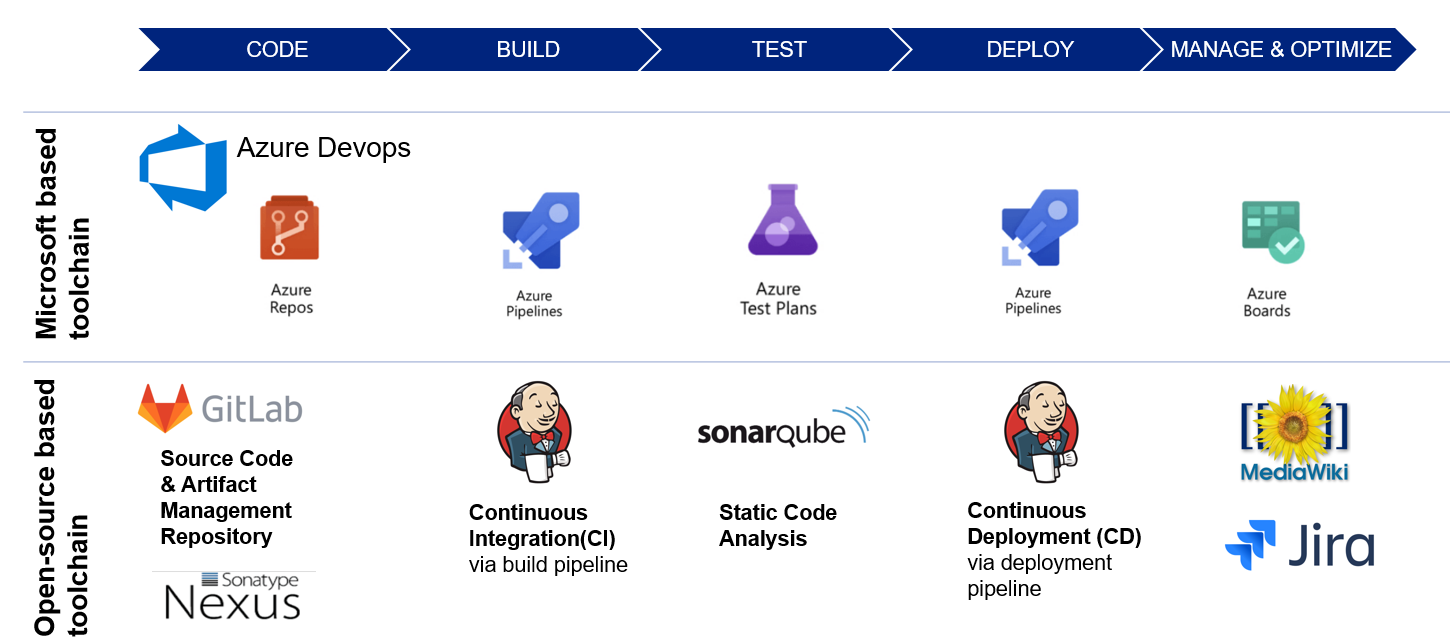
| Service Assets – Software Descriptions | | | | Item | Name | Description | | 1 | 
| Kubernetes, or k8s (k, 8 characters), is an open source platform that automates Linux container operations. It eliminates many of the manual processes involved in deploying and scaling containerized applications. In other words, It is possible to cluster together groups of hosts running Linux containers, and Kubernetes helps easily and efficiently manage those clusters. These clusters can span hosts across public, private, or hybrid clouds. For this reason, Kubernetes is an ideal platform for hosting cloud-native applications that require rapid scaling, like real-time data streaming through Apache Kafka. | | 2 | 
| GitLab is a Git-based platform that integrates a great number of essential tools for software development and deployment, and project management: | | 3 | 
| Jenkins is a self-contained, open source automation server which can be used to automate all sorts of tasks related to building, testing, and delivering or deploying software. It can be used with large variety of build systems, such as Maven, Gradle, NPM and yarn. It can be used for simple build tasks but also for complex multistage CI pipelines. | | 4 | 
| Jira is a family of products built to help all types of teams manage their work. Jira offers several products and deployment options that are purpose-built for Software, IT, Business, Ops teams, and more. JIRA Software allow to plan, track and release world-class software. - Bug tracking
- Project management
- Product management
- Process management
- Task management
- Software development
- Agile software development
- Test Management
| | 5 | 
| SonarQube (formerly Sonar) is an open-source platform developed by SonarSource for continuous inspection of code quality to perform automatic reviews with static analysis of code to detect bugs, code smells, and security vulnerabilities on 20+ programming languages. SonarQube offers reports on duplicated code, coding standards, unit tests, code coverage, code complexity, comments, bugs, and security vulnerabilities. | | 6 | 
| Manage and store components from dev through delivery, build artifacts, binaries, containers, assemblies, and finished goods (releases and release candidates) in one central location, including intelligent staging and release functionality. Understand component security, license, and quality issues. Store and distribute Maven/Java, npm, NuGet, RubyGems, P2, OBR, APT and YUM and more. Nexus IQ and Firewall prevent vulnerable and incompliant components from entering the software supply chain, based on governance policies. When new components are downloaded, Firewall scans every new package against a set of organization-defined policies. Any component or dependency that violates one of these policies is then blocked from the repository. | | 7 | 
| Azure DevOps Services provides development collaboration tools including high-performance pipelines, free private GIT repositories, configurable Kanban boards, and extensive automated and continuous testing capabilities. It includes: - Azure Boards
- Azure Pipelines
- Azure Repos
- Azure Test Plans
- Azure Artifacts
- Extensions Marketplace
| | 8 | 
| The MediaWiki software is used by tens of thousands of websites and thousands of companies and organizations. MediaWiki helps you collect and organize knowledge and make it available to people. It's multilingual, free and open, extensible, customizable, reliable, and free of charge. |
The 2025 Service
Rates v9.1 below are valid for all NCI Agency customers, with
exception of the NHQ, which has a specific arrangement in place. | Service ID | Service
Name | Service
Flavour/Option | Service
Unit | Service
Rate 9.1
O&M only
(EUR) | | PLT008 | DevSecOps
Service | NSF Standard Profile | User/Month | 83
| NSF JIRA Profile | User/Month | 54 | NSF ADO Profile | User/Month | 34 | NSF GitLab Profile | User/Month | 34 | NSF Power BI Profile | User/Month | 19 | | NSF Stakeholder Profile
| 10 Users/Year
| 1,440
|
NSF Stakeholder Profile
| 50 Users/Year | 6,000
| | NSF Stakeholder Profile
| 100 Users/Year | 9,600
| | NSF Private Cloud – Small
| Project/Year | 15,000 | | NSF Private Cloud – Medium
| Project/Year | 22,500
| | NSF Private Cloud – Large
| Project/Year | 30,000 | Non-common-funded
customer – Options: | Azure DevOps
| User/Month | 5 | Azure Credits | User/Month | 84 | Jira | User/Month | 20 | SonarQube | User/Month | 480 | DevSecOps – SME Support
| Unit/Month | 130 | Managed Endpoint | Hour | 42 | NEXUS IQ + Firewall | User/Month | 58 | NATO Trusted Container Registry – small
| Project/Year
| 5,000
| NATO Trusted Container Registry – medium
| Project/Year | 13,000
| NATO Trusted Container Registry – large
| Project/Year | 20,000
|
| Detlef Janezic | N/A | Mariano Valle | SEA | | 25/07/2024 16:14 | PLT008 DevSecOps service is available for NCI Agency internal and external customers' needs to manage software application lifecycle. It consists of a security accredited DevSecOps platform, which enables the NATO Software Factory (NSF) as a space for the collaboration between NCI Agency, Industry, Nations and Academia for development and test activities.
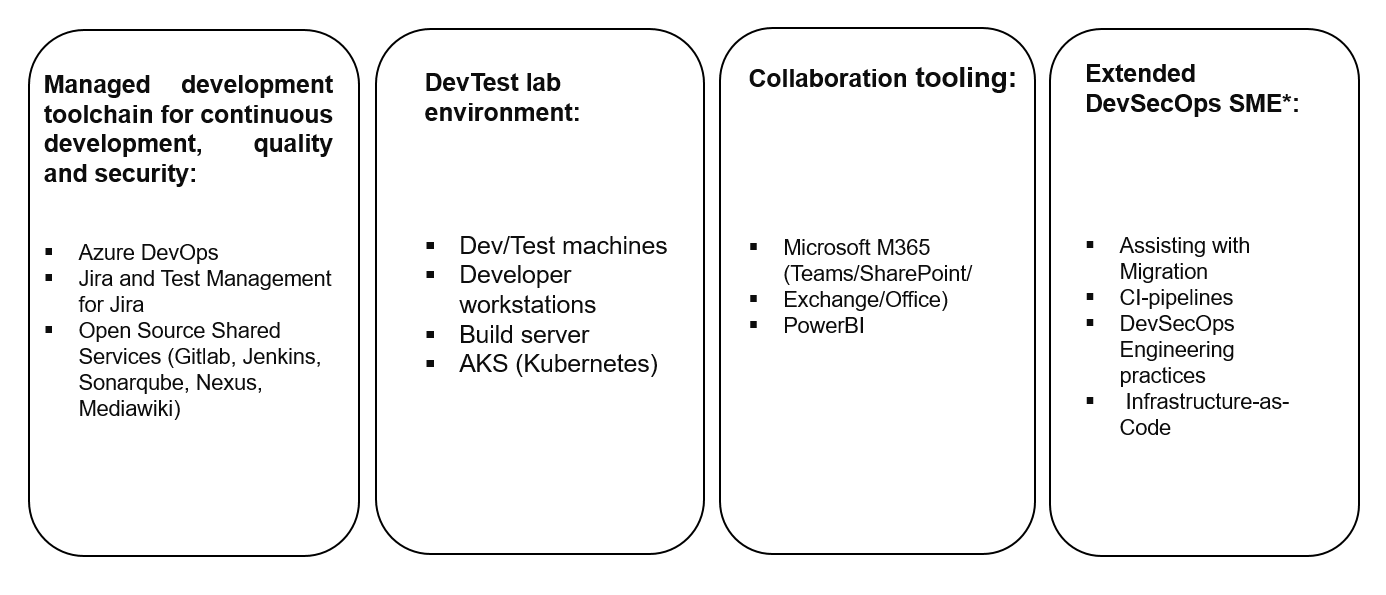
PLT008 is available as Platform as a Service (PaaS) in support of the following practices: - Requirements Management;
- Architecture & Design;
- Agile development;
- Continuous Integration (Build & Test);
- Test Automation;
- Continuous Delivery (Deploy & Release);
- Security By Design;
- Infrastructure as Code (IaC).
| Service Features: Access to managed and supported NSF Toolchain: The DevSecOps platform is used as development and testing environments, and it offers a series of tools (NSF Toolchain) based on both Microsoft, and Open Source Stack technology (OSS) ecosystems to ensure coherency with NATO C4ISR Application and Technology architectures. NSF Toolchain is available in Annex A. DevSecOps SME support: Dedicated support on requestor-specific DevSecOps processes and implementation scenarios such as - Continuous planning: Agile planning, Thread modelling, Security requirements
- Continuous integration: Test-driven development, shift-left testing, micro-services/container development, static application security scanning, secrets scanning
- Continuous delivery: infrastructure as code, release pipeline, security testing, monitoring, telemetry
Cloud Security Operations activities: - monitoring,
- detection and response,
- event and incident response,
- continuity of operations,
- threat hunting
using cloud native tools such as:
- Microsoft Sentinel
- Microsoft Defender for Cloud
- Azure and M365 Logging and monitoring
- Various Microsoft Defenders protecting workloads (O365, endpoint, Identity, cloud apps, containers, DevOps etc)
- Azure Active Directory Identity Protection
- Endpoint detection and response (EDR) solution
- Microsoft Purview Compliance Manager
| | Service Flavours: The service is available in the following flavours. - NSF Standard Profile: Provides access to all NSF services. This is required for most users. Typical use: Developers, Engineers, Testers.
- NSF Stakeholder Profile: Provides access to NSF Team stakeholders without having to procure a NSF Basic User Profile. The stakeholder will be able to use VPN client to join events such as specific test events, User Acceptance Test (UAT) and Demonstrations.
- NSF Jira Profile: Limited NSF user profile that only grants access to JIRA. Typical use: Customer representatives (JIRA based projects), JIRA project management (non-software).
- NSF ADO Profile: Limited NSF user profile that only grants stakeholder access to Azure DevOps (allows access to wiki and work items only). Typical use: Customer representatives (ADO based projects).
- NSF GitLab Profile: Limited NSF user profile that only grants access to GitLab. Typical use: External collaborators (e.g. partners from NATO nations).
- NSF private cloud:
- Private cloud-based platform enabling DevSecOps technology adoption in support of C4ISR information superiority
- Classified but non-operational staging environment to support NATO to test applications
- On-premises enclave for legacy workloads and specialized hardware that cannot be virtualized
- For NSF standard profile the following services are available as additional options:
- NATO Trusted Container building service
- Service flavor to consume a centralized pipeline to build trusted application containers
- Security vulnerability and compliancy assessment using automated scanning tools
- Promotion to NATO Trusted Container Registry for use of containers on operational networks
- Security Validator
- Based on the findings, mitigations, justifications, and other relevant container characteristics, the Security Validator assigns a container image a trust level and documents any restrictions regarding its deployment
- NATO Trusted Container registry consumption service
- Container platform to consume the NATO Trusted Container Registry on operational networks.
- Requires a diode to transfer container images from low to high using 1-way diode
- Centralized high-available container registry on NS
- NSF Managed Endpoint: secured managed baseline for end-user devices accessing NSF resources
- Unified endpoint management - cloud based endpoint management, security hardening and compliance management, apps management, content management
- Endpoint Protection Platform - security protection via Microsoft Defender for Endpoint, EDR (endpoint protection and response) and threat hunting integration with NSF Security Operations (SOC)
| |
| Provision of Subject Matter Expertise for the Federated Mission Networking (FMN) Framework | Customer Facing | Subject Matter Expertise Services | Available | | Service Cost / Price: The unit of measure for the Service is 1. The total of the Service delivery cost is charged in accordance with specifically arranged conditions of the Service delivery. The service charge should take into account the extensive TDY commitment. The 2025 Service Rates v9.1 below are valid for all NCI Agency customers, with exception of the NHQ, which has a specific arrangement in place.
| Service ID | Service
Name | Service
Flavour/Option | Service
Unit | Service
Rate 9.1
O&M only
(EUR) | | SME004 | Provision of Subject
Matter Expertise for the Federated Mission Networking (FMN) Framework | | 1 | 1,918,225 |
| Detlef Janezic | Nicholas Lambert | N/A | SEA | | 26/07/2024 08:28 | This service provides: - Subject Matter Experts (SME) to the ACO funded portion of the management and working group structures that support the direction and development of the FMN Framework. [SLIN13.1]
- Support to derisking of the implementation of federated capabilities through collective and federated CIAV testing with Nations Affiliated with the FMN Framework.
| Service Features: The Service provides the following areas of expertise and facilities: - Support the FMN Secretariat.
- Provision of Change Implementation Coordinator (CIC) within the FMN Secretariat;
- Provision of unclassified DNBL FMN portal infrastructure to the FMN Secretariat for the governance and management bodies of the FMN initiative and the Coalition Interoperability, Assurance and Validation Working Group (CIAV WG);
- Provision of FMN Architect within the FMN Secretariat.
- Support the FMN Operational Coordination Working Group.
- Provision of Operational Analyst/Business Process Analyst to OCWG to assist in the definition of operational processes from Allied doctrine to identify information exchange requirements and functional and non-functional requirements;
- Provision of support for OCWG repository to maintain alignment of data model, modelling conventions and artefacts across FMN Framework products;
- Provision of Operational Analysis expertise to OCWG to support the preparation of products with the chair FMN OCWG and to provide linkage to the NATO Defence Planning Process (NDPP).
- Support the FMN Multinational CIS Security Management Authority.
- Provision of Cyber Security expertise to the MCSMA WG meetings to assist in the preparation of federated security documentation (e.g. the template for the Community Security Requirements Statements (CSRS)) as it relates to each FMN Spiral Specification;
- Provision of Cyber Security expertise to the MCSMA workshops to include fulfilment of tasks received after the escalation of risks to the Military Committee (MC) regarding the misalignment between NATO Security Policies and FMN Goals;
- Provision of technical coordinator to the MCSMA to ensure consistent integration of CIS Security products across FMN Framework products of a Spiral;
- Provision of support for MCSMA WG repository to maintain alignment of data model, modelling conventions and artefacts across FMN Framework products;
- Provision of updated FMN Security Risk Assessment (SRA) using methodologies and tools provided by SHAPE (SRA).
- Support the FMN Coalition Interoperability, Assurance and Validation (CIAV) Working Group.
- Coordinate between CICWG and CIAVWG on RFC tasked to FMN CIAVWG, including planning within CIAV WG
- Provision of support to Framework with tools for event planning, executing and reporting, repository development and maintenance, as well as tracking RFCs;
- Provision of IV&V SME support to Framework with development of the technical AV&V content (Spiral Instructions) including Repository management;
- AV&V Repository Management and development of AV&V content to support CIAV objectives;
- Provide white cell services on the CFBLnet Pink enclave for support of CIAV events.
- Support the FMN Change and Implementation Coordination Working Group.
- Provision of Service Engineering SME and Service Management Expertise to provide advice on templates for the Joining, Membership and Exit Instructions;
- Provide Naming and Registration Authority (NRA) for the FMN Framework to maintain ASN and IP Ranges assigned to the Affiliates and to respond to enquiries and help resolve conflicts;
- Provision of System Engineer/Change Manager for FMN Baseline;
- Provision of support for CICWG repository to maintain alignment of data model, modelling conventions and artefacts across FMN Framework products.
Travel: Due to the meeting schedule of the FMN initiative and its working groups, there is considerable Travel associated with this service.
| | Service Flavours: The service comes as a complete package and is originally based on the scope of ACO funded tasks and funding levels described in 6300/TSC-FCX-0010/TT-140441/Ser:NU1023 dated 7 NOV 14. Over the intervening years this has evolved to keep pace with demand and those tasks pertaining to NATO Command plt0plt008Structure as an Affiliate to FMN Framework (NCSaaA) have been split out from SME004 into SME009.
| |
| Operational Analysis Service | Customer Facing | Subject Matter Expertise Services | Available | | The unit of measure for the Service is Per Defined Service. Cost for each defined service is individually set up, in accordance with agreed scope and conditions of the service delivery, as well as valid NCI Agency Customer Rates. | Sylvie Martel | N/A | N/A | OA | | 12/04/2023 14:57 | Operational Analysis (OA) is a consultancy service, which consists of developing and applying fit-for-purpose approaches and scientific methods to analyse problems across the spectrum of defence activities, and supporting decision makers in understanding, visualising and resolving them. | Service Features: NCI Agency can provide ad hoc and flexible Operational Analysis consultancy to NATO and Nations through the application of tailored analytical methods to solve complex problems as typically faced by organisational leaders and operational commanders. The Service can provide support in a range of fields such as the following (non-exhaustive list). Of note, the support and techniques described here can also be applied in other context. - Defence Planning: provision of a full spectrum of technical consultancy, analysis and advice to support NATO and the Nations in Defence Planning (DP), primarily with focus on support to the NATO Defence Planning Process (NDPP). It includes (non-exhaustive list):
- Analytic expertise in support of the NATO Defence Planning Process (NDPP) activities, including identification of capability requirements, apportionment of requirements, and suitability and risk assessment; this analytic support involves for instance:
- Development of new methodologies;
- Analysis, including very large data sets, through a range of modelling techniques and tools;
- Development of representative scenarios;
- Structured mission analysis (mission-to-task decomposition);
- Assessment of risk and aggregation techniques;
- Support to assessing burden sharing in terms of relative costing techniques;
- Application of OA techniques to facilitate decision making;
- Provision of subject matter expertise (SME) across military and non-military domains, including reach to extensive networks of SMEs across NATO and in the nations;
- Analytic expertise in support of national Defence Planning activities, such as:
- Education and mentoring with NATO analytic approaches;
- Facilitation and delivery of customised Defence Planning studies;
- Access to and development of analytic supporting tools and models (e.g. the Joint Defence Planning Analysis and Requirements Toolset (JDARTS));
- Support to implementation of robust national capability-based planning processes;
- Exploitation of established NATO best practice, tailored to fit national needs;
- Facilitation of the use of NATO DP tools & models.
- Support to Headquarters (peacetime & operational): provision of tailored analytical support to tactical, operational and strategic-level HQs within Nations and the NATO Command and Force Structures, during peacetime and/or crisis situations. This support includes areas such as:
- Wargame development and facilitation;
- Support to planning activities such as Course of Action analysis, support to concept development activities, lessons identified;
- Operational assessment, battle information management, data analysis (time-series, geospatial, survey), and streamlining of existing HQ data collection/analysis processes, implementation of advanced analytical techniques (mathematical modelling and optimisation algorithms);
- Organisational design and improvement of processes, including analysis of 'as-is' processes and provision of 'to be' structures or changes;
- Support to analysis of information exchange requirements, and modelling of processes and information flows.
This support is available on-site (static or deployed locations) or as remote, reach back arrangement. - Operational and User Requirements: provision of expertise to support, through exploitation of products and knowledge from any of the other OA services, a range of areas including:
- User requirements capture and validation;
- Mentoring in the employment of NATO Functional Area Services (FAS) to meet military business process and information exchange requirements;
- Business decision support e.g. development of NATO FAS Lifecycle Roadmap;
- IT procurement and training decision support e.g. development of dashboard highlighting technology employment/retirement and deprecation;
- Gap analysis to enable the integration of NATO processes to ensure a seamless "end-to-end" approach to capability delivery and sustainment.
- Support to architecture development.
| | Service Flavours: The OA service is tailored to meet individual needs of a customer. | |
| Maritime Operational CIS Deployment and Recovery Service | Customer Facing | Subject Matter Expertise Services | Available | |
Service Cost / Price: The unit of measure for the Service is per instance of service flavour requested. For price information, see the Service Rates document. Service Performance Targets: Implementation completed by required date for Service Change Requests received with sufficient notice (timelines specified above) and meeting all prerequisites: 95% Time to complete: SME008-1. 4 days total. SME008-2. 5 days total: 4 days for implementation; 1 day for recovery. SME008-3. 3 days total: 2 days for implementation; 1 day for recovery. SME008-4. 3 days total: 2 days for implementation; 1 day for recovery. SME008-5. 3 days total: 2 days for implementation; 1 day for recovery. The 2025 Service Rates v9.1 below are valid for all NCI Agency customers, with exception of the NHQ, which has a specific arrangement in place. | Service ID | Service Name | Service Flavour/Option | Service Unit | Service Rate 9.1
O&M only
(EUR) | | SME008 | Maritime Operational CIS
Deployment and Recovery
Service | SME008-1: Collocated Major Handover | Per Handover | 36,992 | | SME008-2: Non-Collocated Major Handover | Per Handover | 56,732 | SME008-3: NATO Control and Reporting Centre (CRC) System Interface (CSI) Deployment / Recovery DR
| Per Deployment
| 21,617 | SME008-4: SEMARCIS/SEMARCOM Deployment / Recovery (DR)
| Per Deployment
| 11,625 | SME008-5: Tactical Satellite (TACSAT) Deployment / Recovery (DR)
| Per Deployment | 13,667
|
| Group Captain Paul Prentice | N/A | Joe Martinez | CSU | | 26/07/2024 08:33 | This service provides delivery, installation, configuration, commissioning, and when required, subsequent decommissioning and removal of CIS services. These services may include all or some of the following; Maritime Command and Control Platform (MARC2P) Service (PLT012), SEMARCOM/SEMARCIS service (INF044), Tactical Satellite (TACSAT) service (INF040), and the NATO Control and Reporting Centre (CRC) System Interface (CSI) service (INF041). These services can be provided to and from customer designated location(s) within SACEUR’s Joint Operational Area (JOA).
| Service Features: Planning: This requires in depth coordination with the customer, any nominated additional points of contact, the designated Naval vessel, and if necessary, the Host Nation (HN) of the oncoming vessel. The planning process also includes a site survey of the oncoming vessel 90 days ahead of time for full operational handovers. A site survey may be required for all other activities. This is critical to facilitate a common understanding of the full scope of the upcoming activity, and to advise the HN designated vessel in their preparation to take on the CIS services. Deployment: Includes the requested CIS service(s) equipment to be forward deployed to a designated Naval vessel (or static location) for installation. Implementation: Includes the installation, configuration, and commissioning of requested CIS service(s). Equipment is installed on the identified Naval vessel (or static location), and End-to-End (E2E) configuration is completed utilizing remote support from various NCI Agency service areas. All CIS Services are tested on site and commissioned when considered operational and agreed with the customer on site. Training: Training is provided on site during implementation to designated staff. This includes operator and basic administrator training to facilitate a common understanding of CIS operations, standard operating procedures (SOPs), and basic troubleshooting. Recovery: Where requested, CIS service(s) equipment will be decommissioned (ceasing services), de-installed, and then subsequently recovered to NCI Agency control. At times the same equipment may be immediately re-allocated for additional tasking.
| |
Service Flavours: SME008-1: Maritime Operational CIS Deployment/Recovery Service – Collocated Major Handover: Includes removal of the SNFC2P, TACSAT (if installed), and/or SEMARCIS/SEMARCOM (if installed) CIS equipment from one identified Naval vessel, immediately followed by installation on another identified Naval vessel at the same designated port of call. SME008-2: Maritime Operational CIS Deployment/Recovery Service – Non-Collocated Major Handover: Includes removal of the SNFC2P, TACSAT (if installed), and/or SEMARCIS/SEMARCOM (if installed) CIS equipment from one identified Naval vessel at one designated location, shipment of CIS equipment (via Northwood if required), and subsequent additional travel to a different location for installation on another identified Naval vessel at that separate location. SME008-3: Maritime Operational CIS Deployment/Recovery Service – NATO Control and Reporting Centre (CRC) System Interface (CSI) Deployment / Recovery (DR): Includes deployment and implementation of a CSI capability on an identified vessel at a designated location and then subsequent recovery of the CSI equipment from that vessel at a later date and designated location (may be the same or different from the installation location). SME008-4: Maritime Operational CIS Deployment/Recovery Service – SEMARCIS / SEMARCOM Deployment / Recovery (DR): Includes deployment and implementation of a SEMARCIS or SEMARCOM capability on an identified vessel at a designated location and then the subsequent recovery of the SEMARCIS or SEMARCOM equipment from that vessel at a later date and designated location (may be the same or different from the installation location). SME008-5: Maritime Operational CIS Deployment/Recovery Service – Tactical Satellite (TACSAT) Deployment / Recovery (DR): Includes deployment and implementation of a TACSAT capability on an identified vessel at a designated location and then the subsequent recovery of the TACSAT equipment from that vessel at a later date and designated location (may be the same or different from the installation location). | |
| Ballistic Missile Defence (BMD) System of Systems Management Service | Customer Facing | Application Services | Available | | The unit of measure for the Service is 1. NCI Agency charges the total of the Service delivery in accordance with specifically arranged conditions of the Service delivery. The service APP006 does not duplicate any of the service delivery costs for the above-mentioned BMDC3I System of Systems services. The 2025 Service Rates v9.1 below are valid for all NCI Agency customers, with exception of the NHQ, which has a specific arrangement in place.
| Service ID | Service
Name | Service
Flavour/Option | Service
Unit | Service
Rate 9.1
O&M only
(EUR) | | APP006 | Ballistic
Missile Defence (BMD) System of Systems Management Service | |
| Please refer to the AMD2 PoW for the common funded cost for this service |
| Michael Stoltz | Cyril Lerey | Thomas Mueck | AMDC2 | | 26/07/2024 08:41 | The APP006 service provides coordination and orchestration of In Service Support activities related to BMD System of Systems including interoperability assurance, integration and lifecycle management, and provides the Shared Early Warning Plus service (SEW+I). The service also provides the primary interface between the customers and users (Operational BMD Community) and all NCI Agency Units devoted to perform In-Service Support (ISS) for the BMD Command Control Communication and Information (BMDC3I) System of Systems. The service does not take over or duplicate any of the below defined BMDC3I services.
The BMD capability: Provides full coverage and protection for all NATO European populations, territory and forces against the increasing threats posed by ballistic missiles. This also includes required protection of deployed forces and high value assets/areas within an area of operations/interest from attacks by ballistic missiles. BMD interlinks all levels of military command from the military strategic level down to the tactical level, all across NATO, regardless of the country or the respective military service. BMD is a combined and joint capability.
BMD System of Systems: The NCI Agency IT Systems (products and services), in support of the BMD capability, provide functions that enable NATO Commands to integrate sensor information, build and distribute a comprehensive and real-time BMD operational picture, and exercise command and control of voluntary national contributions (sensors and effectors) provided by Allies. The application Air Command and Control System TMD1 (APP050) is the core integrator of the BMD functions. The BMDC3I systems are in use at the Ballistic Missile Defence Operations Centre (BMDOC) in Ramstein and multiple other NATO Command Structure sites. The following products and services enable the BMD capability and compose the BMDC3I System of Systems: Customer facing services:
• APP002 (SEW Application Service) Shared Early Warning • APP007 (TOPFAS Application Service) - Tool for Operations Planning Functional Services • APP015 (JCHAT Application Service) - Secure Tactical Joint Chat • APP022 (NCOP Application Service) - NATO Common Operational Picture • APP049 (ICC Application Service) - Integrated Command and Control (includes LSID) • APP050 (Air Command and Control System TMD1) • APP061 (AirC2IS Application Service) - Air Command and Control Information System • WPS014 (Secure Voice Service) • WPS015 (Voice Loop Service)
Underlying services:
• APP010 (NIRIS Application Service) - Networked Interoperable Real-Time Information Service • APP011 (OANT Application Service) - Online Analyser for Networked Tactical-Data • APP012 (SMACQ Application Service) - Service to Monitor and Assess Connectivity and Quality • PLT013 (NISP Service) NATO - Integrated Secure Platform • APP055 (Core Geographic Information System -GIS- Application Service) • WPS002 (Entreprise Identity Access Management Service) • WPS003 (Enterprise User License Service) • PLT001 (Information Sharing and Collaboration Platform Services) • WPS012 (E-mail Service) • PLT003 (Web Hosting Service) • SEC011 (Gateway Security Service) • INF001 (LAN Service) • INF002 (NATO General Purpose Communication System (NGCS) Point of Presence (PoP) Service) • INF004 (Infrastructure Virtualization Service) • INF005 (Infrastructure Integration Service) • INF006 (NATO Enterprise Directory Service -NEDS) • INF007 (Infrastructure Storage Service) • INF014 (Transmission Service) • INF018 (Deployable CIS Mini-Point of Presence (PoP) • INF040 (UHF TACSAT Radio Services) - Tactical Satellite
The actual BMDC3I service composition for operational use depends on the customer’s operational requirements. NCI Agency configures the required composition in close cooperation with the customer.
All above listed BMDC3I services operate on the NATO General Communications System (NGCS) network at Wide Area Network level. Nations provide feeds through NATO-National static gateways or through NATO deployable CIS equipment.
| The APP006 service manages the following in support of BMDC3I system of systems: - the BMD SoS Delivery Plan in accordance with the BMD SoS Service Tree.
- The supervision of the processing of ISS ITSM BMD related Tickets (Incident, Services Requests) through their lifecycle and monitoring iaw SLA levels.
- the processing of ISS BMD related L-ECPs, and monitoring of their implementation plan/execution.
the relationship with CSU Ramstein and BMDOC users: Ensure day-to-day coordination with them related to BMD Standing Mission, NS2T Mission, technical evaluation activities, Site Support Manager Role and CAB chairmanship.
- BMD Obsolescence Management: Manage BMD SoS obsolescence; maintaining risk review and gap analysis of the SoS and interconnecting systems in coordination with other Service Lines and system owners. This analysis will consider programmatic and funding mechanisms to ensure the SoS components and services are supported throughout the lifecycle.
| | Service Flavours: The service is available as a single flavour
| |
| NATO Nuclear C2 Reporting Application Service | Customer Facing | Application Services | Available | | The Service is classified. Further information is available upon request and relevant clearance.
| Paul Howland | David Sparks | Alex Van Leeuwen | C2 | | 13/04/2023 10:22 | The Service is classified. Further information is available upon request and relevant clearance. | | | | |
| NATO Nuclear Planning Application Service | Customer Facing | Application Services | Available | | The Service is classified. Further information is available upon request and relevant clearance.
| Paul Howland | David Sparks | Miguel Sancho | C2 | | 13/04/2023 10:22 | The Service is
classified. Further information is available upon request and relevant
clearance. | | | | |
| Military Message Handling Application Service | Customer Facing | Application Services | Available | | The unit of measure for the Service is 1. The total of the Service delivery cost is charged in accordance with specifically arranged conditions of the Service delivery. The 2025 Service Rates v9.1below are valid for all NCI Agency customers, with exception of the NHQ, which has a specific arrangement in place.
| Service ID | Service
Name | Service
Flavour/Option | Service
Unit | Service
Rate 9.1
O&M only
(EUR) | APP029
| Military
Message Handling Application Service | | 1 | 2,682,297 | APP029-1 ACP127 Message Operator Service (SME010)
| | Per Signal Message Address (SMA)
| 698
|
| Paul Howland | Antonio Galiero | Rafal Rychlicki | C2 | | 29/07/2024 09:32 | Military Message Handling Application Service provides the user, in both
static and deployed environments, with the capability of drafting, releasing
and receiving military messages (ACP127 and X400). The service also delivers a
reliable message storing and forwarding infrastructure, which provides
intercommunication between NATO organisations, Maritime Broadcast systems and
National ACP127 networks. | The Military Message Handling Application Service offers the customers the formal messaging capability with elements featuring: - Integrated Messaging Application
- Message Attachments
- Digital Signature(at server level)
- ADat-P3 Integration
- Central Archive
- Access Management
- Alternate Recipients
- Conversation Prohibition
- Deferred Delivery
- Enhanced Message Reporting and Notifications(Read/ Delivered/Deleted)
- Computer Based User Training (JADL Platform – ADL 126 – XOmail Messaging)
- Message Templates Management
- Latest Delivery and Message Security Labelling
- Quality of Service adjustments based on different message priorities (e.g. expediting higher priority messages)
| |
Service Flavours: The Military Message Handling Application service is available in multiple flavours based on the required functionality: Standard: Message reception only Upon request (increased functionality): Sending out: - Through Web Access or Desktop application (XOmail or AIMS);
- Addressing needs to be available;
- Release authority to be granted;
- SMAs and routing need to be configured. This flavour will be upon request.
Note: multiple SMAs to be supported can be installed upon request. Serial ACP127 connections to National Gateways and Broadcast systems (with or without dual homing). Serial connections to end point locations including the installation of a PCTTY (ACP127 protocol). APP029-1 - SME010 ACP127 Message Operator Service
| |
| Tasker and Project Tracker Applications Service (TT+ and PITT) | Customer Facing | Application Services | Available | |
Service Cost / Price: The unit of measure for the Service is “per user". Different types of users are considered for the calculation of the price of the two Service Flavours, as per the following table: | Service Flavour | Definition of “user" | | TT+ | TT+ is designed for the general use by all the users of each customer, so the number of user will be assumed to be equal to the sum of the “NATO Peacetime Establishment (PE)" users plus the “NATO Non-Peacetime Establishment (NPE)" users. | | PITT | Only the users authorized to access the PITT will be counted as “users". |
Each instance of the Service should be counted separately (so for example, if the same user is using two different instances of the Service on two different networks, the user should be counted twice). The cost of the Service does not include the cost of all the underlying Service prerequisites. The total amount of the Service delivery price is charged in accordance with specifically arranged conditions of the Service delivery.
The 2025 Service Rates v9.1 below are valid for all NCI Agency customers, with exception of the NHQ, which has a specific arrangement in place.
|
Service ID |
Service Name |
Service Flavour/Option |
Service Unit |
Service Rate 9.1
O&M only
(EUR) | |
APP030 |
Tasker and Project Tracker Applications Service (TT+ and PITT) |
APP030-1: TT+ |
Per User |
146 | | APP030-2: PITT |
Per User | 42 | | Jean-Paul Massart | Marco Negri | Guray Demirtas | NDW | | 26/07/2024 08:53 | The Service provides information management capabilities for the tracking of organizational tasking activities and for the tracking of all Allied Operations and Missions (AOM) related project information. Provides the quickest path to delivery and is in line with organizational directive for leveraging enterprise-established tools, services and support. The Tasker Tracker Plus Flavour is interoperable with an existing Enterprise Document Management Application Service (APP031) and an existing NATO Information Portal Application Service (APP086), but also deployable as standalone Service. | The Service supports the following core functionalities (subject to the specific Service Flavours): - Multi- user collaborative tasking
- Advanced Task Search Engine
- Sub-Tasking (including favourites)
- Reporting on Taskers by Office and Status
- Business Intelligence
- Traffic Light Monitoring System
- Integrated Document Management.
| |
Service Flavours: APP030-1: TT+ (Tasker Tracker Plus): Provides an Information Management capability for the tracking of the organisational tasking activities, such as raising, delegating, monitoring, and management of tasks. This Service Flavour is interoperable with an existing Enterprise Document Management Application Service (APP031) and an existing NATO Information Portal Service (APP086), but also deployable as standalone Service. APP030-2: PITT (Project Implementation Tracking Tool): Provides the capability of tracking all Allied Operations and Missions (AOM) related project information, facilitates collaborative work, and establishes a coherency to the CUR management of all projects through a centralized approach, which support management boards and additional supporting services, such as search and a report centre.
| |
| Interactive Simulation Package (ISP) Application Service | Customer Facing | Application Services | Available | | The unit of measure for the Service is 1. The total of the Service delivery cost is charged in accordance with specifically arranged conditions between NCIA and SHAPE on an annual basis. The 2025 Service Rates v9.1 below are valid for all NCI Agency customers, with exception of the NHQ, which has a specific arrangement in place.
| Service ID | Service
Name | Service
Flavour/Option | Service
Unit | Service
Rate 9.1
O&M only
(EUR) | | APP043 | Interactive
Simulation Package (ISP) Application Service | |
| Please refer to the AMD2 PoW for the common funded cost for this service |
| Michael Stoltz | Kevin Richardson | Kumar Hiremath | AMDC2 | | 26/07/2024 09:01 | The service provides a flexible, state-of-the-art solution to support the execution of air operations, which enables nations to simulate radar data in order to generate plot data to use it in a training and/or testing environment. | ISP enables generation of necessary data for execution of exercises for air operations, with particular focus at the NATO Integrated Air and Missile Defence System (NATINAMDS) community. More specifically, it enables: - Modelling of airborne, sensor, and ECM exercise elements and to engineer scenarios by retrieval, positioning, manoeuvring, altering and manipulation of various elements via the graphical user interface;
- Performing of scenario management (retrieve, save, add, build, merge and delete);
- Performing of preview functions on the scenario;
- Execution and control of scenarios by starting, stopping, pausing, rewinding and forwarding the exercises;
- Activation and deactivation of radar sensors;
- Performing of interactive “real-time" changes, upon request, to alter the scenario during scenario execution;
- Providing of exercise support for flight plan printouts of selected missions and providing of the generation of flight plans, visible within the Multi AEGIS Site Emulator (MASE) system or any other system using the ADEXP flight plan message format for direct flight plan injection;
- Providing of realistic training for operational crews in the use of mechanical and electronic counter-measures (chaff simulation);
- Allow for the control of simulated fighter aircrafts using manoeuvrable targets
ISP is a standalone product, supported on Solaris, with the NISP configuration for the Solaris installation as preferred one. ISP provides input to the MASE system, but does not dependent on the MASE baseline version.
| | Service Flavours: NCS-wide ISP software maintenance and in service support: (singleton service provided to SHAPE) Includes the development, testing, and documentation of maintenance releases of all ISP software components and the continuous support of the eligible user sites.
| |
| Release Server (RS) Application Service | Customer Facing | Application Services | Available | | The unit of measure for the Service is 1. The total of the Service delivery cost is charged in accordance with specifically arranged conditions of the Service delivery. The 2025 Service Rates v9.1 below are valid for all NCI Agency customers, with exception of the NHQ, which has a specific arrangement in place.
| Service ID | Service
Name | Service
Flavour/Option | Service
Unit | Service
Rate 9.1
O&M only
(EUR) | | APP058 | Release
Server Application Service | | 1 | 250,697 |
| Matt Roper | Bernard Frala | Diederik Zaaijer | JISR | | 26/07/2024 09:10 | The Release Server (RS) service interface provides an abstraction layer for applications to release information between two security domains of different security levels. The service hides the complexity of Cross Domain Solutions for client applications. 
| The Application features: - Configurable release rules based on release-ability markings (Authority, Classification and Release-ability);
- Automated or controlled (man in the loop) release of information;
- Monitoring;
- Fully Web based user interface;
- Fully documented;
- Automated installation package.
Support features: - * Support to implementation, integration and customization;
- * Support to operations and maintenance;
- * Support to training requirements;
- * Information gathering for technical and training support.
| | The
Service is available as a single flavour. | |
| ISR Coalition Shared Data (CSD) Service | Customer Facing | Application Services | Available | | The unit of measure for the Service is 1. The total of the Service delivery cost is charged in accordance with specifically arranged conditions of the Service delivery. The 2025 Service Rates v9.1 below are valid for all NCI Agency customers, with exception of the NHQ, which has a specific arrangement in place.
| Service ID | Service
Name | Service
Flavour/Option | Service
Unit | Service
Rate 9.1
O&M only
(EUR) | | APP060 | ISR
Coalition Shared Data (CSD) Application Service | | 1 | 329,740 |
| Matt Roper | Bernard Frala | Pascal VAN PARIDON | JISR | | 26/07/2024 09:11 | The Service supports a wide range of CSD-dependent customer facing applications (CSD clients), including Exploitation and IRM&CM applications, and Sensor Systems. Currently, supported applications are HMART, ICMT, and INTEL-FS, as well as national applications. The Service: - enables the exchange of NATO Intelligence, Surveillance and Reconnaissance (ISR) products through provision of a standard interface for storing, discovering, accessing and sharing heterogeneous ISR libraries maintained by NATO and Nations;
- provides workflow support to the overall JISR Process of Tasking, Collection, Processing, Exploitation and Dissemination (TCPED) spanning multiple echelons, multiple military services and multiple NATO and national applications and services; and
- provides access to live or recorded Streaming Data types, such as Full Motion Video, Video Clips, or Ground Moving Target Indicator (GMTI) data.
| Intelligence Surveillance Reconnaissance Coalition Applications features in the following categories: - CSD ISR Product Library: storage, discovery, access and dissemination
- CSD ISR Workflow: support for JISR Collection Management and TCPED Process
- CSD ISR Streaming: access to live or recorded streaming data types
Supported JISR data formats, interfaces, and technical service contracts: STANAG 4545, STANAG 4609, STANAG 4607, STANAG 5516, STANAG 4559, and MAJIIC2 Bravo .1 Baseline.
| | | |
| DCIS - Signal Support Group (SSG) Service | Customer Facing | Security Services | Available | | The Service has been consolidated under the INF035 DCIS – Deployable Nodes Service. | Andreas Hutzenlaub | Ian Walton | Graeme Birnie | NSII | | 14/07/2022 14:11 | The Service has been consolidated under the INF035 DCIS – Deployable Nodes Service. | | | | |
| Application Layer Firewall for Sensors and Flight Plans (ALF-SFP) Security Service | Customer Facing | Security Services | Available | | Service Cost / Price: The unit of measure for the Service is 1. Service Initiation and In-Service-Support will be provided and charged in accordance with the scope and financial estimates developed and agreed through site specific Technical Agreements.
| Service ID | Service Name | Service Flavour/Option | Service Unit of Measure | | SEC022 | Application Layer Firewall for Sensors and Flight Plans (ALF-SFP) Security Service | NCS wide ALF-SFP software baseline maintenance and In Service Support (ISS) | 1 | | SEC022 | Application Layer Firewall for Sensors and Flight Plans (ALF-SFP) Security Service | Site specific ALF-SFP installation | 1
|
| Michael Stoltz | Kevin Richardson | Kjell Apalvik | AMDC2 | | 15/10/2025 15:24 | The Application Layer Firewall for Sensors and Flight Plans(ALF-SFP) is an AirC2 specific service and secures the interconnection of Sensor and Flight Plan data sources provided at lower level of classification with Air Command and Control Systems (AirC2 systems). The ALF-SFP has been initially developed to satisfy requirements to secure the Air Command and Control System (ACCS) system boundary for sensor and flight plan data exchange but can be utilized for any other Command and Control System used in the Air Domain. In principle, the Service is leveraging a secured Trusted Computing Base providing hardening as well as Application Layer Firewall functions for a variety of similar security appliances. The ALF-SFP service is relying on a secured operating platform, data syntax validation and a hardened Application Layer Firewall. The Service provides unidirectional data flow from lower to higher level of classification as required to operate ACCS. The ALF-SFP falls under the AirC2 governance for programmatic and configuration control aspects. In regard to cyber security evaluation and approval to operate, the ALF-SFP Security Service is under oversight of the ACCS Security Accreditation Board which might call for SECAN evaluation when deemed necessary.
| The ALF-SFP is built on a secured Solaris platform utilizing the NISP Service (PLT013) and comprises a message syntax validation through proxies and an Application Layer Firewall as an evaluated security enforcing capability including required secured access to manage required components and interfaces.
The ALF-SFP service can be deployed and used in two scenarios: - Stand-Alone ALF-SFP: The ALF-SFP supports handling and forwarding Eurocontrol ASTERIX and NATO STANAG 5535/ ADatP-35 compliant messages, as supported by ASIM (INF028), and it supports ICAO compliant Flight Plan Messages, as required for ACCS (APP050).
- ALF-SFP Service combined with ASIM (INF028) to ensure integrity of sensor data and to protect system boundaries against cyber threats.
| | Service Flavours: - NCS wide ALF-SFP single SW baseline maintenance and In-Service-Support (ISS). The NATO ALF-SFP baseline maintained with this service flavour is a prerequisite for all other service flavours.
- Site specific ALF-SFP integration customised to local site specific requirements outside the NCS.
The ALF-SFP Service can be combined with ASIM (INF028) for sensor integration as required for the connected AirC2 system consuming sensor and flight plan data.
| |
| CIS Asset & Materiel Management Service | Customer Facing | Logistics Support Services | Available | | The unit of measure for the Service is 1. The total of the Service delivery cost is charged in accordance with specifically arranged conditions of the Service delivery. The 2025 Service Rates v9.1 below are valid for all NCI Agency customers, with exception of the NHQ, which has a specific arrangement in place.
| Service ID | Service
Name | Service
Flavour/Option | Service
Unit | Service
Rate 9.1
O&M only
(EUR) | | LOG001 | CIS
Asset & Materiel Management | | 1 | 3,365,990 |
| Colonel Cornelis Kees Marselis | N/A | Giuseppe Paleologo | CSSC | | 26/07/2024 09:55 | The CIS Asset & Materiel Management Service embraces all of the CIS Asset and Materiel Management activities that the CIS Sustainment Support Centre (CSSC) provides both directly to the Customer and internally as a support function to the Service Lines. CIS Asset and Materiel Management includes CIS equipment codification, database management, inventory management, receipt, dispatch, storage, stock management, warehousing, internal controls, handover takeover, equipment write-on/write-off, support to operations and disposal coordination. The CSSC performs as the single point of entry for the majority of new CIS equipment procured through common funding of NATO. In addition, CSSC provides Asset Management Subject Matter Expert Services directly to the Customer or internally to the NCI Agency Service Lines. This service only includes the Agency's centralised resources required to deliver the service. Local support from collocated Agency staff in support of day-to-day operations is not included and must be funded locally.
| - Codification: Codification and management of item master data information that is used to support procurement, supply and material management of CIS Equipment purchased using NATO common funding. Codification is used within NATO in order to improve CIS/Non-CIS identification, supply and property accounting. Codification, if carried out correctly, will result in cost savings for NATO as assets will be more efficiently and effectively managed in support of NCI Agency Service provision. The codification is also executed NCI Agency non-CIS equipment and common elements of the AMDC2 System in support of property accounting tasks. Codification is divided into Codification of CIS Assets and Codification of Non-CIS Assets.
- Planning: Planning, scheduling, coordination and documentation update for Storage Management and Warehousing Services. Planning, scheduling and coordination for Receipt and Dispatch Services. Planning, scheduling and coordination for asset management SME services.
- Receipt/Dispatch: The CSSC performs as the mainpoint of entry for the majority of new CIS equipment procured through common funding of NATO. The Receipt and Dispatch (R/D) activities are an essential element, which supports project execution, service delivery, supply management, asset management and database management activities associated with CIS. CSSC also receives and dispatches non-Common funded materials on request from some Host Nations and MoU organizations. The receiving process, which is managed in the ORACLE Inventory/Order Management database is handled either directly or indirectly by the CSSC Receipt and Dispatch. This is an Asset Management activity providing identification, serialization and traceability of CIS equipment. CIS Materiel consignments are processed, prepared and dispatched through the R/D section of CSSC. Dispatch can include freight forwarding, special deliveries, urgent request and courier coordination services. R/D also coordinates the most suitable and cost effective transportation service in conjunction with NSPA. Although NSPA is responsible for the management of transportation of CIS Material on behalf of the NCI Agency, CSSC provides a single point coordination Service to our internal and external customers to ensure that material moves are managed efficiently and effectively. Transportation Requests are received and processed by CSSC to support the original customer requests (MR/IR/MOI etc.). R/D also manages classified equipment.
- Storage: Assets are stored and managed in the CSSC Warehouse as part of the Inventory Project supporting the procurement, supply, exchange, repair and upgrade processes for CIS equipment within the NCI Agency. The Service relates to the CIS requisitioning and supply activities of the NCI Agency.
- Stock Management: CSSC provides a Stock Management Service in conjunction with the Inventory Project of the NCI Agency. Planning, scheduling, coordination and documentation update for stock management service. Supply of CIS stock managed materiel in line with PM requisition requirements. Replenishment activities related to all stock Managed CIS equipment.
- SME Services: Provide customers with near real time management of CIS Equipment Account Balances associated with the Custodian Account and Depot Stock Organization Structure. The inventory management service is an essential enabler of material management and property accountability. CSSC provides advice and support to the Operations and Exercise Service Line in the development of CIS Logistics related plans in relation to Exercise and Operational Planning. This planning effort may be dedicated to a specific Exercise/Operation or included within an existing SLA. CSSC provides expert logistics support to projects such as those related to the AMDC2 (AirC2/BMD) in the data capture and inventory setup/management of associated assets. CSSC conducts data cleansing activities in support of Projects/Programmes such as EBA and ITM. Although this is not meant to be a day-to-day activity, it is anticipated that this task will continue in excess of 12 months.
- Inventory Management: The indirect or direct support is provided to the Custodian Account holder in the completion of the annual inventory activities. The support activities are related to handling of discrepancies within an account balance list. This can be associated with the annual counting process or for an individual or multiple item loss/damage report.
- Logistic Maintenance Support: This is a required activity related to the accountability of CIS materiel that is returned by the customer for preventative or corrective maintenance actions or to storage for future reuse (reverse logistic). In these cases CSSC will conduct handover/takeover (HO/TO) checks of the property which includes full inventory of materiel prior and after completion of the maintenance activities.
- End of Life asset management: when an asset reaches his end of life (obsolescence, failure or loss), CSSC provides assistance in reporting, including pre-investigations, creation of Report Of Survey (ROS), in case physical handling of condemned equipment (palletizing, storage) and Write-off from the Book.
- Support Planning The HO/TO is an essential element of inventory checking when equipment is moved from the responsibility of one Sub-PAO to another or back to CSSC. The HO/TO process is required to ensure that common funded equipment is handled in accordance with the Financial Regulations and Asset Management Directives and Procedures.
| | Service Flavours: The Service is available in multiple flavours, depending on the required features and forms of support.
| |
| Test Equipment & TEMPEST Level Testing | Customer Facing | Logistics Support Services | Available | | The total of the Service delivery cost is charged in accordance with specifically arranged conditions of the Service delivery. Categorized areas of measurement capability and types supported. Due to the huge variety of different models and build-in options, detailed costs will be provided to customers on a case-by-case. Cost in TAS hours seen in table below, is indicative average cost per item. | | Type of Test Equipment | Support | Average Costs | | Category A | RF attenuator set / step, termination, power splitter / divider, directional coupler, high power load, optical sources, power meter, attenuator, optical laser source, fusion splicer, cable analyser, smart remote, LAN tester, digital multimeter (hand held), clamp on meter, high voltage probe, ISDN tester, bit error rate tester, RF power sensor, sweep generator, frequency counter, radiation meter and field probe, 8,5 digit bench multimeter, oscilloscope (Hand Held), megger, cable tester, data communication analyser, media test set ... | TE In-house
Onsite | Average TAS hours 1.5, which could deviate depending of the model to be tested.
| | Category B | OTDR modules, spectrum analyser (hand held), oscilloscope, earth ground tester, communication analyser, function generator, test set analyser… | TE In-house
Onsite | Average TAS hours 3.0, which could deviate depending of the model and options installed. | | Category C | RF signal generator, level generator, OTDR (hand held), … | TE In-house
Onsite | Average TAS hours 5.0, which could deviate depending of the model and options installed.
| | Category D | OTDR bench type (quad models), precision spectrum analyser, ATM tester, network analyser, signal analyser… | TE In-house
Onsite | Average TAS hours 8.0, which could deviate depending of the model and options installed.
| | Category E | Repair of fibre optic cable reel and testing
(e.g. 500m, Type HMA connector, Single Mode) | FOR In-house | Average TAS hours 3.0, which could deviate depending of the type, and installed connectors.
|
| | Type of TEMPEST Equipment | Support | Average Costs | | Category A | Keyboard, smartcard readers, … | TEMPEST In-house | Average TAS hours 0.5, which could deviate depending of the model to be tested.
| | Category B | Ext. DVD writer, monitor, TFT, KVM, switch, router, VoIP Phone, tablet, firewall, ... | TEMPEST In-house
| Average TAS hours 2.0, which could deviate depending of the model and options installed.
| | Category C | Server, scanner, PC, projector, Thin Client, beamer, printer, … | TEMPEST In-house
| Average TAS hours 2.5, which could deviate depending of the model and options installed.
| | Category D | Video Teleconference (VTC), Laptop … | TEMPEST In-house
| Average TAS hours 4.0, which could deviate depending of the model and options installed.
|
The 2025 Service Rates v9.1 below are valid for all NCI Agency customers, with exception of the NHQ, which has a specific arrangement in place.
| Service ID | Service
Name | Service
Flavour/Option | Service
Unit | Service
Rate 9.1
O&M only
(EUR) | | LOG002 | Test
Equipment Verification and Maintenance Service – 3rd Level | | 1 | 815,479 |
| Colonel Cornelis Kees Marselis | N/A | Detlef Zantif | CSSC | | 26/07/2024 09:55 | CIS Sustainment Support Centre (CSSC) Brunssum is NCI Agency single point of contact for all Test Equipment (TE) and Fibre Optic Reel (FOR) requirements, general maintenance, verification and repairs. This service entails initial acceptance testing of new procured TE and FOR, verification of calibration performed by external institutions, repairs and technical evaluation of items fulfilling manufacturer criteria to NATO standards. The service also entails equipment TEMPEST level testing to SDIP-27 standards under the technical direction of the NATO Cyber Security Centre (NCSC).
| • Testing and repair of TE and FOR to confirm manufacturer specification, performance and functionality. • The periodic maintenance and testing of TE and FOR does not simply mean checking the specifications. A comprehensive function test and minor preventive maintenance are also performed, improving the reliability of the TE and preventing failures. At the same time, a firmware update will be performed to make sure the instrument has all the latest features. • The standards used in the maintenance process are traceable to national and international standards or other intrinsic standards. The method and procedures used for certifying TE complies with most IEC/ISO 17025 and military requirements. • All TE maintenance is performed either at the CSSC or at customer’s location within a controlled environment room. • Providing unbiased technical advice and engineering support, ensuring solutions are “fit for purpose” and “fit for use” whilst minimizing the cost to the customer.
• Performing mandatory Electrical Safety Inspection for compliance to NEN 3140 (standard for operation of electrical installations - Low voltage). • Testing and evaluation of Electric Radiation (ER) signals for Compromising Emanation (CE) in order to allocate the appropriate SDIP-27 TEMPEST Level B or C rating. • Acceptance testing of TEMPEST equipment certified by NATO Approved Suppliers to confirm that the equipment meets the SDIP-27 TEMPEST Level rating allocated.
| | Service Flavors: In-House support: - TE and FOR will be maintained within the CSSC where additional shipping costs could arise.
- All devices to be TEMPEST tested need to be send to the CSSC.
On-Site support: - Based on an accepted price proposal, TE and FOR will be maintained at customer location where additional transportation and staffing costs arise.
| |
| Test and Evaluation of Electromagnetic Environmental Effects Service – 3rd Level | Customer Facing | Logistics Support Services | Available | | The total of the Service delivery cost is charged in accordance with specifically arranged conditions of the Service delivery. The 2025 Rates v9.1 below are valid for all NCI Agency customers, with exception of the NHQ, which has a specific arrangement in place. | Service ID | Service
Name | Service
Flavour/Option | Service
Unit | Service
Rate 9.1
O&M only
(EUR) | | LOG003 | Test
and Evaluation of Electromagnetic Environmental Effects Service – 3rd Level | | 1 | 445,809 |
| Colonel Cornelis Kees Marselis | N/A | Detlef Zantif | CSSC | | 26/07/2024 09:56 | The Service entails Shielding Effectiveness Testing and maintenance of shielded enclosures to meet the requirements for Electromagnetic Pulse Protection (EMPP), Communication Security (COMSEC), TEMPEST and any other Radio Frequency (RF) interference protection on NATO common static facilities and transportable CIS systems according to MIL-STD-188 125-1/2 and SDIP 29/2. Testing is performed on all NATO shielded enclosures and bunkers, detailed in the ACO Directive 80-052 and all NATO mobile Communications and Information Systems (CIS) embedded in shelters or transportable boxes particularly used with CP0149 at various locations and mission related systems in Resolute Support (RS). | • Planning, scheduling and coordination for electromagnetic environmental effects (E3) service • Subject Matter Expertise (SME) in RF measurements of attenuation provided by the shield (Shielding Effectiveness [SE] testing) according to the IEEE STD-299, as well on existing and new up-coming projects with E3 concerns • Testing of: o RF Shielded Enclosures o TEMPEST Testing Facilities o Microwave Sites o Satellite Ground Terminal (SGT) o Satellite Ground Segment (SGS) o CIS Systems (TSGT 2nd &TSGT 3rd Generation; SRDLOS; LRDLOS) o CIS Shelters (HF; Crypto; Helpdesk; AirC2; SIGINT COINS; NNCCRS) • EMPP testing of Bunkers as detailed in the Allied Command Operation (ACO) Directive 80-5 • Annual inspection and preventive maintenance according to Allied Command Europe (ACE) Manual 93-5-1 • Testing of power and signal line filters according to MIL-STD-220 and publication method CISPR17 • Maintenance on manual and pneumatic operated electromagnetic shielded doors • Acceptance testing of new and modified installations • Technical advice of lightning, surge protection and grounding of CIS networks including power distribution systems • Analysis and technical advice related to Electromagnetic Field Safety (EMF) of workplaces imposed by European and derived National Regulations
| | Service Flavors: On-Site Support: testing and measurements performed at the customer's site. | |
| Account Management Service | Customer Facing | Other Services | Available | | The unit of measure for the Service is Per Agreement. For the price details, see the Service Rates document. The 2025 Service Rates v9.1 below are valid for all NCI Agency customers, with exception of the NHQ, which has a specific arrangement in place.
| Service ID | Service Name | Service
Flavour/Option | Service Unit | Service Rate
9.1
O&M only
(EUR) | | OTH002 | Account
Management Service | Non-Common Funded Customer Service* | 1 | 5% of the total cost of the SSP | | Global Enterprise (CSLA) | Per Agreement | 232,900 | | Enterprise Agreement (eSLA) | Per Agreement | 106,038 | | Local SLA | Per Agreement | 77,638 |
* Service available only to External NCI Agency Customers | Anthony Burgin | N/A | N/A | COO SSAM | | 26/07/2024 10:01 | The Account Management Service provides dedicated Account Managers to each NCI Agency eligible customer. Account Manager (AM) is responsible for Customer engagement, and establishes and maintains the Agency relationships with a customer or group of customers. AM serves as the principal interface between the Customer and the delivery of the NCI Agency services, ensuring understanding of the Customer's demands and their translation into clear set of requirements for services, as well as in sound plans how to meet these demands. This service is provided as part of the established/signed service agreement. Accordingly, service cannot be requested separately, i.e. without the existence of an agreement. This service only includes the Agency's centralised activities and resources required for service delivery. Local support from collocated staff in support of Account Management, Customer Relationship and Service Level Management daily operations is not included, and must be funded locally.
|
Customer relationship management: the Account Manager (AM) provides focal POC for the Customer in the NCI Agency regarding CIS services, and understands Customer's business/operational processes and how NCI Agency CIS services may support them. He/she ensures Customer CIS services requirements are properly understood within the NCI Agency and represents Customers' interests within internal NCI Agency processes of prioritization and service delivery. AM maintains relevant information on the Customer required for internal NCI Agency business processes and streamlines interaction between different organisational levels of the NCI Agency and the Customer. AM enables effective Customer's definition of CIS service requirements and identifies any relevant new opportunities for improvements of the relationship between NCI Agency and its customers. Customer request management: AM receives customer requests and subsequently manages the prioritisation of this request through the Agency Business Intake process, communicating as appropriate to keep the Customer fully informed. Development, coordination and amendment of service provisioning agreements: AM is the Customer and Agency focal point for tracking the production, issue and acceptance of formal offers from the Agency for any service delivery (Service Level Agreements, Service Support Packages, etc.). Complaint and escalation Management: AM coordinates internal NCI Agency management of any problem the Customer may have in relation to the NCI Agency delivery of services and ensures prompt feedback to the Customer on the progress. Reporting: AM contributes to reporting on service provisioning in accordance with specific stipulations established within service provisioning agreements.
| | Service Flavours: The Service is available in following flavours: Account Management of the Global Enterprise Centralized Service Level Agreement (CSLA): provides AM service to a customer having a large, consolidated service level agreement with NCI Agency for provision of the CIS services across entire NATO CIS enterprise. Applicable only to the Centralized Service Level Agreement. Account Management of an Enterprise Service Level Agreement (ESLA): provides AM service to customer(s) having a consolidated service level agreement with NCI Agency for provision of CIS services to multiple user organizations customers tied into one organizational and/or budget structure. Account Management of a Local Service Level Agreement (SLA): provides AM service to customers having a service agreement with NCI Agency for provision of CIS services to a single user organization (which may have elements of other user organizations as additional elements within the same SLA). Account Management of a Service Support Package (SSP): provides AM service to customers having a Service Support Package with NCI Agency for provision of CIS services.
| |
| AirC2 In Service Support Program of Work (ISS POW) General Support Service | Customer Facing | Other Services | Available | | The unit of measure for the Service is 1. The total of the Service delivery cost is charged in accordance with specifically arranged conditions of the Service delivery. The 2025 Service Rates v9.1 below are valid for all NCI Agency customers, with exception of the NHQ, which has a specific arrangement in place.
| Service ID | Service
Name | Service
Flavour/Option | Service
Unit | Service
Rate 9.1
O&M only
(EUR) | | OTH003 | AirC2
In Service Support Program of Work (ISS POW) General Support Service | |
| Please refer to the AMD2 PoW for the common funded cost for this service |
| Michael Stoltz | Cyril Lerey | Miguel Rodriguez | AMDC2 | | 26/07/2024 10:01 | The Service entails services provided to ACO as a part of the AirC2 ISS POW that are not directly related to individual application services, due to the generic nature of performed activities to support services across a number of systems.
| Service Features: The service entails the following activities: - Contract and licence management;
- Interoperability management;
- Security management;
- Support to governance meetings and NATO committees and Working Groups;
- Support to Platforms and Tools;
- Development of POW related price proposals.
| | Service Flavours: The Service is available as a single flavour. | |
| DCIS - Management Support Service | Customer Facing | Other Services | Available | | The Service is costed as an underlying service within each DCIS service (INF020, INF035, INF036, INF037, INF040, INF044). The 2025 Service Rates v9.1 below are valid for all NCI Agency customers, with exception of the NHQ, which has a specific arrangement in place.
| Service ID | Service
Name | Service
Flavour/Option | Service
Unit | Service
Rate 9.1
O&M only
(EUR) | | OTH004 | DCIS
– Management Support Service | | 1 | Not separately priced |
| Andreas Hutzenlaub | Ian Walton | Graeme Birnie | NSII | | 26/07/2024 10:02 | The Service provides Operations Planning and Service Management (OPSM) support to the customer, as well as the primary NCI Agency interface and initial point of contact with the customer for in year execution of the services in accordance with agreed standards within the Service Level Agreement (SLA). The Service entails the management and coordination of all Deployable Services that are delivered to the service consumer at each of their peace time locations.
| The Service has the following features: - Service monitoring, measuring, and Quality reporting, as defined in the SLA including Quarterly Service Level Reports;
- Availability Management Quarterly Service level Report (QSLR);
- Change Management Plan, Monthly update;
- Obsolescence Management, Quarterly Report on End of Life (EoL) of software and/or hardware;
- Service Delivery Schedule (Mid-Term and Short-Term Planning and coordination of Preventive Maintenance Activities (PMI), Advanced Schedule Interventions (ASIs), and Minor and agreed Major Changes);
- Transition Management for projects that are in support of the customer, but funded through the NATO Security and Investment Program (NSIP);
- Customer Account Management to supplement, but not replace, existing processes, for example: Customer Request Form (CRF) and related Price Proposal/ Purchase Order tracking, Exercise/ Operational planning, SLA Development, etc.
- Completion reports after each scheduled maintenance activity.
| | Service Flavours: The Service is available as a single flavour. | |
| Cyber Security Management Service | Customer Facing | Security Services | Available | | | Ian West | Fred Jordan | Michael Faulkner | CS | | 15/10/2025 15:27 | Cyber Security Operations Management Service underpin and enable the delivery of the other NATO Cyber Security Centre (NCSC) Services. | Acquisition Support: Acquisition support activities to procure the necessary external CIS required for the delivery of NCSC’s cyber security services in compliance to NATO Financial Regulations for transparency and competitiveness. This may include the procurement of annual hardware support and software licenses, professional support services, outsourced support contracts, and consumables and sundry items.
Business Management Support: Planning and execution of NCSC business, financial, resource, logistics, training coordination, operational deployment planning, travel, and personnel related activities. Review, creation, maintenance, distribution, and advising on NCSC business, financial, resource and personnel planning project plans and documents. Coordination of NCSC logistic requirements, development and management of the NCSC budget, leading the submission of Medium-Term Financial Plan (MTFP) bids and management of all procurement requirements. Includes NCSC level travel coordination and liaison.
Service Delivery Management Support: Acting as a source of expertise and single point of entry for NCSC Service Level Management activities, including: service catalogue and Service Level Agreement (SLA) reviews, formation of metrics and KPIs, monthly and quarterly reporting, contingency planning, change management, and configuration management. Liaison with internal and external customers to ensure mutual agreement on the evolution of NCSC’s services.
Project Management Support: Management of projects according to PRINCE2 methodology. This service includes the definition of acquisition requirements and contracting strategy, followed by a competitive outsourcing to industry from the 30 NATO nations. It includes as well partnering with industry to ensure that the latest, state-of-the-art technology is implemented in a coherent and cost-effective way.
Architecture Support: Architecture expertise to ensure the evolution of NCSC services are coherent with the overarching direction of NATO’s technical CIS architecture. Assessment of customer requests and solution approach to recommend the set of NCSC services necessary to be compliant to NATO security directives.
Internal IKM and Administrative Support: Cyber Security Information Knowledge Management: Management of the content of all the data-centric CIS Security systems, ensuring the coherence and the accuracy of all the data stores used by CIS Security Capabilities. Day-to-day administrative support to ensure smooth operation within the NATO Cyber Security Centre.
| | Service is available as a single flavour. | |
| Electronic Definitive Media Library (EDML) Service | Customer Facing | Platform Services | Available | | The unit of measure of NATO App Store service flavour is 1. The total of the Service delivery cost is charged in accordance with specifically arranged conditions of the Service delivery. The unit of measure for the Multi-tenant Media Delivery (SaaS) flavour is per tenant per year with cost break as per Annex A. The 2025 Service Rates v9.1 below are valid for all NCI Agency customers, with exception of the NHQ, which has a specific arrangement in place. | Service ID | Service
Name | Service
Flavour/Option | Service
Unit | Service
Rate 9.1
O&M only
(EUR) | | PLT009 | Electronic
Definitive Media Library (EDML) Service | Multi-tenant Media
Delivery (SaaS) | Per
Instance | 37,447 |
| Detlef Janezic | N/A | Mariano Valle | SEA | | 25/07/2024 16:15 | Electronic Definitive Media Library (EDML) service is available to customers to meet the demand for media delivery. Example of media are COTS SW, NATO FAS, artefacts, graphics and documentation. The service is available from the public cloud, Microsoft Azure.
| The Electronic Definitive Media Library provides a secure one-stop-shop for NATO software and media, accessible from anywhere in the world. It offers a number of specific benefits including user registration and controlled user access, public key encryption and access logging and auditing.
| | Service Flavours: - NATO App Store. Allows NATO Nations and NATO Partners, which have signed a NST Licence agreement with NATO to download NATO software tools used for testing, evaluation and operational purposes.
- Multi-tenant Media Delivery (SaaS[1]). Instances of EDML enabling:
- Data segregation between EDML instances
- RBAC access mode with tenant administration accountability to customers whereas main root administration is ensured by the service provider
- Upload of media via the Uploader App, which encrypts the media before the move to public cloud service provider datacentre;
- Visibility and transparency over service cost consumption from the service provider;
- Access the EDML Decrypter App required for the download of media.
[1] In a nutshell it means that I can have different EDMLs for different cases but that do more or less the same thing: uploading and downloading media.
| |
| Operational Application Support Service | Customer Facing | Subject Matter Expertise Services | Available | | For the flavours/options where there is a defined unit of measure, a standard service cost is specified. For the Extended FAS (COI) OPS and Tailored FAS (COI) OPS Reduced Scale options, the unit of measure is 1, the total of the service delivery cost for these flavours is charged in accordance with specifically arranged conditions of the service delivery.
| Service Flavours / Service Options | Service Unit | | Regular FAS OPS - Bundle B | Per Site | | Regular FAS OPS - Bundle C | Per Site | | Regular FAS OPS - Bundle D | Per Site | | Regular FAS OPS - Bundle E | Per Site | | Regular FAS OPS - On-Site Support Option | Per Site/Per Bundle | | Regular FAS OPS - Complete | Per Site | | Extended FAS OPS | 1 (custom calculated) | | Tailored Reduced FAS OPS | 1 (custom calculated) |
The 2025 Rates v9.1 below are valid for all NCI Agency customers, with exception of the NHQ, which has a specific arrangement in place.
| Service ID | Service
Name | Service
Flavour/Option | Service
Unit | Service
Rate 9.1
O&M only
(EUR) | | SME007* | Operational
Application Support Service | SME007-1: Regular FAS OPS –
Bundle B | Per
Site | 21,174 | | SME007-2: Regular FAS OPS – Bundle C | Per
Site | 18,885 | | SME007-3: Regular FAS OPS – Bundle D | Per
Site | 18,885 | | SME007-4: Regular FAS OPS – Bundle E | Per
Site | 16,678 | | SME007-5: Regular FAS OPS – On-Site Support Option | Per
Site/Per Bundle | 2,777 | | Regular FAS OPS – Complete | Per
Site | 86,730 |
* Service available only to External NCI Agency Customers | Paul Howland | Tibor Kruty | Egyd Holovac | C2 | | 26/07/2024 08:32 | Operational Application Support Service maintains and supports a consistent and interoperable FAS set up for External Customers stakeholders. It provides technical support for the FASes including:
- JCHAT, MLINK, OPENFIRE, JOCWATCH, LOGFAS, TOPFAS-EFGTM/NCRS/RRT/ OCC
- NIRIS, NISP, ICC, JTS/FAST, SEW, AIRC2IS, MCCIS
- NCOP, LC2IS
- INTEL-FS, HMART, NAMIS, CORE GIS
| Support for Incidents and Service request[1]
- Problem management
- Monitoring and Event management (if agreed with a Customer and remote access is possible)
- Software upgrades in line with the NCI Agency approved FAS (COI) baseline. It includes:
- Up to one onsite supported upgrade
- Up to two remotely supported upgrades of the existing installed FAS (COI) instances (e.g. through emails, ITSM, remote access, and phone)
The scope is a subject of annual refinement, as new applications and versions integrate into NATO FAS (COI) baseline, or old applications become obsolete and out of support.
Escalation criteria and timelines, e.g. Time to Response and Time to Resolve, are defined as part of the reference framework. The details usually relates to SSP, but also can be negotiated.
By default, the on-site installation is limited to one service instance per FAS (COI) application. Additional instances are subject to resource availability (work force, time, funds). Change requests to the application deliverables that trigger source code modification are, however, not part of this Service
[1] In the case NCI Agency has no remote access (connectivity) to the National application services supported, NCI Agency will provide remote support in the form of guidance in troubleshooting and resolution. Guidance for resolution will include a proposed solution within the agreed timeframe. | |
Service Flavours: - Bundle B - Support to JCHAT, MLINK, OPENFIRE, JOCWATCH, LOGFAS, TOPFAS-EFGTM/ NCRS/RRT/OCC
- Bundle C - Support to NIRIS, NISP, ICC, JTS/FAST, SEW, AIRC2IS, and MCCIS
- Bundle D - Support to NCOP, LC2IS
- Bundle E - Support to INTEL-FS, HMART, NAMIS, CORE GIS
Following options can be requested additionally: On-site support – Available for each bundle, service cost table depicts the additional cost per each bundle. Complete Solution – Includes remote and on-site support for all listed applications (all bundles). Tailored FAS (COI) OPS Scale: The Service conditions adopted to meet specific customer requirements (e.g. changed or reduced number of supported applications or adjusted scope of support) per site, per bundle. Extended FAS (COI) OPS: Support required outside of normal business hours per site, per bundle, on weekends and public holidays; additional charges apply.
| |
| Enterprise Business Application (EBA) Service | Customer Facing | Application Services | Available | | The unit of measure for the Service is 1. The total of the Service delivery cost is charged in accordance with specifically arranged conditions of the Service delivery. | Bert Tiems | Alain Otjacques | Philippe DeClerck | SSBA | | 13/04/2023 15:11 | The EBA service is built as an integrated system of systems tailored to support a number of enabling processes for day-to-day operational activities of the NATO C&I Agency processes. The service can be offered as-is as an extension of the operational service defined for the NATO C&I Agency through the execution of a project. Alternatively, the service can be replicated and adapted to meet specific customers' needs subject to proper analysis and implementation though a fully funded project. | The Service provides support to: - All financial processes in line with IPSAS;
- Full acquisition processes including the direct interaction with the industry for ordering services and supplies;
- NATO specific Travel process;
- Most of the HR processes;
- Management of assets (ICT and non-ICT);
- Full P3SM process to manage Portfolio, Programs, Projects, Services and Resources;
- Reporting for each function/process area;
- Enterprise Reporting (Business Intelligence) across functional/process areas.
| | Service Flavours: The Service can be tailored to include only specifically required features to meet specific customer needs. | |
| Core Financial System (CFS) Application Service | Customer Facing | Application Services | Available | | The unit of measure for the Service is 1. The total of the Service delivery cost is charged in accordance with specifically arranged conditions of the Service delivery. | Bert Tiems | Alain Otjacques | Philippe DeClerck | SSBA | | 13/04/2023 15:12 | COTS-based service offering a system that supports standard & IPSAS financial processes used in NATO. | The service covers requisition, purchasing, project accounting, payments, General Ledger, and reporting. It supports standard financial, procurement, payment, and reporting functions belonging to a COTS-based financial system. | | The Service is available as a single flavour. | |
| Active Directory and Federation Service | Retired | Platform Services | Available | | Service Retired and became a flavour under WPS002 - Entreprise Identity Access Management Service (Former User Access Service).
| Pierre Pradier | Ilker Aygun | Claudiu Grigorut | CES | | 21/04/2023 11:17 | Service Retired and became a flavour under WPS002 - Entreprise Identity Access Management Service (Former User Access Service). | | | | |
| Cloud Application Access (CloudApp) Service | Customer Facing | Platform Services | Available | | The unit of measure for the Service is Per Concurrent User (CCU), with a minimum number of 10 CCUs required to establish the Service on an existing CloudApp Platform (100 CCUs are required for a dedicated Platform). The price details available in the Service Rates document.
The 2025 Service Rates v9.1 below are valid for all NCI Agency customers, with exception of the NHQ, which has a specific arrangement in place. | Service ID | Service
Name | Service
Flavour/Option | Service
Unit | Service
Rate 9.1
O&M only
(EUR) | | PLT011 | Cloud
Applications Access (CloudApp) Service | | Per
CCU | 270 |
| Pierre Pradier | Berend Seegers | Mareno Ackermann | CES | | 25/07/2024 16:18 | The Cloud Application Access Service provides
users with the possibility to access applications in the NATO Datacentre
through the use of a local web browser. The Cloud Application Access Service provides a
simple web page containing icons for the applications the user can access. A
centralised application provisioning allows a single point of management for
the application baseline and user authorisation. | The service features include secure web access to a web page that lists a selection of icons for every published application for each particular user. By accessing this published application, a local session (in the datacentre) starts under the credentials entered as part of the web page logon. As the session and application data is running in the NATO datacentre, the performance for each user is identical (depending on the type of network access). Usage, metering, and performance measures are being recorded and may be shared with the customer representative.
| | Service Flavours: MIR Cloud: Specific flavour of Cloud Application Access Service that allows access to MS published applications from the NS network NS/NU Cloud: Specific flavour of Cloud Application Access Service that allows access to NS/NU published applications from the same NS/NU network. Note that the client device from which the application is accessed does not need to be managed by NCIA (f.e. BICES)
| |
| Maritime Command and Control Platform (MARC2P) Service | Customer Facing | Platform Services | Available | | This service is moved to INF035 DCIS - Deployable Nodes Service as of CCSC v9.0 as a flavour.
| Andreas Hutzenlaub | n/a | Keith Young | NSII | | 09/04/2024 10:45 | This service is moved to INF035 DCIS - Deployable Nodes Service as of CCSC v9.0 as a flavour. | | | | |
| Recognized Air Picture (RAP) Dissemination Service | Customer Facing | Infrastructure Services | Available | | The unit of measure for the Service is 1. The total of the Service delivery cost is charged in accordance with specifically arranged conditions of the Service delivery The 2025 Service Rates v9.1 below are valid for all NCI Agency customers, with exception of the NHQ, which has a specific arrangement in place.
| Service ID | Service
Name | Service
Flavour/Option | Service
Unit | Service
Rate 9.1
O&M only
(EUR) | | INF034 | Recognized
Air Picture (RAP) Dissemination Service | |
| Please refer to the AMD2 PoW for the common funded cost for this service |
| Andreas Hutzenlaub | tbd | tbd | NSII | | 25/07/2024 15:54 | Service Status: L1DDN flavour: Available Secure RAP flavour: Pipeline Service Description: The Recognized Air Picture (RAP) Dissemination service primarily provides the infrastructure for transporting unencrypted Link 1 Data from the originating head end over NGCS network to the terminating tail end where the Link 1 Data is required. The Service is defined as the provision of infrastructure assets and capacity that enables the user to establish defined point-to-point connectivity. Secure RAP flavour is yet to be fully defined once the pipeline phase has completed. Secure RAP is geared towards providing the transporting of secure Link 1 Data and other required protocols references in Minimum Military Requirements (MMR) from the customer and AIRCOM mission.
| The L1DDN flavour services are available in the black domain of NGCS with the extended infrastructure elements to the CRC locations. L1DDN enables the transport of unencrypted Link 1 data, VL and ACCS data delivery. Secure RAP shall enable the secure transport of Link 1 data and ACCS data delivery. | | Service Flavours: L1DDN – enables the transport of Link 1 data between National CRCs and enables X-Border interconnections for same data exchange. The data exchanged and transported through the L1DDN is represented by Tactical Data Link (TDL) Link 1, operational Voice Loop services, and in some specific cases ACCS data. The Service is provided by leveraging and having dependencies on the capabilities delivered via NATO General Purpose Communication System (NGCS) available at the national NGCS Point of Presence (POP) and the National Defence Networks. The L1DDN is operational across all 30 NATO Nations, with presence and interconnections[1]. Secure RAP – distribution capability currently being implemented. A number of sites are planned start to distribute their Link 1 data or similar protocols via the secure links. The other will be integrated as the implementation project progresses in the following years. L1DDN should be decommissioned after the Secure RAP distribution is fully operational.
[1] As defined in AD 80-7 Vol III
| |
| Deployable CIS Nodes Service | Customer Facing | Infrastructure Services | Available | |
Service Cost / Price: The unit of measure for each of the Service Flavours is Per System. Price details available in the Costed Customer Service Catalogue.
The 2025 Service Rates v9.1 below are valid for all NCI Agency customers, with exception of the NHQ, which has a specific arrangement in place.
| Service ID | Service
Name | Service
Flavour/Option | Service
Unit | Service
Rate 9.1
O&M only
(EUR) | INF035 | DCIS –
Deployable Nodes Service | DragonFly (INF008) | Per
System | 524,761
| Limited Interim NATO Response Force (NRF) CISExpansion (LINC-E) (INF009)
| Per
System | 295,783
| Communications Gateway Shelters (CGS) (INF010) | Per
System | 539,519
| In-Theatre Mobile CIS Detachment (IMCD) (INF017)
| Per
System | 267,098
| Mini Point of Presence (Mini-PoP) (INF018)
| Per
System | 62,127
| Theatre Liaison Kit (TLK/ILK) (INF019) | Per
System | 34,341
| Theatre Liaison Kit (TLK/ILK) STK (INF019-1)
| Per
System | 35,283
| Afloat Command Platform (ACP) (PLT007)
| Per System | 261,407
| DCIS – Remote Network Module (RNM) (INF045)
| Per System | 46,580
| Maritime Command and Control Platform (MAR C2P) Single Domain (PLT012-1)
| Per System | 137,925
| Maritime Command and Control Platform (MAR C2P) Dual Domain (PLT012-2)
| Per System | 193,278
| SEMARCIS/SEMARCOM Deployable Maritime CIS (INF044)
| Per System | 45,944
| Signal Support Group (SSG) (SEC021)
| Per System
| 90,795
|
| Andreas Hutzenlaub | Ian Walton | Graeme Birnie | NSII | | 25/07/2024 15:56 | This Service provides Standardised and Certified Deployable Communication and Information Systems (DCIS) Nodes. The Service provides the infrastructure and platform for a deployable CIS capability with inherent characteristics of modularity, scalability, sustainability, and interoperability. Each customer can adapt the Service to meet specific operational requirements through selection of the required workplace and application services. The customer can select those services from the workplace and application services sections of the Customer Costed Service Catalogue. The Service includes service monitoring and reporting. This service has been upgraded in 2024 with the addition of enhanced cyber defence capability.
| Included NCI Agency Services: listed for each specific flavour in the Service Flavours section. Included NCI Agency Services correspond with standard NCI Agency services, as described in respective service definitions. However, due to deployable nature of the entire DCIS Nodes Service, features of these services may differ from the standard ones, and standard flavours and service support levels may be not applicable. Where required, these differences will be described in detail within the respective service provisioning agreement (i.e. SLA, SSP, TA, etc.). Delivery cost of these services differs from the standard service rates, and it is entirely included within the DCIS Nodes Service cost. The DCIS Nodes Service can host a variable number of Users (workplace services) and Application Services (Functional Area Services, FAS). The customer can select the specific requirements for the workplace and application services using the service catalogue, at additional cost. Included in the service rates are the workplace services and applications for the system administrators to perform their duties.
Included CIS Assets: listed for each specific flavour in the Service Flavours section. Included Non-CIS Assets: listed for each specific flavour in the Service Flavours section. Reporting: Manually generated, no automated 24/7 monitoring of the Service status/availability is feasible. Configuration Changes: Major – Defined as a significant change to the service, such as complete re-configuration of all or majority of key configuration items (change of the service baseline), primarily in order to prepare a service for a new mission. The standard change of the service baseline, costed as one complete change every two years. The schedule of Major Changes are agreed by both Provider and Customer in advance. The configuration baseline is made available to the customer through the Configuration Management Database. Minor – Defined as low risk, continuous routine housekeeping such as minor software maintenance, security updates, and patches. Minor Changes are conducted continuously throughout the lifecycle of the Service, undertaken by the Provider without affecting operational availability. Configuration and maintenance of the backup capability included. Maintenance: Preventative Maintenance Inspections (PMI) – The PMI to the Service are conducted at support Level 3 (L3) and in coordination with Customer to take into account the impact on operational availability and requirements, as a standard, along with configuration changes schedules taking into account manufacturer's instructions on maintenance, or otherwise defined technical maintenance standards; Corrective Maintenance Inspections (CMI) – CMI is undertaken by Provider in the event of Service asset failure, at support Level 3 (L3) and in accordance with the Customers' requirements as described in the service provisioning agreement. This includes replacement of non-reparable equipment, where applicable under NATO financial rules and regulations. Maintenance includes regular sustainment of used applications and related licenses. Shipment and transportation: Service assets will be provided at Customer's disposition at any of customer's permanent locations. Full shipping between the repair- and peacetime location is included. Documentation: Customer will be provided with required technical documentation, as specified in the service provisioning agreement. Spare parts: Service includes required stock of support L1 and L2 spare parts, as specified in the service provisioning agreement. L1 and L2 spares are delivered to the Customer baselined at the factory state. Provider holds sufficient spares needed for Agency scheduled maintenance and anticipated incident resolution at the level to meet the service KPIs. Local users hold L1 spare parts in accordance with recommended spare part list provided in the specifications for each system. Local users are responsible to request replenishments trough Provider's Material Request Procedure. Security Accreditation Documentation: Customer will receive prepared documentation required for the Security Accreditation. Signal Support Group Cyber Defence Toolkit (SSG CDT) (SEC021): Available as an option to specific flavours, as specified in the Service Flavours section. The feature supports a Deployed Network Operations Centre (DNOC) of a JFC Commander by providing a single deployable Cyber Defence Toolkit (SSG CD Kit) for monitoring the NU domain against intrusion. Customer personnel operate the SSG CD Kit from the DNOC by adhering to all relevant NATO cyber defence related policies and processes. In the event that the cyber service is impacting the delivery of services to the user community, the provider will inform the customer and the service will be terminated immediately. The SSG CDT feature entails: - L3 engineering support;
- Microsoft standard software support to successfully detect malicious traffic, email attachments, SQL injection attacks, denial of service attacks, and other cyber threats; and
- Provision of the following security services: Cyber Security Incident Management Service (SEC006), Cyber Security Monitoring Service (SEC007), Cyber Security OPCEN Helpdesk Service (SEC008), Cyber Security Outreach Service (SEC009), Cyber Security Information Sharing Service (SEC010), Gateway Security Service (SEC011), and CIS Protection Support Service (SEC012).
There are the following assets included in this feature: - CIS Assets: DNOC SIEM Server, Sensor Workstations, Eclypt Hard Drive (HDD), Eclypt External Hard Drive (HDD), Eclypt Hard Drive (HDD) Management, VPN/Firewall, VPN Concentrator/Firewall, and Network Taps (Datakom);
- Non-CIS Assets: General Purpose (GP) Tents, Environmental Control Unit (ECU), UPS, Racks, Power Strips.
Additional Options: listed for each specific flavour in the Service Flavours section.
| | Service Flavours: The flavours of the Service are designed with different capabilities to effectively meet all operational scenarios. Each flavour includes additional options to enable full adaptation of the Service to the operational requirements. Options are to be requested by the customer through the annual submission of the requirements changes, in accordance within the established and/or agreed requirements establishment and budgeting process. Any in-year change of options shall be dealt with in accordance with the procedures agreed within the service provisioning agreement. Costing of options is conducted on per request basis. The flavours of the Service are: DragonFly (INF008) – a 3 domain system integrated into transit cases, full FMN and NRF compliant. Can operate self-sustained without reach-back to the data centre, provides standard user services and can host full set of FAS applications, supports up to 192 users per domain. Interconnects using X-Band SATCOM, digital line of sight, military or commercial landline. The service is provided with non CIS assets; tents, BC protection, and ECU, UPS and manual handling equipment to enable operation in harsh environments between -30° and +49° Celsius. The Service provisions the user equipment for 30 users and can be augmented by the DCEP Service (INF020) to bring it up to 192 users. Communications Gateway Shelters (CGS) (INF010) – a 3 domain, shelter based system, that can operate self-sustained without reach-back to the data centre, provides standard user services and capable of hosting full set of FAS applications. It supports up to 250 users per domain. Interconnects using X-Band SATCOM (INF037), High Capacity Digital Line Of Sight (INF026), and military or commercial landline. The Service is provided with non-CIS assets, such as: shelters (CIS, crypto maintenance and system administration), ECU, UPS, and generators to enable operation in harsh environments between -30° and +49° Celsius. The CGS Shelter is transportable on any transportation equipped with TWIST-locks for 20-ft ISO Containers, including road, rail, cargo ship, and cargo aircraft means of transportation. The Service provisions the user equipment for 30 users and can be augmented by the DCEP Service (INF020) to bring it up to 250 users. Limited Interim NRF CIS – Expansion (LINC-E) (INF009) – a 3 domain system integrated into transit cases, meets NRF requirement for low intensity operations but not FMN compliant as an interconnection node (no INM), can operate self-sustained without reach-back to the data centre, provides standard user services and capable of hosting a limited set of FAS applications (to be specified in the SLA), supports up to 126 users per domain. Interconnects using X-Band SATCOM, digital line of sight or military landline. The Service is provided with non-CIS assets: light cargo vehicles, tents, ECU, UPS, and generators to enable operation in harsh environments between -30° and +49° Celsius. The Service provisions the user equipment for 30 users that can be augmented by the DCEP Service (INF020) to bring it up to 126 users. In-Theatre Mobile CIS Detachment (IMCD) (INF017) – a 3 domain system integrated into transit cases capable of supporting low intensity operations, does not meet the requirements of NRF (not C130/C160 RORO) and not FMN compliant as an interconnection node, can operate self-sustained without reach-back to the data centre, provides only standard user services, and supports up to 40 users per domain. Interconnects using X-Band SATCOM, digital line of sight, or military landline. The service includes non-CIS assets: tents, ECU, UPS, and generators to enable operation in harsh environments between -30° and +49° Celsius. This Service provisions the user equipment for 30 users that can be augmented by the DCEP Service (INF020) to bring it up to 40 users. Afloat Command Platform (ACP) (PLT007) –a 3 domain system integrated into transit cases, meets the requirement for a Joint Task Force (JTF) deployed on-board a NATO flag ship in support of NRF or a Maritime heavy operation, can operate self- sustained without reach-back to the data centre, provides standard user services and capable of hosting a limited set of FAS applications, supports up to 110 users per domain. Interconnects using SATCOM provided by the hosting vessel. Dependent on the hosting vessel to provide 18 KW of electric power and sufficient cooling. Provisioned with the user equipment for 110 users. Mini Point of Presence (Mini-PoP) (INF018) – a 2 domain system integrated into transit cases capable of supporting low intensity operations, dependent on reach-back to data centre for services, provides only standard user services, not NRF or FMN compliant, and supports up to 12 users per domain. Interconnects using X-Band SATCOM, digital line of sight, or military landline. The Service non-CIS support is limited to the UPS. The Service provisions the user equipment for 12 users that cannot be augmented. Theatre Liaison Kit/ In-Theatre Liaison Kit (TLK/ILK) (INF019) – a 2 domain system integrated into transport cases capable of supporting low intensity operations, dependent on reach-back to data centre for services, cannot operate self-sustained, provides only standard user services, not NRF or FMN compliant. The system operates in one of three modes. BGAN, military SATCOM or terrestrial mode of operation. BGAN can operate up to 7 devices concurrently, which is a maximum of up to 3 laptops and 4 IP phones across the domains. The military SATCOM and terrestrial operation modes can operate up to 10 devices concurrently, which is a maximum of up to 6 laptops and 4 IP phones across the domains. The Service does not include any non-CIS assets. It provisions the user equipment for a maximum of 10 physical devices that cannot be augmented. DCIS – Remote Network Module (RNM) (INF045) The Remote Network Modules enable connection of nationally owned Deployable Communication and Information Systems (DCIS) to NATO DCIS in order to maintain and exercise Command and Control (C2) in accordance with the operational requirements of the NATO Readiness Forces (NRF). The users connected to the national DCIS will benefit from services hosted remotely on the NATO DCIS with neither DCIS system having to deploy. By adding a User Access Module (UAM), the RNM has the functionality to host up to 20 directly connected users per information security domain who will receive services provided from the remote NATO DPOP. This function does not require the connection of national DCIS system. The RNM can connect to the NATO DCIS described under INF035 (INF008 and INF009) in the NCI Agency Costed Customer Service Catalogue (CCSC). All services hosted on the NATO DCIS system are available for extension to and through the Remote Network Module. Maritime Command and Control Platform (MAR C2P) Service (PLT012-1 and PLT012-2) Former name of the service: SNFC2P PLT012 Maritime C2 Platform (MAR C2P) service provides deployed C2 services designed to be installed on maritime vessels. There are 2 flavours of MAR C2P PLT012-1 Single Domain MAR C2P Service provides a single domain deployable NATO instantiation of the Bi-Strategic Command Automated Information System (Bi-SC AIS) Communication and Information Systems (CIS), enabling delivery of bespoke maritime Command and Control (C2) services (as specified in the service agreement) for up to 20 users. The PLT012 service includes provision of remote support to the SNFC2P throughout its deployment and on board maintenance and support in exceptional circumstances. The PLT012 service requires connectivity through the existing CIS architecture of the hosting vessel, which is outside of scope of PLT012. Deployment of PLT012 onto a vessel, including coordination of connectivity, can separately be requested through ordering SME008 Maritime Operational CIS Deployment and Recovery Service. PLT012-2 Dual Domain MAR C2P service (available from 2025) updates the single domain service, to provide maritime C2 services (as specified in the service agreement) in 2 security domains: up to 22 users in the classified domain; and up to 5 users in the unclassified domain. The PLT012-2 service connects through the operational anchor functions and the deployable gateway. The PLT012 service includes provision of remote support to the MAR C2P throughout its deployment and on board maintenance and support in exceptional circumstances. The PLT012 service requires connectivity through the existing CIS architecture of the hosting vessel, which is outside of scope of PLT012. Deployment of PLT012 onto a vessel, including coordination of connectivity, can separately be requested through ordering SME008 Maritime Operational CIS Deployment and Recovery Service
SEMARCIS/SEMARCOM Deployable Maritime CIS (INF044) SEMARCOM provides single user secure access communication and information systems (CIS) as well as the corresponding services enabling deployed commands to exercise Command and Control (C2) between NATO and non-NATO Nation (NNN) vessels in a NATO Operation / Mission / Exercise. SEMARCOM provides a single user, single domain system integrated into transport cases capable of supporting low intensity operations. It supports the parallel use of Inmarsat FleetBroadband Streaming, IP background and PSTN calls (all 3 services concurrently). The Service is provided with Broadband Global Area Network (BGAN) satellite terminal. It provisions the user equipment for 1 user that cannot be augmented. SEMARCIS provides increased functionality. SEMARCIS provides interoperability with SEMARCOM plus enhancements providing up to 2 users to include: An additional Ethernet switch and an additional backup Firewall at the NDOG to improve system continuity. SEMARCIS is capable of exchanging secure, mission critical information between the NATO Command platform and the maritime assets provided by Non-NATO Nations. A fall-back over BGAN to MARCOM will be configured to appropriate server in Jchat, web browser, or VoIP phone. The Service does not include any non-CIS assets. It provisions the user equipment for 2 users that cannot be augmented. Features of flavours are provided in the table below. | Feature/Option | | DragonFly | CGS | LINC-E | IMCD | ACP | RNM | Mini-PoP | TLK/ILK | SNF C2P | SEMARCOM / SEMARCIS | | | General | | | | | | | | | | | | Maintenance and repair of non-CIS equipment and supply of L1 – L3 system spare parts and consumables, including also crypto spares, is included within the funding specified in the service provisioning agreement. | | X | X | X | X | X | X | X | X | X | X | | Maintenance/ sustainment/ replacement of UPSs | | X | X | X | X | X | X | X | | X | | | | Included NCI Agency Services | | | | | | | | | | | | WPS001 Managed Devices Service - Laptop | | X | X | X | X | X | | X | X | X | | | WPS009 Voice Collaboration Service | | X | X | X | X | X | | X | X | | | | WPS010 Video (VTC) Collaboration Service | | X | X | X | X | X | | X | | | | | WPS012 E-Mail Service | | X | X | X | X | X | | X | X | | | | INF003 Enterprise Internet Access Service | | X | X | X | X | X | | X | X | | | | INF007 Infrastructure Storage Service | | X | X | X | X | X | | | | | | | WPS007 Print/ Scan/ Copy Service | | X | X | X | X | X | | X | X | | | | INF016 Infrastructure Backup/Archive Service | | X | X | X | | X | | | | | | | INF001 LAN Service | | X | X | X | X | X | | X | | | | | INF002 NATO General Purpose Communication System (NGCS) Point of Presence (PoP) Service (only WAN Infrastructure Assets feature) | | X | | | | | | | | | | | INF005 Infrastructure Integration Service | | X | X | X | X | X | | X | | | | | PLT001 Information Sharing and Collaboration Platform Services | | X | X | X | X | X | | | | | | | PLT003 Web Hosting Service | | X | X | X | X | X | | | | | | | PLT006 Database Platform Service | | X | X | X | X | X | | | | | | | WPS014 Secure Voice Service | | X | X | X | X | X | | X | | | | | APP029 Military Message Handling Application Service | | X | X | X | X | X | | | | | | | | Included CIS Assets | | | | | | | | | | | | µCOM | | X | X | X | X | X | | | | | | | IEG-B and IEG-C | | X | X | X | | X | | | | | | | Break Our Boxes (BOB) | | X | X | X | X | X | | X | | X | | | MS Core | | X | X | X | X | X | | X | X | X | | | NU Core | | X | X | X | X | X | | X | X | | | | NS Core | | X | X | X | X | X | | X | X | X | X | | SATCOM Modems | | | | | | X | | | | | | | SATCOM terminals (DART and BBSST or BGAN). | | | | | | | | X | X | | X | | Crypto Assets | | X | X | X | X | X | | X | X | | | | Helpdesk Assets | | X | X | | | | | | | | | | NAS | | X | X | X | | X | | | | | | | µISM | | X | X | X | X | X | | | | | | | Intra Nodal Distribution System (INDS | | X | | | | | | | | | | | Service Access Points (SAP) | | | | | | | | | | | | | Cyber Defense | | X | X | X | X | X | | X | X | | | | Element Network Manager (ENM) | | X | | | | | | | | | | | Integrated Network Management System (INMS) | | X | | | | | | | | | | | Interface to Nations Module (INM) | | X | | | | | | | | | | | Remote Network Module (RNM) | | X | X | X | X | X | | | | | | | | Included Non-CIS Assets | | | | | | | | | | | | Power Generator | | | X | | X | | | | | | | | Environmental Control Unit | | X | X | X | X | | | | | | | | Power Generator Set (PGS) | | | | X* | | | | | | | | | Cargo Transport Cases | | X* | X* | X* | X* | X* | X* | X* | X* | X | X | | Racks | | | | | | X* | | | | | | | Uninterrupted Power Supply (UPS) | | X | X | X* | X** | X* | X | X | X | X | | | Transit case | | X | X | X | X | X | X | X | | | | | Tent (with Furniture) | | X | X | X | X | | | | | | | | Biological Chemical Tent and Filters | | X | | | | | | | | | | | Manual Handling Equipment | | X | | | | | | | | | | | | Available Options | | | | | | | | | | | | Additional Baseline Changes | | X | X | X | X | X | X | X | X | X | | | Increase in Service Availability | | X | X | X | X | X | X | X | X | | | | Change to Service Restoration Period | | X | X | X | X | X | X | X | X | | | | Additional Domain Change | | | | | | | | X | | X | | | Functional Area Services (FASs to be specified within the service provisioning agreement) | | X | X | X | | | | | | X | | | ISO standard transportation containers | | X | | X | | | | | | | | | | Additional Prerequisites | | | | | | | | | | | | Operators and maintainers completed the Agency approved training. | | X | X | X | X | X | X | X | X | | | | Customer ensures the provision of secure facility to enable operation | | X | X | X | X | | X | X | X | X | X | | Domain Availability | | | | | | | | | | | | | Single domain | | | | | | | | | | | X | | 2 Simultaneous Domains | | | | | | | X | X | X | X | | | 3 Simultaneous Domains | | X | X | X | X | X | X | | | | | | | | | | | | | | | | | |
* Number of assets depending on the chosen options ** Number of assets depending on the requested operational configuration
| |
| DCIS – Deployable SATCOM Service | Customer Facing | Infrastructure Services | Available | | The unit of measure for the Service is Per System. Price details available in the Service Rates document. The 2025 Service Rates v9.1 below are valid for all NCI Agency customers, with exception of the NHQ, which has a specific arrangement in place.
| Service ID | Service
Name | Service
Flavour/Option | Service
Unit | Service
Rate 9.1
O&M only
(EUR) | | INF036 | DCIS –
Deployable SATCOM Service | TSGT
(INF021) | Per
System | 123,688 | | DSGT
(INF022) | Per
System | 50,177 | DART/Fast Small (INF032)
| Per
System | 31,135 |
| Andreas Hutzenlaub | Ian Walton | Graeme Birnie | NSII | | 25/07/2024 15:58 | The Service provides a Deployable CIS to deployed commands of the NATO high readiness Response Force (NRF) enabling them to:
• Communicate between deployed NATO command units.
• Access the NATO strategic communications infrastructure and the Bilateral Strategic Command (Bi-SC) Automated Information Service (AIS).
• Communicate with mission partnering Nations and non-governmental organisations.
| Service Features: The NCI Agency services in deployed environment: - SATCOM (INF012);
- Managed Devices Service - Laptop (WPS001);
The above listed services correspond with standard NCI Agency services, as described in respective service definitions. However, due to deployable nature of the entire Deployable SATCOM Service, features of these services may differ from the standard ones, and standard flavours and service support levels may be not applicable. Where required, these differences are to be elaborated in detail within the respective service provisioning agreement. Delivery cost of these services differs from the standard service rates, and it is included within Deployable SATCOM Service delivery cost. CIS Assets: listed for each specific flavour in the Service Flavours section. Non-CIS Assets: listed for each specific flavour in the Service Flavours section. Configuration Changes: Major – Defined as a significant change to the service with the replacement of components that have reached end of life. The schedule of Major Changes is agreed by both Provider and Customer in advance and is managed and maintained by both parties. The new configuration will be made available to the customer. Minor – Defined as low risk, continuous routine housekeeping such as minor software maintenance, security updates, and patches. Minor Changes are conducted continuously throughout the lifecycle of the Service, undertaken by the Provider without affecting operational availability. Maintenance: Defined and provided by the NCIA as Preventative Maintenance Inspections (PMI) and Corrective Maintenance Inspections (CMI) on all Service assets. - PMI – The PMI to the Service are conducted at support Level 3 (L3), as a standard, along with configuration changes schedules taking into account manufacturer's instructions on maintenance, or otherwise defined technical maintenance standards;
- CMI – In the event of Service asset failure, Provider undertakes CMI at support Level 3 (L3) and in accordance with the Customers' requirements as described in the service provisioning agreement.
Maintenance includes regular sustainment of used applications and related licenses. Shipment and transportation: Service assets will be provided at Customer's disposition at any of customer's permanent locations. Full shipping between the repair- and peacetime location is included. Spare parts: Service includes required stock of support L1 and L2 spare parts, as specified in the service provisioning agreement. L1 and L2 spares are delivered to the Customer baselined at the factory state. Provider holds L1 and L2 spares needed for PMIs, CMIs, and uplifts. All L3 spares are held by Provider. Local users hold L1 and L2 spare parts in accordance with recommended spare part list provided in the specifications for each system. Local users are responsible to request replenishments trough Provider's Material Request Procedure. Additional Options: Additional Baseline Changes, Increase in Service Availability, and Change to Service Restoration Period. Costing of options is conducted on per request basis. Options are to be requested along with any possible additional requirements for Major Changes. Any in-year change of options shall be dealt with in accordance with procedures agreed within the service provisioning agreement. | | Service Flavours: TSGT (INF021) – the Generation 3 Transportable Satellite Ground Terminal (TSGT) and Upgraded generation 2 terminals (UTSGT) are vehicle mounted Satellite transmission systems that are designed for high capacity links utilizing the military X-Band space segment. Each terminal is capable of providing up to six 8-Mbit satellite bandwidth carriers. Both types of terminal have a 4.6 m antenna and redundant 750 W amplifiers, and the TSGT has additional functionality with an addition of a rapidly deployable 2.4 m pop-up antenna with redundant 250 W amplifiers enabling the terminal to establish simultaneous communications over two different satellites. Each terminal is operated by the deployed CIS crew and can be remotely managed by NCI Agency utilizing an out of band management system. The systems can be interconnected over Fiber optic Ethernet to Dragonfly, CGS, LINC-E, IMCD, or Mini PoP flavours of DCIS Nodes Service. The service is provided with non-CIS assets enabling operation in harsh environments between -30° and +49° Celsius. Available sub-flavours: - TSGT3G – T1 Variant: may use optionally the 4.6 meter or the 2.4 meter pop-up antenna, Dual Satellite Operation. Maintenance includes the re-integration of NSPA-maintained PGS into SATCOM systems by NCIA;
- TSGT3G – T2 Variant: equipped with the 2.4 meter pop-up antenna single satellite operation. Maintenance includes the re-integration of NSPA-maintained PGS into SATCOM systems by NCIA;
- Upgraded TSGT (UTSGT): 4.6m antenna single satellite operation.
Included CIS Assets:
- Antenna ;
- Redundant Solid state power amplifier (SSPA)
- Redundant Low Noise Amplifiers (LNA)
- PSK & EMS modems (quantities can be defined by the customer)
- Management system enabling remote operation and service monitoring.
- I.P. Baseband module
- System Engineer PC/ Laptop.
Included non-CIS Assets: - Power Generation System (PGS; UTSGT only);
- Antenna heaters
- 3rd Generation TSGT Generator;
- Antenna Trailer TSGT 2nd generation;
- Shelters with AIRCO System (ECU);
- UPS;
- BC Protection System.
Number of non-CIS assets depends on the specific configuration for each deployment. DSGT (INF022) – the Deployable Satellite Ground Terminal (DSGT) is a modular terminal in transit cases that can be transported by light commercial vehicles, designed for medium capacity links utilizing the military X-Band space segment. Each terminal has a 2.4 m 200 W single amplifier that is capable of providing up to four carriers with a total throughput of up to 12Mbit. Each terminal is operated by the CIS crew deployed and there is currently no remote management capability. The system can be interconnected over Fiber optic Ethernet to Dragonfly, CGS, LINC-E, IMCD or Mini Pop flavours of DCIS nodes. The service non-cis support is limited to the UPS. Available sub-flavours: - 1st Generation DSGT: consists of a 2.4 meter X-band antenna with a 125W power amplifier and a maximum duplex data link capacity of 4 Mbit/sec on global beam.
- 2nd Generation DSGT: consists of a 2.4 meter X-band antenna and featuring an upgraded 200 watt power amplifier and a maximum duplex data link capacity of 8Mbit/sec on global beam
Included CIS Assets: - 1st Generation Deployable Transportable Satellite Ground Terminal (1st Generation DSGT);
- 2nd Generation Deployable Transportable Satellite Ground Terminal (2nd Generation DSGT);
- System Engineer PC/Laptops.
Included non-CIS Assets: UPS and Transit Cases. DART and FAST Small (INF032) – Dual Band Auto Pointing Rapidly Deployable Terminal (DART) and the Flexibly Assigned Satellite Terminal (FAST) are small modular terminals in hardened cases rapidly deployable and transportable in light commercial vehicles, designed for low capacity links utilising the military X-Band and commercial Ku Band space segment. Each terminal has approximately 1 metre to 1.3 metre, 50W to 125W single amplifier that is capable of providing a single carrier with a nominal throughput of up to 2 Mbit. The deployed CIS crew operates each terminal, with no remote management capability. The system can be interconnected over Fibre optic Ethernet to Mini-PoP or ILK/TLK flavours of Deployable CIS Nodes Service. Available sub-flavours: - DART SATCOM
- FAST Small SATCOM
Flavours differ only by equipment manufacturer, with no essential technical differences. Included CIS Assets: - Dual Band Auto Pointing Rapidly Deployable Terminal (DART);
- Flexibly Assigned Satellite Terminal (FAST);
- Antenna 1m - 1.3m;
- Antenna Tracking Controller;
- Ruggedized Laptop.
Included non-CIS Assets: UPS, Tent, Cargo Vehicle Rough Terrain (CVRT type SHERPA), Trailer, and PGS.
| |
| DCIS – Deployable Radio Transmission Service | Customer Facing | Infrastructure Services | Available | | The unit of measure for the Service is Per System. Price details available in the Service Rates Document. The 2025 Service Rates v9.1 below are valid for all NCI Agency customers, with exception of the NHQ, which has a specific arrangement in place.
| Service ID | Service
Name | Service
Flavour/Option | Service
Unit | Service
Rate 9.1
O&M only
(EUR) | | INF037 | DCIS –
Deployable Radio Transmission Service | HF (INF024-1) - HF Shelter | Per System | 30,940
| |
HF (INF024-2) - HF T-Case
| Per
System | 16,951
| DLOS (INF025)
| Per System
| 17,530
|
| Andreas Hutzenlaub | Ian Walton | Graeme Birnie | NSII | | 25/07/2024 15:59 | The Service provides a directional transmission service and secure voice and data transfer capability based on the HF/VHF radio communication systems to deployed commands of the NATO high readiness Response Force (NRF) enabling them to communicate between deployed NATO command units and down to the tactical user.
| Included NCI Agency Services: listed for each specific flavour in the Service Flavour section. Included NCI Agency Services correspond with standard NCI Agency services, as described in respective service definitions. However, due to deployable nature of the entire Deployable Radio Communications Service, features of these services may differ from the standard ones, and standard flavours and service support levels may be not applicable. Where required, these differences are to be elaborated in detail within the respective service provisioning agreement. Delivery cost of these services differs from the standard service rates, and it is entirely included within the Deployable Radio Transmission Service delivery cost. Included CIS Assets: listed for each specific flavour in the Service Flavour section. Included Non-CIS Assets: listed for each specific flavour in the Service Flavour section. Reporting: Manually generated, no 24/7 monitoring of the Service status/availability feasible. Configuration Changes: Major – Defined as a significant change to the service, such as complete re-configuration of all or majority of key configuration items (change of the service baseline), primarily in order to prepare a service for a new mission. Minor – Defined as low risk, continuous routine housekeeping such as minor software maintenance, security updates, and patches. Minor Changes are conducted continuously throughout the lifecycle of the Service, undertaken by the Provider without affecting operational availability. Maintenance: Preventative Maintenance Inspections (PMI) – The PMI to the Service are conducted at support Level 3 (L3) and in coordination with Customer to take into account the impact on operational availability and requirements, as a standard, along with configuration changes schedules taking into account manufacturer's instructions on maintenance, or otherwise defined technical maintenance standards; Corrective Maintenance Inspections (CMI) – CMI is undertaken by Provider at support Level 3 (L3) in the event of Service asset failure, in accordance with the Customers' requirements as described in the service provisioning agreement. This includes replacement of non-reparable equipment, where applicable under NATO financial rules and regulations. Shipment and transportation: Service assets will be provided at Customer's disposition at any of customer's permanent locations. Full shipping between the repair- and peacetime location is included. Documentation: Customer will be provided with required technical documentation, as specified in the service provisioning agreement. Spare parts: Service includes required stock of support L1 and L2 spare parts, as specified in the service provisioning agreement. L1 and L2 spares are delivered to the Customer baselined at the factory state. Provider holds L1 and L2 spares needed for PMIs, CMIs, and uplifts. All L3 spares are held by Provider. Local users hold L1 and L2 spare parts in accordance with recommended spare part list provided in the specifications for each system. Local users are responsible to request replenishments trough Provider's Material Request Procedure. Security Accreditation Documentation: Customer will receive prepared documentation required for the Security Accreditation. Additional Options: Additional Baseline Changes, Increase in Service Availability, Change to Service Restoration Period. Customer requests for in-year Major Changes, in addition to the service provisioning agreement agreed Major Changes, shall be dealt with in accordance with procedures agreed within the service provisioning agreement.
| |
Service Flavours: DCIS HF (INF024-1) – the deployable High Frequency Radio system enabling secure voice and data chat services between the users in the field and the commands in the 3 – 30MHz range. The system is built into transit cases (t-cases) that can be deployed in a tent or building of opportunity. No interconnection to DCIS Nodes available. Included CIS Assets: HF Radio Systems; with telescopic Clark mast and antenna and user laptop. Included non-CIS Assets: Transit case. DCIS HF (INF024-2) – the deployable High Frequency Radio system enabling secure voice and data chat services between the users in the field and the commands in the 3 – 30MHz range. The system is built into transit cases that can be operated from within the transportation vehicle or deployed in a tent or building of opportunity. No interconnection to DCIS Nodes available. The service includes supporting non-CIS assets to enable operation in harsh environments between -30° and +49° Celsius. Included CIS Assets: HF Radio Systems; with telescopic Clark mast and antenna and user laptop. Included non-CIS Assets: Biological - Chemical (BC) Shelter; Uninterruptible Power Supply (UPS); Power Assembly; Generators; Lifting Device. Maintenance includes the re-integration of NSPA-maintained PGS into SATCOM systems by NCIA. DLOS (INF025) – the deployable Line Of Sight is capable of establishing a Digital Transmission link utilising I.P. over Ethernet at a data rate of up to 800Mbit per second using adaptive modulation up to a distance of 50km. The system is assembled into transit cases operable from within the transportation vehicle or deployed in a tent or building of opportunity. Possible interconnection over Fibre optic Ethernet to INF035 Services. Non-CIS assets included to enable operation in harsh environments between -30° and +49° Celsius. Each system consists of one BC protected shelter mounted on an all-terrain vehicle. Included CIS Assets: UHF Radio, Fibre Optic System; Switch; Modem; F.O. Multiplexer; Mast; Self-Aligning Antenna. Included non-CIS Assets: BC-Shelter; ECU; UPS; Lifting device.
| |
| DCIS – Deployable Nodes Anchor Service (Mission Anchor Function – MAF) | Customer Facing | Infrastructure Services | Available | | The unit of measure for the Service is Per System. Price details available in the Service Rates document. The 2025 Service Rates v9.1 below are valid for all NCI Agency customers, with exception of the NHQ, which has a specific arrangement in place.
| Service ID | Service
Name | Service
Flavour/Option | Service
Unit | Service
Rate 9.1
O&M only
(EUR) | | INF038 | DCIS – Deployable Nodes Anchor Service | Mission Preparation Centre Service (INF027) | Per
System | 25,697 | | DOG
(INF026) | Per
System | 691,385 |
| Andreas Hutzenlaub | Ian Walton | Graeme Birnie | NSII | | 25/07/2024 16:01 | The Service enables the operational user to prepare the Deployable CIS Nodes in garrison and keep them at high readiness to deploy, as well as to interconnect to NATO General-Purpose Communications System (NGCS) when deployed. With the DCIS Nodes installed in garrison in the Mission Preparation Centre (MPC; a.k.a. PoP Replication Centre, PRC), they are interconnected to the Deployable Operational Gateway (DOG) from where they will synchronize the services, replicate all user data, and interconnect to deployed DCIS Nodes.[1]
[1] Throughout this Service Description, all reference to Mission Secret (MS) network or domain is to be considered under the new Vigilance and Enhanced Vigilance Activities Mission Network (VeVA MN) SH/CYBER/J6/SPP/080/23-015016 – Implementation of VeVA MN – dated 16 Oct 2023
| Included NCI Agency Services: listed for each specific flavour in the Service Flavour section. Included NCI Agency Services correspond with standard NCI Agency services, as described in respective service definitions. However, due to deployable nature of the entire Deployable Nodes Anchor Service, features of these services may differ from the standard ones, and standard flavours and service support levels may be not applicable. Where required, these differences are to be elaborated in detail within the respective service provisioning agreement. Delivery cost of these services differs from the standard service rates, and it is entirely included within the Deployable Nodes Anchor Service delivery cost. Included CIS Assets: listed for each specific flavour in the Service Flavour section. Included Non-CIS Assets: listed for each specific flavour in the Service Flavour section. Reporting: This service is monitored 24/7 and availability reports will be provided. Configuration Changes: Major – Defined as a significant change to the service, such as complete re-configuration of all or majority of key configuration items (change of the service baseline), primarily in order to prepare a service for a new mission. Minor – Defined as low risk, continuous routine housekeeping such as minor software maintenance, security updates, and patches. Minor Changes are conducted continuously throughout the lifecycle of the Service, undertaken by the Provider without affecting operational availability. Maintenance: Preventative Maintenance Inspections (PMI) – The PMI to the Service are conducted in coordination with Customer to take into account the impact on operational availability and requirements, as a standard, along with configuration changes schedules taking into account manufacturer's instructions on maintenance, or otherwise defined technical maintenance standards; Corrective Maintenance Inspections (CMI) – CMI is undertaken by Provider in the event of Service asset failure, in accordance with the Customers' requirements as described in the service provisioning agreement. This includes replacement of non-reparable Besides PMI and CMI at Level 3 of the MPC network and information system hardware, the Service includes shipping (3 locations) to/from repair facility, and supply of Level 1 through Level 3 system spare parts and consumables. In support of the DCIS mission preparation, the Provider conducts overall management of all activities. Additional options: Additional Baseline Changes; Increase in Service Availability; Change to Service Restoration Period.
| | Service Flavours: DOG (INF026) – the Deployable Operational Gateway Service (DOG) provides two anchor points for all NATO deployable forces that interface into the NATO General Purpose Communication Systems (NGCS) static CIS network as well as between NATO Secret (NS) and Mission Secret (MS) domains, or among different MS domains. Each of the DOG systems provides 4 (four) security domains (NS, NU, and 2X MS), with each domain providing the complete set of mission information exchange requirements to support the operational commands on deployment. The DOG is hosted in the two NCI Agency data centres and are interconnected with the Satellite Ground Stations (SGS) and Mission Information Room (MIR) that enables enterprise wide connectivity of users to the mission services. Included NCI Agency services: LAN Service (INF001); NATO General Purpose Communication System (NGCS) Point of Presence (PoP) Service (INF002); Enterprise Internet Access Service (INF003); Infrastructure Integration Service (INF005); Infrastructure Storage Service (INF007); Infrastructure Backup/Archive Service (INF016); Managed Devices Service for the system administrators (WPS001); E-Mail Service (WPS012); Print/ Scan/ Copy Service (WPS007); Voice Collaboration Service (WPS009); and Video (VTC) Collaboration Service (WPS010). Maintenance is conducted at support Levels 1-3 (L1-L3), and it includes regular sustainment of used applications and related licenses. Configuration and maintenance of the backup capability is included. Available sub-flavours: - None
Included CIS Elements: - Terrestrial network connectivity into NGCS and the respective NS, MS and NU domains;
- Satellite Connectivity;
- BGAN network interconnectivity with Inmarsat (NDOG);
- X Band Satellite connectivity through the SGT terminal (MDOG) with each MDOG able to provide connectivity for 12 deployed TSGTs;
- An IEG-C for cross-domain service flows;
- Cross-domain Service interfaces for Mail, Voice and VTC.
Included CIS Assets: - Transmission and Network layer routing with redundancy;
- Distribution Layer Switches;
- Border Protection Firewalls;
- Voice Call Managers;
- VTC Conference units;
- Cross domain capability for mail and file transfers, low to high and between high side domains;
- Centralised Services for security patching for each domain;
- Crypto Equipment.
MPC/PRC (INF027) – the Mission Preparation Centre or PoP Replication Centre (MPC or PRC) is an in-garrison capability to connect Deployable Nodes in the static domain to the deployed Mission Secret domains in order to enable the replication of user data and the update of services between the DOG and Deployable Nodes. The MPC/PRC capability is essential to support the operational requirement for 48 hours or 5-days notice to move. For MPC/PRC on short NTM, e.g. assigned to mission in stand-by, COI enabling and COI services are installed and operational, supporting the generic C2 service requirements of the JTF or LCC HQ that the specific PoP will support upon deployment. Additionally, all applicable IA tools and processes are set as active. In support of the DCIS mission preparation, the Provider conducts overall management of all services, to include enabling the distribution of Mission-specific configuration updates, system patches, security patches and updates, and also supports on-the-job training of Customer personnel. Included NCI Agency services: Gateway Security Service (SEC011); Managed Device Service (WPS001); and Print/ Scan/ Copy Service (WPS007). Maintenance is conducted at support Level 3 (L3). Spare parts: This flavour of the Service includes required stock of support L1 and L2 spare parts, as specified in the service provisioning agreement. L1 and L2 spares are delivered to the Customer baselined at the factory state. Provider holds L1 and L2 spares needed for PMIs, CMIs, and uplifts. All L3 spares are held by Provider. Local users hold L1 and L2 spare parts in accordance with recommended spare part list provided in the specifications for each system. Local users are responsible to request replenishments trough Provider's Material Request Procedure. Included CIS Assets: Server Hardware. Prerequisite: INF038 DCIS – Deployable Nodes Anchor Service (DOG flavour). Locations hosting systems require appropriate security certification for storage and use of cryptographic equipment and key material, connection to the NGCS Protected Core Segment which allows interconnection with the NGCS Gateways, deployed nodes and the NCI Agency Network Control Centre (within ESOC), and sufficient test equipment to simulate other Nations' networks.
| |
| E-Mail Federation Service | Retired | Infrastructure Services | Available | | Service Retired and became a flavour under WPS002 - Entreprise Identity Access Management Service (Former User Access Service).
| Pierre Pradier | Ilker Aygun | Claudiu Grigorut | CES | | 17/04/2023 09:29 | Service Retired and became a flavour under WPS002 - Entreprise Identity Access Management Service (Former User Access Service). | The Service is provided through the implementation of the NCI Agency Microsoft Exchange Hub and a number of directory synchronisation servers, which are inter-connected to identity directories of the participating NATO organisations and Nations. A common repository is maintained centrally to allow the exchange of shared recipient information (such as E-Mail Addresses, Display Name, Organisation Name, and any other relevant contact information) between service subscribers. Scheduled data synchronization tasks are performed on daily basis. | | The service is available as a single flavour. | |
| NATO Lessons Learned Portal (NLLP) Application Service | Customer Facing | Application Services | Available | | The unit of measure for the Service is 1. The total of the Service delivery cost is charged in accordance with specifically arranged conditions of the Service delivery. The 2025 Service Rates v9.1 below are valid for all NCI Agency customers, with exception of the NHQ, which has a specific arrangement in place.
| Service ID | Service
Name | Service
Flavour/Option | Service
Unit | Service
Rate 9.1
O&M only
(EUR) | | APP074 | NATO
Lessons Learned Portal (NLLP) Application Service | | 1 | 138,424 |
| Garry Hargreaves | Dirk Coppieters | Serge Potier / Matthijs van Bommel | NCI Academy | | 26/07/2024 09:16 | The NATO Lessons Learned Portal Application Service supports the Lessons Learned communities in sharing and searching through lessons learned data, in tracking the progress of the staffing of observations, in managing the user accounts, roles and access, and in managing portal meta-data through a concept of data dictionaries. The Service supports NLLP managers, Lessons Learned Community of Interest (COI) site administrators, lessons learned facilitators, and regular NLLP users in: - Tracking the progress on the NATO Lessons Learned process of specific observations;
- Managing the users and their access and rights to collaboration sites;
- Managing collaboration site metadata;
- Managing shared COI-specific collaboration sites with dedicated search metadata, with document libraries and event information.
| The Service provides the following features to NLLP users: - Creation and management of COI shared sites, including exercise event sites (NATO EXTRA COI);
- Management of metadata for COI shared site searches;
- Management of metadata for the lessons learned document searches;
- Integration with authenticated classified windows domain users;
- Management of membership users and roles;
- Access through forms-based solution;
- Assignment of users to NLLP application roles: site collection managers, NLLP managers, lessons learned facilitators, and NLLP users;
- Distinction of COI users into owners, members, and visitors;
- Facilitation of the NATO Lessons Learned Process workflow through:
- Adding observations;
- Maintenance of the lessons status;
- Provision of the automated mail notifications;
- Tracking of progress from noted, potential best practice, lessons learned, and best practice stage;
- Archiving of lessons learned data;
- News pages;
- Conversion of the lessons learned data into PDF format documents to enable sharing;
- Storing and provision of the lessons learned documents;
- Management of specific site related to lessons learned related events and activities;
- Access to usage data collection datasets in a standardised and documented manner
| | Service Flavours: The Service is available in two flavours: The full NLLP – includes all the features of the Service, including the tracking of lessons learned; Public NLLP – includes all the features of the Service, except the tracking of lessons learned.
| |
| Electronic Warfare Functional Services (EW-FS) Application Service | Customer Facing | Application Services | Available | | The unit of measure for the Service is 1. The total of the Service delivery cost is charged in accordance with specifically arranged conditions of the Service delivery. The 2025 Service Rates v9.1 below are valid for all NCI Agency customers, with exception of the NHQ, which has a specific arrangement in place.
| Service ID | Service
Name | Service
Flavour/Option | Service
Unit | Service
Rate 9.1
O&M only
(EUR) | | APP075 | EW
FS Application Service | | 1 | 635,537 |
| Matt Roper | Bernard Frala | Pascal VAN PARIDON | JISR | | 26/07/2024 09:16 | The EW-FS Application Service provides an integrated, robust, and flexible capability supporting a suite of services available throughout the Bi-Strategic Command (Bi-SC) Automated Information System (AIS) to address the NATO's emitter data management processes and dissemination of EW information in a timely and responsive manner in accordance with NATO policy, doctrine, and guidance. It is as a web-based capability, with advanced data storage, and near-real time data sharing capabilities, deployable in a federated infrastructure of system of systems. The Service includes Increment 1 of Electronic Warfare Functional Services (EW-FS), and it is implemented through the NATO Emitter Database – Next Generation (NEDB-NG) application. The capability can adequately describe modern complex emitters, which continue to proliferate within the electromagnetic environment and it supports the automation and integration with other information capabilities. | EW-FS Application Service is comprised of the following features: - Manage Emitters: support a user-friendly method of describing Emitters of Radar, EO/IR and Communications External (COMMS EX) types, platforms, weapons and site information and other waveform features belonging to modern multifunction emitters. Enable a realistic description of emitting modes built from discrete values, added with modulation details in sets and combined in a user defined sequence to a final Mode Line.
- Active Tasks: support NEDB-NG users to manage tasks related to emitters stored in the NEDB-NG. Within these Active Tasks there are two main groups: global and national.
- Manage Views: provide users of NEDB-NG with a user-friendly and intuitive interface to search, navigate and display emitters, emitting modes, platforms, weapons and site information.
- Query Builder: is a tool in the application which will allow the users to extract information of the NEDB-NG with the desired criteria.
- Manage users: support the management of user accounts and association of NEDB-NG with various roles and functionalities. The main roles associated with NEDB-NG are: System Administrator (SA), Database Manager (DBM), Database Administrator (DBA), and Database Provider (DBP).
| | Service Flavours: The EW-FS Application Service may be fully customized to provide different views supporting the following operational roles: - NEDB-NG Database Manager (DBM);
- NEDB-NG Database Administrator (DBA);
- NEDB-NG Database Provider (DBP);
- NEDB-NG Database Reader (DBR);
- NEDB-NG System Administrator.
| |
| Indications & Warnings (I&W) Application Service | Customer Facing | Application Services | Available | | The unit of measure for the Service is 1. The total of the Service delivery cost is charged in accordance with specifically arranged conditions of the Service delivery. The 2025 Service Rates v9.1 below are valid for all NCI Agency customers, with exception of the NHQ, which has a specific arrangement in place.
| Service ID | Service
Name | Service
Flavour/Option | Service
Unit | Service
Rate 9.1
O&M only
(EUR) | | APP076 | I&W
Application Service | | 1 | 161,460 |
| Matt Roper | Bernard Frala | Emmanuel Delmarche | JISR | | 26/07/2024 09:17 | The Indications & Warnings (I&W) Application Service provides a portal for the intelligence watch community, with a tool enabling monitoring of indicator statuses and sharing of warning intelligence. | - A comprehensive I&W indicators and reports search capability;
- Creation, upload, and management of warning reports;
- Color-coded Watch Conditions (WATCHCON);
- User-updatable indicators, sub-indicators, and their definitions;
- User-updatable links and supporting documents;
- User-configurable news and newsfeed system.
| | Service Flavours: The Service is available as a single flavour. | |
| ACP127 Message Operator Service | Customer Facing | Subject Matter Expertise Services | Available | | The unit of measure for the
Service is per Signal Message Address (SMA). Price Details available in the
Service Rates document.
| Paul Howland | Antonio Galiero | Rafal Rychlicki | C2 | | 26/07/2024 08:37 | This service provides 24/7 ACP127 Message Operator Support to NCI Agency
External Customers in cases where their own nations are not providing them with
adequately integrated ACP127 Military Message Operator services.
| ACP127 Signal Message Addressee (SMA): An organizational SMA will be created and a routing indicator will be assigned. The information (including Long Title and Location) will be appropriately published. The SMA will then be available for integration into AIGs or other collective addresses.
Note: The term SMA is used interchangeably with Plain Language Addressee, or PLA or PLAd. Organisational Receipt of ACP127 Messages: Messages addressed to the SMA are received by the Communications Centre (Commcen) and distributed by email to pre-arranged NSWAN-reachable Functional mailboxes. Indirect relay over NATO Mail Exchanges will be used whenever direct SMTP email service is not made available. Nightly reports permit independent verification of the previous day's message distribution. Organisational Sending of ACP127 Messages (optional): Origination of and reply to ACP127 Messages requires installation and maintenance by local technical support team of the AIFS Integrated Message System (AIMS) software and maintenance of a coordinated authorised releaser list. The Commcen confirms each AIMS release with a Release Notification receipt. ACP127 Organisational Support: Messages which fail automatic processing are handled 24/7. Upon request, the Message Service Operator can re-distribute messages, retrieve messages, or trace delivery and receipt of messages. Release and distribution rules are adapted as required. ACP127 Message Handling: ACP127 messages are transmitted according to precedence, enforcing flash receipt and ensured end-to-end delivery (fire-and-forget). Exceptionally, any messages which cannot be delivered will be “serviced" back to originating Commcen. If necessary ACP127 Messages can be traced from end-to-end throughout the entire store and forward ACP127 Military Messaging network. The Commcen regularly maintains addressing databases to provide accurate addressing and delivery.
| | Service Flavours: The service is available as a single flavour. | |
| Provision of Subject Matter Expertise to support the NCS as an Affiliate (NCSaaA) to the Federated Mission Networking (FMN) Initiative | Customer Facing | Subject Matter Expertise Services | Available | | Service Cost / Price: The unit of measure for the Service is 1. The total of the Service delivery cost is charged in accordance with specifically arranged conditions of the Service delivery. The service charge should take into account the extensive TDY commitment. The 2025 Service Rates v9.1 below are valid for all NCI Agency customers, with exception of the NHQ, which has a specific arrangement in place.
| Service ID | Service
Name | Service
Flavour/Option | Service
Unit | Service
Rate 9.1
O&M only
(EUR) | | SME009 | Subject
Matter Expertise Services to support the NCSas as an Affiliate to the Federated
Mission Networking (FMN) | | 1 | 1,787,939 |
| Detlef Janezic | N/A | Nicholas Lambert | SEA | | 26/07/2024 08:34 | The scope of this service is to provide subject matter expertise services to Allied Command Operations (ACO) in order for the NATO Command Structure (NCS) to contribute as an Affiliate and conduct activities to maintain the Federated Mission Networking (FMN) Framework.
| Service Features: The Service provides the following areas of expertise and facilities: - Support the Management of the NCSaaA.
- Provide SME to support ACOS J6 within his role as NCS Affiliate Representative within the FMN Management Group (MG);
- Provision of Technical Advice in support of NCSaaA routine preparation for Military Committee Working Group (CIS) (MCWG (CIS)) meetings prior to FMN MG and FMN MG Preparation meetings.
- Represent the NCSaaA in FMN Architecture related activities.
- Provision of an enterprise architect to represent NCSaaA in the Architecture Coordination Board (ACB) and to follow up on decisions and actions.
- Support the Representation of NCSaaA within the FMN Operational Coordination Working Group (OCWG).
- Provision of an operational analyst to support the derivation and maintenance of NCS Affiliate Operational Requirements for inclusion within the FMN Operational Requirements process.
- Support the Representation of NCSaaA within the FMN Coalition Interoperability, Assurance and Validation (CIAV) Working Group.
- Represent NCS Affiliate as the National lead within FMN CIAV;
- Provide NCS Affiliate CIAV Support to FMN Integrated Working Groups (IWG) and ACB;
- Represent NCS Affiliate in FMN CIAV WG Break Outs and meetings;
- Plan and execute AV&V Events to support NCS Affiliate requirements (i.e. conduct AV&V for each NCSaaA Request for Change to enable inclusion in FMN baseline);
- Provide CV2E lab support.
- Support the Representation of NCSaaA within the FMN Change and Implementation Coordination Working Group.
- Provision of a Service Engineer to prepare and manage NCSaaA Requests for Change (RFC) to the FMN Product Baseline.
- Support the annual technical assessment of federation at Exercise STEADFAST COBALT (STCO).
- Provision of a Service Engineer (with a broad technical knowledge of federation) to the JFC led evaluation team.
Travel. Due to the meeting schedule of the FMN initiative and its working groups, there is considerable Travel associated with this service.
| | Service Flavours: The service comes as a complete package and is originally based on the scope of ACO funded tasks and funding levels described in 6300/TSC-FCX-0010/TT-140441/Ser:NU1023 dated 7 NOV 14. Over the intervening years this has evolved to keep pace with demand and NCSaaA tasks have been split out from SME004 into SME009. | |
| CBRN Application Service | Customer Facing | Application Services | Available | | The unit of measure for the Service is 1. The total of the Service delivery cost is charged in accordance with specifically arranged conditions of the Service delivery. The 2025 Service Rates v9.1 below are valid for all NCI Agency customers, with exception of the NHQ, which has a specific arrangement in place.
| Service ID | Service
Name | Service
Flavour/Option | Service
Unit | Service
Rate 9.1
O&M only
(EUR) | | APP005 | CBRN
Application Service | | 1 | 501,195 |
| Paul Howland | Jean-Francois Cosse | Andy Lumsden | C2 | | 26/07/2024 08:40 | The Chemical, Biological, Radiological, and Nuclear (CBRN) Application Service provides functions that enable CBRN Community of Interest to support the three pillars of CBRN Defence – Prevent, Protect and Recover. | - Centralised acquisition and management of CBRN software licenses;
- Support of the software accreditation process for NATO security domains;
- Installation and configuration of software application instances;
- Operational Support
- Centralised routine support: the regular maintenance of the software applications in the NATO networks requires a set of routine maintenance activities:
- Overall service management and planning;
- Communication of the service roadmap;
- Support and maintain the accreditation of the CBRN application assets;
- Centralised support provided to the CBRN community of interest;
- Analysis of incidents and problems related to the operation of CBRN applications;
- Coordination of the investigation of issues and requirements with the respective software vendors;
- Specific service instance support: provides the required individual support services to the specific sites at charge and may include:
- Support to design, planning and implementation of the CBRN Application Services on the end user devices;
- Acquisition of the respective software licenses and export authorisations;
- Provision of a training session for the user community;
- Online support regarding incidents related to the installed application assets;
- Implementation of the required software updates on the end user devices in accordance with the service roadmap.
- Training and Mentoring on the usage of CBRN applications aligned with the NATO doctrine and best practices.
The Service includes the following software-application assets: - CBRN Analysis:
An advanced, COTS -based CBRN information management application that includes Hazard Prediction and Warning and Reporting (W&R). Provides users with rapid and accurate information to increase their CBRN situational awareness within an area where CBRN materials may be used. CBRN-Analysis effectively supports and enhances risk-management in all phases of an operation, both in the planning and pre-deployment phase, in-theatre and in the post conflict or recovery phase. - Hazard Prediction and Assessment Capability (HPAC):
HPAC models the release of Chemical Biological Radiological and Nuclear (CBRN) materials to the atmosphere and the associated dispersion using detailed meteorological information. Note: SHAPE governs the release of this application.
| |
Service Flavours: The Service may be fully customized to meet requirements of a specific customer or a specific site. | |
| Enterprise Managed Mobility Service | Customer Facing | Workplace Services | Available | | The unit of measure of the first flavour (WPS016-A) Smartphone/Tablet (iOS device only) is per device.
The service rate used for service costing of cellular subscriptions, (i.e. WPS016-B1 to B5), is per SIM Card. The exact service rate varying from country to country. For 2024 budgetary purposes the following annual service rates are recommended to be used:
*Please note that cellular subscriptions will be charged as per actual usage and above service cost is solely for budgetary and planning purposes. Customers will be provided with monthly usage reports enabling close cost control on the actual utilization
The 2025 Service Rates v9.1 below are valid for all NCI Agency customers, with exception of the NHQ, which has a specific arrangement in place. | Service Name | Service Flavour/Option | Service Unit | Service Rate 9.1 | | O&M only | | (EUR) | WPS016 | Enterprise Managed Mobility Service | WPS016-A: Smartphone/Tablet (iOS only)
| Per Device | 483 | |
WPS016-B1: Celullar Subscription (Profile Plan 1 - Basic) | Per SIM Card | 200 | |
WPS016-B2: Cellular Subscription (Profile Plan 2 - Standard) | Per SIM Card | 300 | WPS016-B3: Cellular Subscription (Profile Plan 3 - Traveller) | Per SIM Card | 360 | WPS016-B4: Cellular Subscription (Profile Plan 4 - Traveller Unlimited) | Per SIM Card | 450 | WPS016-B5: Cellular Subscription (Profile Plan 5 - Data Plan Hotspot) | Per SIM Card | 360 | WPS016-C: Entreprise Managed Mobility Service (NU/NR) | Per Device | 262 | WPS016-5: Multi-Factor Authentication Token (OTP) 1
| Per Device
| 31
| Mobile Secure Communication on smartphones - SecuSUITE
| Per connector
| 433
|
1 Rate applies to existing quantities of tokens (2022 SLAs), flavour no longer available for new requests.
| Jean-Paul Massart | Antonio Galiero | Kaan Kahraman | NDW | | 25/07/2024 14:27 | The Enterprise Managed Mobility Service provides the users with various flavour of mobile solutions ranging from a basic cellular subscription to fully managed mobility solutions enabling users to connect to NATO Unclassified or NATO Restricted networks. The more advanced Enterprise Mobility flavour provides the capability to connect a managed Apple iOS device (Smartphone or Tablet) to NATO Unclassified or NATO Restricted services such as e-mail and other enterprise business applications.
| The service provides mobile users with the capability to access Enterprise Applications and mobile apps, in line with NATO security requirements. In detail, the Service features are: • Managed device in accordance with the NATO security guidelines; • Mobile subscription, cellular provider expense management, and data cost management; • Productivity mobile apps (e.g. mail app, collaboration apps, web browser).
| | Service Flavors (for customer ordering) WPS016-A Smartphone/Tablet (iOS device only) Covers the Life-Cycle management of the Smartphone/Tablet provided by the NCI Agency (Dependency: WPS008 Enterprise Services Operations Centre (ESOC) Service)
WPS016-B1 Cellular Subscription (Profile Plan 1 - Basic) (*note) Unlimited SMS/Calls in EU+ Unlimited SMS/Calls in USA (if user is based in the USA only)
WPS016-B2 Cellular Subscription (Profile Plan 2 - Standard) (*note) Unlimited SMS/Calls in EU+ 10GB internet in EU+ Unlimited SMS/Calls in USA (if the User is based in the USA only) 10GB internet in USA (if the User is based in the USA only)
WPS016-B3 Cellular Subscription (Profile Plan 3 - Traveller) (*note)
Unlimited SMS/Calls in EU+ 10GB internet in EU+ Unlimited SMS/Calls in USA (if the User is based in the USA only) 10GB internet in USA (if the User is based in the USA only) 3GB in Extended Roaming Countries*
WPS016-B4 Cellular Subscription (Profile Plan 4 - Traveller Unlimited) (*note) Unlimited SMS/Calls in EU+ Unlimited Data in EU+ Unlimited SMS/Calls in USA (if the User is based in the USA only) Unlimited internet in USA (if the User is based in the USA only) 5GB in Extended Roaming Countries
WPS016-B5 Cellular Subscription (Profile Plan 5 - Data Plan Hotspot) (*note) Unlimited GB Data in EU+ Unlimited GB Data in USA (if the User is based in the USA only)
WPS016-C Enterprise Managed Mobility Service (NU/NR) Provides the capability for remote access to business collaboration tools via Apple iOS Smartphone/Tablet. It also provides remote connectivity for WPS001-C Portable (Laptop/Tablet) Device in case it has WiFi or cellular capabilities enabled. (Dependency WPS016-A or WPS001-C)
*note: The subscription cost is location/country specific and only indicated as an average for SLA/SSP planning purpose. NCI Agency will conduct a competition for a NATO-wide Global Mobile Telephony contract has been put in place early 2023.
Note 1: Due to supply chain security and other important security considerations, any smartphone and/or table connecting to a NCI Agency supported CIS shall have both the actual device (WPS016-A) and its cellular subscription, i.e. SIM Cards (WPS016-Bx), provided by the NCI Agency.
Note 2: Tablets can be provided with an optional SIM card slot installed which can be used for gaining access to the Internet. If the SIM card slot is utilized in tablets that connects remotely to a NCI Agency supported CIS, the cellular subscription must be provided via WPS016-B5 service flavour. Provision of cellular subscriptions for legacy devices or Phones not provided by the NCI Agency is optional through WPS016-B1 or WPS016-B2 service flavour only.
Note 3: Customers who selects only the WPS016-A service flavour, i.e. the device only without a cellular subscription, will have the device considered as a SIM Less device. Customers will be able to use their own cellular subscriptions while still have a supported smartphone/device. If a customer wants to utilize their own cellular subscription together with the WPS016-C Enterprise Managed Device Mobility (NU/NR) service flavour, the NCI Agency will need to review the contractual and legal agreements of the customer’s cellular subscription. This is mandatory to ensure the required contractual and legal frameworks are in place for secure and reliable connectivity to a NCI Agency supported CIS. The cost for the review will be charged to the customer on a cost reimbursable basis.
Service options (additional charges apply): • Mobile Secure Communication on smartphones – provides secure voice solutions on smartphones, up to NATO Restricted level by using commercial solution based on SecuSUITE. • Other specific applications: special mobile apps such as custom developed app for orientation in the NATO HQ building.
*1
Extended Roaming
Countries includes: Albania, Australia,
Bosnia and Herzegovina, Brazil, Canada, Cape Verde, China, Egypt, Guernsey
(Bailiwick of), Hong Kong, India, Indonesia, Israel, Japan, Jersey Island,
North Macedonia, Man (Isle of), Mexico, Montenegro, Morocco, Republic of
Türkiye, Russian Federation, Serbia, Singapore, South Africa, Switzerland,
Thailand, Tunisia, Ukraine and United States of America.
| |
| Training Capability Battle Lab Support Service | Customer Facing | Other Services | Available | | The unit of measure for the Service is 1. The total of the Service delivery cost is charged in accordance with specifically arranged conditions of the Service delivery. The 2025 Service Rates v9.1 below are valid for all NCI Agency customers, with exception of the NHQ, which has a specific arrangement in place.
| Service ID | Service
Name | Service
Flavour/Option | Service
Unit | Service
Rate 9.1
O&M only
(EUR) | | OTH005 | Training
Capability Battle Lab Support Service | | 1 | 938,310 |
| Garry Hargreaves | Dirk Copieters | Vladimir Manda / Tom Koolen | NCI Academy | | 26/07/2024 10:02 | The Training Capability Battle Lab Support Service provides CIS services*1 and expertise in the Modelling and Simulation (M&S), Training and Exercise (T&E), and CIS expertise required to support planning, design, management, and execution of the customer's Training Capability Battle Lab's annual program of work for testing, experimentation, capability development and wargaming in support of Warfare Development. Caveats: - The service assumes that the security accreditation and the operational use of the Training Capability Battle Lab are responsibilities of the customer.
- The service provides O&M of one unclassified platform.
- The service is currently designed for the JFTC environment and to meet JFTC's requirements.
*1 Disclaimer: The IT platform and services are provided locally and will need to be modified to be ITM compliant after ITM delivers to the sites where this platform is used. | The service provides the following:
1. Management of a platform, including a combination of existing and/or new M&S, T&E and interoperable capabilities of NATO on the Battle Lab Unclassified standalone platform with VPN connectivity.
2. A combination of existing and/or new T&E and/or interoperable capabilities of NATO on the following existing platforms: • CFBLNet Pink, • CFBLNet Grey, • Exercise MS.
3. Existing NATO T&E capabilities with support for validation of data sets replicating multi-operational domain warfare environment on the existing Exercise MS platform.
4. Best-effort CIS support on the existing Battle Lab Standalone unmanaged platform that consists of laptops with OS connected to a standalone LAN.
5. The required flexibility, enabled by providing: a) Standing capabilities on supported platforms with a pre-defined set of systems and their interconnections; b) Pro-active maintenance to prevent issues and manage availability; c) Managed roadmap for systems to ensure agreed versions of systems are available and operational; d) 10% capacity to add new capabilities or new versions of capabilities; e) Dedicated on-site support by a team of CIS staff integrated with the customers’ Battle Lab event management team; f) A set of pre-approved standard service requests with defined standard service fulfilment times; g) Critical priority response and restoration times (P1) during Training Capability Battle Lab event execution or as agreed in the event planning phase; h) Remote connections for remote support purposes; i) Remote connections for 3rd party users; j) Provisions for on-boarding of non-AFPL listed systems and users.
| | Service Flavours: The Service is available as a single flavour. | |
| Inspection of Electronic Devices for Security Measures | Customer Facing | Logistics Support Services | Available | | The unit of measure is per testing. Provided the variety of possible device and enclosure testing, each testing is costed specifically. | Colonel Cornelis Kees Marselis | N/A | Detlef Zantif | CSSC | | 17/04/2023 09:27 | The Service entails measurement of extremely low-level RF emanating signals of electrical devices. Within a shielded enclosure, isolated from external RF environmental noise, the RF energy of activated devices can be detected and reported across a wide frequency band. This could be used for individual devices, smaller than 80cm width, up to a system of components. | - Active testing technique: undertaken by actively stimulating the equipment (i.e. simulating the processing of information).
- Passive testing technique: listening to the equipment's electronic operation to detect any unusual or unexplained functionality, emanated signals and/or frequencies.
- Shielded enclosure testing for bugs, excessive Radio Frequencies (RF) emissions at frequencies around GSM 3G/4G and Wifi. Evaluation of Emanating Radiation (ER) for compromising emanation.
- Analysis of the effects of broadcasting audio signals
- 24h test to look for transmissions of signals without any stimulus.
| | Service Flavors: The service is offered as a single flavour: In-House support: all devices to be tested need to be send to the CSSC where additional shipping costs could arise.
| |
| Ultra High Frequency (UHF) Tactical Satellite (TACSAT) Radio Services | Customer Facing | Infrastructure Services | Available | | The unit of measure for the Service is Per Device. For price details please see the Service Rates Document.
The 2025 Service
Rates v9.1 below are valid for all NCI Agency customers, with
exception of the NHQ, which has a specific arrangement in place.
| Service ID | Service Name | Service Flavour/Option | Service Unit | Service Rate 9.1 | | O&M
only | | (EUR) | | INF040 | UHF TACSAT Radio Services |
INF040-1: On The Pause
(OTP), Portable Back- pack configuration
| Per Radio | 2,574 | | INF040-1: On The Move (OTM), Vehicle- or Mobile-mounted configuration | Per Radio | 2,574 | | INF040-1: Static
Radio Site | Per Radio | 2,574 | INF040-2: TACSAT
Site infrastructure support service | Per Site | 23,386 |
| Andreas Hutzenlaub | Richard Griffiths | Graeme Birnie | NSII | | 25/07/2024 16:04 | The NATO Ultra High Frequency (UHF) Tactical Satellite (TACSAT) Radio Services provide secure low data rate communication links to the tactical edge in all battle-space environments, in both the back-pack and vehicle-mounted configuration. The TACSAT terminals come equipped with a U.S Type 1 Control Cryptographic Item (CCI) radio and associated ancillaries required to communicate in both secure voice and secure data at all NATO classifications. The NATO terminals are capable of operating in Single Carrier Per Channel (SCPC), Demand Assigned Multiple Access (DAMA) and Integrated Waveform (IW), with data rates of up to 64Kb/s. The current NATO TACSAT is the Harris AN/PRC 117F. Please note that this service does not cover the TACSAT network subsystem, the NATO UHF Control Capability (NUCC); this is covered under the INF012 SATCOM Service. The customer will have direct access to the Agency Service Management team for Deployable CIS and will be supported as described in the OTH004 Service Description.
| Point to Point and Point to Multi Point Tactical communications consisting of voice, email, chat and local FTP. | | Service Flavours: The UHF TACSAT Radios capability consist of two variants: - On-The-Pause (OTP), back-pack portable configuration and On-The-Move (OTM), vehicle- or mobile-mounted configuration
- Static installation, consisting of the additional equipment (Matrix switch, antennas, amplifiers, cables etc) installed at static sites
| |
| CRC System Interface (CSI) Local Support Service | Customer Facing | Infrastructure Services | Available | | This service is moved under the APP087 CRC System Interface (CSI) Application Service as one of its service flavours. The service ID INF041 will be retained for financial tracking purposes (please see APP087 for further clarification). The 2025 Service Rates v9.1 below are valid for all NCI Agency customers, with exception of the NHQ, which has a specific arrangement in place | Service ID | Service Name | Service Flavour/Option | Service Unit | Service Rate 9.1
O&M only
(EUR) | | INF041 | CRC System Interface Service (CSI) Local Support Service | | Per Deployment | 31,005 |
| Michael Stoltz | Kevin Richardson | Pedro Tavares | AMDC2 | | 25/07/2024 16:05 | This service is moved under the APP087 CRC System Interface (CSI) Application Service as one of its service flavours. The service ID INF041 will be retained for financial tracking purposes (please see APP087 for further clarification). | | | | |
| Service Oriented Architecture & Identity Management Service (SOA&IDM) | Customer Facing | Platform Services | Available | | The unit of measure for the Service is 1. The total of the Service delivery cost is charged in accordance with specifically arranged conditions of the Service delivery. Please see Service Rate document for price details. The 2025 Service Rates v9.1 below are valid for all NCI Agency customers, with exception of the NHQ, which has a specific arrangement in place.
| Service ID | Service Name | Service Flavour/Option | Service Unit | Service Rate 9.1
O&M only
(EUR) | | PLT004 | Service Oriented Architecture & Identity Management | | 1 | 3,503,153 |
| Pierre Pradier | Ilker Aygun | James Bizzell (acting) | CES | | 25/07/2024 16:11 | Using the Polaris Private Cloud Infrastructure-as-a-Service (IaaS), the Service Oriented Architecture & Identity Management Platform-as-a-Service (PaaS) simplifies collaboration across the NATO Enterprise Business Applications. A platform of SOA&IDM services, based on the best of breed technology, makes this cheaper and more efficient. Our solution follows the principles of service orientation, applying them to the design of the platform services themselves, and supports the transformation of silo-based IT system into an information system that is fully aligned with the organisation, and is easily adapted to future demands.
| The SOA&IDM Platform will deliver: - AGILITY: The Platform will be available on the ON and PBN networks, and will allow Functional Services (FS) to be rapidly deployed and/or reconfigured in response to Mission environment and requirements.
- INFORMATION SHARING: Information availability to the widest possible audience, thus supporting NATO's "responsibility to share". Information flows are supported between different systems, and will be agnostic of data formats.
- RISK REDUCTION: Proficient planning and control of identities and credentials for all NATO staff, while providing effective, comprehensive authentication and access management processes.
- SIMPLICITY: FS software developers in NATO will be able to focus solely on delivering capabilities that meet the needs of the users in the operational community, rather than also providing the middleware for those capabilities, including security and interoperability. This middleware is provided by the SOA&IDM Platform services.
- INTEGRATION: IT Service lifecycle automation across NATO, which will provide an integrated service delivery environment that facilitates automation, traceability, collaboration and quality assurance throughout all phases of the service delivery lifecycle.
Wave 1 aims to achieve Final System Acceptance (FSA) by Aug 2021. Work started officially on the 6 January 2020. Wave 1 will provide the following SOA&IDM Platform middleware services: - Identities Management
- Credentials Management
- Authentication Management
- Access Management
- Messaging Service
- Mediation Service
- Configuration Management
- Event Management
- Performance and Capacity Management
- Process Automation
- Platform Environment
| | The Service is offered as a single flavour. | |
| Cloud Services Management and Integration (CSMI) Service | Customer Facing | Platform Services | Available | |
Service Cost / Price: 1- MarIE – Maritime Information Exchange (per user) | Service ID | | Unit of Measure | | PLT010 - 1A | Start pack (up to 50 users) | 1 | | PLT010 - 1B | Additional users (> 50) (per user/year) | Per user
|
2- Resource Consumption (per Credit) : | Service ID | | Unit of Measure | | PLT010 – 2A | Start Pack (min 4 Credits for creation of subscription) | Per Credit | | PLT010 – 2B | Additional Credit | Per Credit |
The 2025 service Rates v9.1 below are valid for all NCI Agency customers, with exception of the NHQ, which has a specific arrangement in place.
| Service ID | Service
Name | Service
Flavour/Option | Service
Unit | Service
Rate 9.1
O&M only
(EUR) | | PLT010 | Cloud Services Management and Integration Service - Office 365 | PLT010-1A MarIE Start pack (up to 50 users)
| 1 | 75,310 | PLT010-1B MarIE Additional users (> 50)
| Per
user | 625 |
PLT010-2A Resource Consumption Start pack (min 4 credit)
| 1
| 7,200
| PLT010-2B Resource Consumption – Additional Credit
| Per credit
| 1,800
|
| Pierre Pradier | Ilker Aygun | Christophe Troessaert | CES | | 25/07/2024 16:16 | PLT010
is an enabler for public cloud based services and facilitates scalable CIS
environment for NCI Agency’s internal and external customers over the public
internet. It operates on multiple Security Accredited Could Environments and
offers robust suite of services leveraging the benefits of public cloud, such
as scalability, flexibility, enhanced security and availability.
| - Cloud Service Management and Governance, including cloud cost management, tenant and subscription management;
- Identity and Access Management, including account management, conditional access, permissions and policies (through WPS002- Enterprise IDAM Service);
- Cloud Resource Management, including networks, subnets, VPNs, compute and storage, backups operations, IaaS, PaaS and SaaS offering of cloud provider;
- Scalability and Flexibility, in terms of deploying, managing and scaling resources to accommodate changing workloads and business requirements.
- Monitoring and Performance, including comprehensive monitoring capabilities to track the performance, availability and health of cloud resources;
- Cloud Security & Compliance, including hardening of the resources offered by cloud provider, as well as security monitoring and compliance;
- Integration of the cloud-based services into the existing Service Management and Control (SMC) processes, as well as the existing resources and services;
- Shared Foundation with below capabilities:
- Capacity management (tenant wide):
- Controlling, monitoring and optimizing resources usage to keep the cost in agreed limits,
- Provisioning of resources, implementing and maintaining the templates (200+ products offered by Cloud provider),
- Setting and monitoring the configured metrics like performance, resources consumption, security, availability.
- Cost management / FinOPS (tenant wide):
- Optimizing the cost of each subscription to stay in the agreed financial limits,
- Migrating the resources between different groups or locations to reduce the cost or increase the saving,
- Monitoring and controlling the cost of shared foundation service to lower the financial implications,
- Accreditation & documentation (tenant wide & assisting subscriptions):
- Supporting accreditation and development of document package for shared foundation, as well as subscriptions.
- Registering any design and architecture changes on tenant level into the respective CIS Description.
- Reviewing, updating SecOps, SOPs, SOIs and providing feedbacks for respective contracts.
- Integration (tenant wide & assisting subscriptions):
- Enabling platform for common and managed services as “shared foundation" at tenant level,
- Delivering the underlying, secure and accredited shared foundation for each subscriptions,
- Integration of new resources with shared foundation to achieve standards and to ensure governance at tenant level.
- Enabling and configuring built-in tools for tuning, securing, logging, alerting and notification in tenant and subscriptions,
- Automation of provisioning and configuration of resources (IaC),
- Lifecycle management of APIs and interconnectors,
- Providing Level-3 support for subscription, and Level-2 on tenant level,
- Tenant management:
- Governance of the tenant, and managing tenant level resources, including global administration,
- Managing and controlling the global level permissions, rights of the tenants,
- Managing lifecycle of subscriptions; assignment of customer and resources to the subscription,
- Tagging all resources for empowering fair costing and charging the service,
- Policies (tenant wide):
- Ensuring the compliancy of the latest NATO regulations and best practices.
- Implementation, monitoring and control of applied policies, like conditional access, allowed locations for resource deployments, taxonomic tag enforcement, diagnostic logs and analysis.
- Remediation of resources non-compliant with policies.
| | Service Flavours: The Service is available in two flavors:
1- MarIE (Maritime Information Exchange): MarIE is a dedicated cloud environment for MARCOM to enable a platform for information exchange. The unit is “Per User": - Start pack (up to 50 users): Minimum 50 users are mandatory to operate the environment.
- Additional users (> 50): Cost of a user after first 50 with reduced price.
2- Resource Consumption: The cost of cloud resources varies based on consumption. It covers the costs of assigned resources (via Azure credits), the portion of the cost of the shared foundation and operation/maintenance cost. The unit measure of the service is “Per Credit": - Start Pack: Minimum 4 credits are mandatory to initiate and operate new subscriptions,
- Additional Credits: Cost of each credit (includes 1 Azure Credit).
| |
| Subject Matter Expertise and Technical Consultancy Service for NATO Software Tools (NST) Communications and Information (C&I) Partnership | Customer Facing | Subject Matter Expertise Services | Available | | Cost for each defined effort is individually calculated, in accordance with agreed scope and conditions of the service delivery, as well as valid NCI Agency Customer Rates. | Paul Howland | Dario Cadamuro | Demeter Karpat | C2 | | 12/04/2023 15:43 | NST C&IP provides Participants with SME and Technical Consultancy services for evolution of programme of work including incorporation of new operational requirements, building and/or acquiring new tools, collection and management of NST C&IP related functional service and support requirements for subsequent years' Programme of Work. Based on this service provision for participant Nations, NST C&IP is experienced to advise requestors, primarily the potentially joining Nations, on the best use of a wide range of NCI Agency services related to applications, to meet their specific business requirements and achieve their business objectives (See service features).
References:
• NST C&IP 2020 POW and Appendices • CIP General Rules, 08 Dec 2015 • NST CIP Partnership Arrangement, 12 Oct 2016
| • Provision of remote SME support on NCI Agency processes
1.1 SME support for Request for Information(RFIs) on NCI Agency processes such as acquiring access to EDML, joining a partnership, and submitting a CRF.
• Provision of remote SME support on legal, contractual and IPR issues and constraints with utilization of NATO FASes for national purposes
2.1 SME support for RFIs on current status and initial analysis towards the resolution of issues • Integration of C5ISR IT systems related to NATO FASes
3.1 Remote SME support for RFIs on new solutions and their feasibility and cost analysis for way ahead • Achievement of increased effectiveness in usage of NATO FASes to manage business processes
4.1 NST C&IP FAS Overview training on-site
4.2 On-site SME support for implementing national processes via the usage of NATO FASes
4.3 Provision of initial feasibility and cost analysis for business process interoperability between NATO and national tools
4.4 On-site SME support for RFIs on new business solutions and their feasibility and cost analysis • Resolution of infrastructure and NATO/Nation network boundaries issues and architectural changes affecting workability with NATO FASes
5.1 Provision of one service request for changing the existing network configuration
5.2 Provision of remote SME support for addressing potential solutions and cost estimates for wider service request
• NATO FASes application lifecycle transformation including the adoption of current and new technology, methodologies and processes such as DevOps , Microservices , Containerization and Cloud Technologies
6.1 Provision of on site knowledge transfer session on new technologies:
6.2 Remote SME Support for effective usage of new technologies within the Nation: • Determination of strategy for the way ahead • Stakeholders analysis
• Inclusion of national requirements in NATO Applications in the NST C&IP POW toolset mainly via the provision of support for:
7.1 Requestor representatives in Change Control Boards (CCBs) and Operational User Groups (OUGs)
7.2 Formulation of one user requirement or change request for inclusion
7.3 End-to-end monitoring and reporting on the change management processes
| |
Service Flavours: Remote support - Available On-site support – Available
| |
| VeVA CIAV Support | Retired | Subject Matter Expertise Services | Not Available | | Service Retired as per BC decision.
| Brian Christiansen | Marek Flis | N/A | IV&V | | 25/07/2024 13:40 | Service Retired as per BC decision.
| | | | |
| Support to Exercises with Deployable CIS Equipment Pool (DCEP) Service | Customer Facing | Logistics Support Services | Available | | The unit of measure for the Service is 1. The total of the Service delivery cost is charged in accordance with specifically arranged conditions of the Service delivery. The 2025 Service Rates v9.1 below are valid for all NCI Agency customers, with exception of the NHQ, which has a specific arrangement in place.
| Service ID | Service
Name | Service
Flavour/Option | Service
Unit | Service
Rate 9.1
O&M only
(EUR) | | LOG005 | Support
to Exercises with Deployable CIS Equipment Pool (DCEP) Service | | 1 | 715,753 |
| Colonel Cornelis Kees Marselis | N/A | Marek Kochaniec | CSSC | | 26/07/2024 09:56 | The Service provides CIS user equipment from a DCEP Pool to eligible customers in order to support the exercise requirements of the Allied Command Operations (ACO). The service comprises: planning and coordination activities to make sure that high level exercise support requirements are matched with technical capability and existing capacity of DCEP; asset management and supply (including arranging transportation), maintenance (bench check, cleaning and serviceability testing) as well as logistics maintenance support of the DCEP pool. The pool contains laptops, workstations, telephones, printers, projectors, Video Teleconference (VTC) Terminals, Multi-Function Devices (MFD), and LAN extension assets to expand the user access domains for each flavour of the DCIS node (in accordance with INF020 service definition). The service does not comprise: build, upgrade, repair of DCEP pool assets (covered by INF020), on-site support and support to customer funded exercises (covered by specific Exercise Budget), upgrade (major configuration changes covered by NSIP projects). Costs of commercial shipments are charged against respective exercises.
| Support to Exercises with Deployable CIS Equipment Pool (DCEP) Service provides planning and coordination, logistics as well as maintenance activities.
• Planning and Coordination: In coordination with NCIA Operations and Exercises Service Line (OPEX), appropriate CSSC representation is present at key planning events in order to provide right level expertise required to evaluate feasibility of requirements' fulfilment and coordination of proceedings leading to the provision of service at a required level. Resource Management Branch (RMB) leads this process. Upon receipt of the DCEP requirements, CSSC analyses them by performing quantitative and qualitative checks as well as, together with ACO J6 CyOC and NCISG, de-conflicting delivery dates for the customer locations. CSSC receives requirements from OPEX according to the timelines based on ACO exercise planning process. As in INF020 service, Service Delivery Schedule and Change Management Plan as planning and coordination tools are used and updated on a monthly basis. Service Delivery Managers (SDM) also provide Service Availability Management and Service Obsolescence Management Reports.
• Logistics: o Storage: Most of DCEP assets are stored in sturdy cases allowing multiple deployments without too quick degradation of equipment. After DCEP is received back from exercise and cleaning, bench check test, serviceability check (maintenance activities) are accomplished, equipment is put back each time into cases making preparation time for next deployments shorter. o Dispatch: After CSSC internal task is released, respective asset management activities are performed and the warehouse team (cleanliness, serviceability check), along with the crypto custodians as required, prepare consignments to be dispatched to the customer. Receipt and Dispatch (R&D) team coordinates and tracks deliveries, as per requested timelines. Equipment can be collected or shipped commercially, as per requirements/possibilities. Shipping is not included in the service rate. o Receipt: Upon completion of the exercise, the DCEP is returned, in its entirety to the R&D and inventoried within 24 hours of physical receipt. As discrepancies are identified, the R&D reports the information to the RMB for rectification. o Logistics Maintenance Coordination (LMC): Equipment returned from exercises is processed to respective workshops and according to particular types of equipment for serviceability test (e.g.: motherboard, memory, processor, network card, video card, storage, battery, usb).
• Maintenance: The various workshops of the Engineering and Maintenance Branch (EMB) perform full serviceability check of received equipment. After bench checking all serviceable assets are sent back to storage. If unserviceable items are identified, they will be processed for repair at CSSC or sent for an external repair. Note: The repair itself is excluded from this service as included in INF020.
| | The Service is available as a single flavour. | |
| Education and Individual Training Delivery | Customer Facing | Training Services | Available | | Service prices (course prices) are provided as an annex to the NCI Academy Cyberspace Learning Catalogue. Prices for tailored NCI Academy training will be calculated upon request. | Garry Hargreaves | Jan van Geest | Adrian Praag | NCI Academy | | 14/04/2023 11:03 | This service manages, coordinates and delivers cyberspace education and training services (EIT) to NATO, the Nations and internal NCI Agency staff. The service delivers training courses and other Education and Individual Training (EIT) opportunities by the NCI Academy, an integral element of the NCI Agency. The full list of services, including a description and features, is available in the NCI Academy Cyberspace Learning Catalogue. The service includes the provision of a comprehensive Catalogue of Cyber Learning and Curriculum along with the planning, scheduling, quality management and continuous improvement for the delivery and management of the training services listed in the catalogue and support to the students attending them. This service includes the specialist IT, tools and infrastructure required to manage the service and to deliver on-site, live on-line, self-paced and blended learning. This service does not include the NATO systems (hardware, software and applications) that are the subject of the respective courses.
This service does not include the training environment for services delivered at the customers' sites or local support from collocated Agency staff for ad-hoc, on-site training events, such as preparation of training facilities, IT training environment etc; such support must be funded separately.
| The features of this service are available in the NCI Academy Cyberspace Learning Catalogue. | | Service Flavours: Training opportunities are available as pre-defined in-house courses at Agency sites, through Mobile Training Teams delivered on-site at customer locations, hybrid learning, live on-line, self-paced on-line or through blended learning Tailored training will also be considered upon request. | |
| Education and Individual Training Availability and Maintenance | Customer Facing | Training Services | Available | | The unit of measure for the
Service is 1. The total of the Service delivery cost is charged in accordance
with specifically arranged conditions of the Service delivery. The 2025 Service Rates v9.1 below are valid for all NCI Agency customers, with exception of the NHQ, which has a specific arrangement in place.
| Service ID | Service
Name | Service
Flavour/Option | Service
Unit | Service
Rate 9.1
O&M only
(EUR) | | TRA003 | Education
and Individual Training Availability and Maintenance (EIT A&M) | | 1 | 3,834,469 |
| Garry Hargreaves | Sherri Aker | N/A | NCI Academy | | 26/07/2024 09:52 | This service maintains the NATO-Required training curriculum delivered through service TRA002: Education and Individual Training Delivery and ensures the availability of professional, certified instructional capacity and the high quality training capability to plan, coordinate and deliver these courses.
| | | | |
| Advisor Network (ANET) Application Service | Customer Facing | Application Services | Available | | The unit of measure for the service is Per Deployment. Price details
available in the Service Rates Document. The 2025 Service Rates v9.1 below are valid for all NCI Agency customers, with exception of the NHQ, which has a specific arrangement in place.
| Service ID | Service
Name | Service
Flavour/Option | Service
Unit | Service
Rate 9.1
O&M only
(EUR) | | APP068 | Advisor
Network (ANET) Application Service | Small | Per
Deployment | 285,827 |
| Paul Howland | Jean-Francois Cosse | Vassil Iordanov | C2 | | 25/07/2024 13:54 | The Advisor Network (ANET) Application Service provides services for
planning, coordinating, reporting, analyzing and archiving partner engagements.
Originally designed to support Advisors engaging partner nations in the scope
of Train Advise and Assist missions, it has been since also enhanced to a
broader context of stakeholder engagement managements. It provides an audit
trail of past engagements and people, as well as the ability to assess
additional elements such as partner capabilities, engagement coverages and
mission objectives. It provides capabilities commonly found in Customer
Relationship Management (CRM) tools, while strongly tailored to support
NATO-specific requirements.
| ANET is a web-based tool with the following features: - Record, collate and store engagements
- Plan and coordinate future engagements
- Gain and maintain partner relationships on both organisational and personal levels
- Assess partner personal and organizational capabilities, mission objectives and progress
- Understand and improve engagement coverage
- Advanced search, analytics and visualisation capability including GIS
| | Service Flavours: The Service is available only in 1 flavour: - Small deployment: 0-200 users
| |
| Orion Space Domain Application Service | Customer Facing | Application Services | Available | | The unit of measure for the Service is 1. The total of the Service delivery cost is charged in accordance with specifically arranged conditions of the Service delivery The 2025 Service Rates v9.1 below are valid for all NCI Agency customers, with exception of the NHQ, which has a specific arrangement in place.
| Service ID | Service
Name | Service
Flavour/Option | Service
Unit | Service
Rate 9.1
O&M only
(EUR) | | APP078 | ORION
Space Domain Application Service | | 1 | 434,479 |
| Matt Roper | | Laryssa Patten | JISR | | 26/07/2024 09:18 | The Orion (Space Domain System) Application Service provides an integrated and flexible capability supporting Space Support in Operations services throughout the Bi-Strategic Command (Bi-SC) Automated Information System (AIS). Orion provides a centralised location for up-to-date Space Domain information (Space Domain Awareness), ensures the dissemination of operational Space support information (Operational Space Support) in a timely and responsive manner, and facilitates the coordination of Space actions with the other operational Domains (Space Domain Coordination), in accordance with NATO policy, doctrine and guidance. | The Orion Application Service is comprised of the following features that combined support the three key tasks of the Space Operational Community: - Provides a system to request, approve and monitor Space Support Requests (SSRs).
- Intelligence management. Provides the operational community with up-to-date Space-related intelligence information (including counter-Space).
- Intelligence Processing – creation/management of intelligence products on RED Space capabilities, such as Space Order of Battle (ORBAT)
| | Service Flavours: The Orion Application Service can be customized and adapted to the requirements of the operational community. | |
| NATO Automated Biometrics Identification (NABIS) Application Service | Customer Facing | Application Services | Available | | The unit of measure for the Service is 1. The total of the Service delivery cost is charged in accordance with specifically arranged conditions of the Service delivery. The 2025 Service Rates v9.1 below are valid for all NCI Agency customers, with exception of the NHQ, which has a specific arrangement in place.
| Service ID | Service
Name | Service
Flavour/Option | Service
Unit | Service
Rate 9.1
O&M only
(EUR) | | APP079 | NATO
Automated Biometrics Identification (NABIS) Application Service | | 1 | 293,682 |
| Matt Roper | Bernard Frala | | JISR | | 26/07/2024 09:18 | The NATO Automated Biometrics Identification System (NABIS) is designed to support the NATO Biometrics capability by enabling the user community to safely exchange biometric data in a NATO Joint Operations Area (JOA), between JOAs and beyond the operational context. The NABIS supports the full spectrum of the military operations, from tactical to strategic level, and can make a critical contribution to removing anonymity from threat actors. | NABIS is comprised of the following essential features: - imports and stores biometric enrolments (i.e. fingerprints, face and iris) as well as latent prints from both collection devices and other ABISs;
- conducts automated searches of a newly imported/ received biometric file against the entire data base;
- performs an automated match/ no match decision based on pre-set thresholds and matching scores;
- provides a list of candidates sorted on the fused matching score, which supports further examination of face and latent images;
- it is NATO STANAG 4715 compliant;
- imports data from enrolment devices or other data collection and storage systems;
- shares biometric files through “Ping&Ring" transactions with networked ABISs, which allows for exchanging architecture where each participant retains the ownership of their data;
- enables management of PoI on the BEWL.
| | Service Flavours: NABIS supports Biometric Operations by storing, comparing, matching and disseminating three biometric modalities – fingerprints, face images and iris images. Within NABIS, data is grouped in two main categories based on how the biometric modalities have been collected: (a) enrolments, which includes the enrolled fingerprints, face and iris and (b) latent, which contains the latent prints collected from various objects. The NABIS also displays the JOA BEWL through a dedicated folder. The NABIS allows for advanced searches based on contextual information as well, and for saving the searches for accessing any potential updates. Likewise, it allows for subscriptions, which enables the user to be notified by emails whenever a new data matching the subscription was received in the system. | |
| Joint Advanced Distributed Learning (JADL) System Service | Customer Facing | Application Services | Available | | The unit of measure for the Service is 1. The total of the Service delivery cost is charged in accordance with specifically arranged conditions of the Service delivery. The 2025 Service Rates v9.1 below are valid for all NCI Agency customers, with exception of the NHQ, which has a specific arrangement in place. | Service ID | Service Name | Service Flavour/Option | Service Unit | Service Rate 9.1
O&M only
(EUR) | | APP081 | Joint Advanced Distributed Learning (JADL) Service | | 1 | 308,701 |
| Garry Hargreaves | n/a | Sebastiaan Tampinongkol | NCI Academy | | 26/07/2024 09:20 | JADL Application Service and Support provides users across the Alliance the ability to access and deploy e-learning. In addition, it provides help desk services for all users. | For end-users (individual learners): - Provides access and consume e-learning modules
- Provides certificates after successful completion
- Provides helpdesk support to all users
For NATO entities (commands, Nations etc.) deploying online content on JADL - Manages content on JADL
- Provides reporting and analytics
The helpdesk support will have the following characteristics (all included in one package, no cost differentiation between support levels): Guidance / micro-learning in JADL about basic features so users can trouble-shoot themselves, and prevent tickets in the first place
- Level 1: Basic helpdesk support
Support basic issues in the start-to-end process: access, account request, approval, login, search for course, join course, course progress, certificates. Support more complex and non-standard issues + managing content, e.g. modules that won't play (troubleshooting and fixing needs to take place in the SCORM package /module itself, not in the LMS), uploading and testing new courses, removing obsolete content, generating reports for specific customers etc.
- Level 2: Advanced help desk support
Support to solve deeper engineering issues in the platform itself.
| | | |
| Digital Emergency Alert Notification Service | Customer Facing | Application Services | Available | | Service Cost / Price: The unit of measure for the service is 'per managed device'. Please see Service Rate document for the price details. The 2025 Service Rates v9.1 below are valid for all NCI Agency customers, with exception of the NHQ, which has a specific arrangement in place.
| Service ID | Service
Name | Service
Flavour/Option | Service
Unit | Service
Rate 9.1
O&M only
(EUR) | | APP082 | Digital
Emergency Alert Notification Service | | Per
Managed Device | 33 |
| John Sterling | tbd | John Sterling | | | 26/07/2024 09:20 | The Digital Emergency Alert Notification Service provides customers with
timely emergency alerts and mass notifications which can be sent to target
audiences or broadcasted in mass to users on NATO Networks; as well, to the
community members. The service enhances security and situational awareness with
comprehensive enterprise class alerting essential to crisis response and civil
communications
| The Service is installed as a client application on Managed Devices and when activated by "push" notifications from “notification moderators", the user receives a near real-time Pop-Up notification box where a pre-defined or custom tailored message can be seen. Includes a fully managed VM centrally hosted, a web-based server application solution secured with the appropriate posture for use on NATO Networks. The Service approach is based on applications that work in tandem with stakeholders to deliver a comprehensive solution.
Features and Options include: - Templates: create and save alert templates for future use
- Scenarios: create alerts in advance for rapid activation manually or automatically
- Pre-scheduling of alerts for release at scheduled date and time
- Scheduling of recurring alerts
- Built-in capability for scrolling banner text computer alerts
- Sizing of computer alerts from small to full screen display
- Text-to-voice feature automatically reads the computer alert out load
- Each user may have multiple email addresses, multiple phone numbers, multiple SMS numbers, multiple keywords, multiple groups, multiple roles
| |
Service Flavours: The service is offered as a single flavour. Activities in scope of service: - Service management of entire service lifecycle including regular user communication;
- Requirements analysis and validation with the customer:
- Propose technical solution;
- Evaluate and propose costs based on requirements and technical solution;
- Application management:
- Incident Management:
- Issue Investigation and Resolution; Escalation of tickets to 3rd party supplier when required and follow up until their final resolution;
- Independent Verification & Validation:
- Change Configuration Proposal (CCP) Submission and Follow up;
- Deployment:
- Configuration & Reconfiguration;
- Deploying & Release, and Patches Management;
- Operations:
- Operate and perform the required maintenance on the application servers and the underlying platform;
- Set up and Maintenance required Reference/Test and Development environment in NSF and make it available for the customer.
| |
| International Submarine Escape and Rescue Liaison Office (ISMERLO) Application | Customer Facing | Application Services | Available | | The unit of measure for each of the Service Flavours is 1. The total of the NATO Service Delivery cost is charged in accordance with specifically arranged conditions of the Service Delivery. The 2025 Service Rates v9.1 below are valid for all NCI Agency customers, with exception of the NHQ, which has a specific arrangement in place.
|
| Service Name | Service Flavour/Option | Service Unit | Service Rate 9.1 | | O&M
only | | (EUR) | | APP084 | International
Submarine Escape and Rescue Liaison Office (ISMERLO) Application | | 1 | 377,754 |
| Paul Howland | | | C2 | | 26/07/2024 09:21 | ISMERLO is a web based Command & Control system used to plan and co-ordinate escape and rescue efforts for the worldwide submarine community during peace time. | - Time to First Rescue and Time to First Intervention C2 planning calculations.
- Real world navigational routing for support vessels.
- Vessel position updates via AIS
- SMS and email notifications of real world alerts and exercises.
- Vessel of Opportunity management.
- Submarine management.
- Rescue and intervention asset management.
- Airport & Seaport data management.
- Medical data management.
- Private and group communications.
- Forum, event and calendar management.
- Site data managed and maintained through comprehensive integrated Content Management System.
| | Service Flavours: One version of the system is available. | |
| Housing Office Management Application Service | Customer Facing | Application Services | Available | | The unit of measure for the Service is by a Database instance. Price details available in the Service Rates Document. The 2025 Service Rates v9.1 below are valid for all NCI Agency customers, with exception of the NHQ, which has a specific arrangement in place.
|
| Service Name | Service Flavour/Option | Service Unit | Service Rate 9.1 | | O&M
only | | (EUR) | | APP085 | Housing Office Management Application Service | | 1 | 32,144 |
| Bert Tiems | | | SSBA | | 26/07/2024 09:23 | The Service offers our Customers an improved and effective Housing Management solution that supports properties managed by local Housing Offices, both on-base and off-premise properties, allowing consolidated management of leases and coordinate maintenance requests. | Housing Office Application includes the following Modules: - Register customer application - Customer application form management and printing;
- Customer Administration – Search Customer; List Customers; Edit Customer Details; Add customer to waiting list; Print customer validation form;
- Residence Administration - Register residence; Search residence; List residence on criteria; Edit residence details;
- Proposals Administration - Register proposal; Print proposal/offer from template; Search customer proposals; List proposals;
- Booking Administration - Register booking; Print acceptance from template; Search customer bookings; List Bookings;
| | Service Flavours: The Service is available as a single flavour. | |
| NATO Information Portal Application Service (NIP) | Customer Facing | Application Services | Available | | The unit of measure for the Service is “per user". Since the Service is designed for the general use by all the users of each customer, the number of user will be assumed to be equal to the sum of the “NATO Peacetime Establishment (PE)" users plus the “NATO Non-Peacetime Establishment (NPE)" users. Each instance of the Service should be counted separately (so for example, if the same user is using two different instances of the Service on two different networks, the user should be counted twice). The cost of the Service does not include the cost of all the underlying Service prerequisites. The total amount of the Service delivery price is charged in accordance with specifically arranged conditions of the Service delivery.
The 2025 Service Rates v9.1 below are valid for all NCI Agency customers, with exception of the NHQ, which has a specific arrangement in place. | Service ID | Service Name | Service Flavour/Option | Service Unit | Service Rate 9.1
O&M only
(EUR) | | APP086 | NATO Information Portal (NIP) | | Per User | 152 |
| Jean-Paul Massart | Marco Negri | Christoph Opitz | NDW | | 26/07/2024 09:23 | The Service provides a secure, online collaborative environment for users to create, capture, store, manage, broadcast, publish, view, and search all types of digital content. It allows organizational elements to establish an Intranet rich collaboration environment by utilising and combining web information publishing and portal feature options. This Service is interoperable with an existing Tasker Tracker Application Service (APP030) and an existing Enterprise Document Management Application Service (APP031), but also deployable as standalone Service. Best for: portals that require high volumes of information frequently updated to be pushed to users and native integration with EDMS and/or TT+.
| The Service provides the following features: - Dashboard: a standard landing page for each Command.
- Command Structure: implementation of the Command Structure to navigate the NIP and reorganization driven by metadata.
- Dedicated Command Page, with Alert State and Footer links categorized by groups.
- Site Templates: Landing page, Document Collaboration, Exercise, etc.
- Events Management: approval workflow for publishing on Command page, events sharing across Commands and Departments, conference room management, bookings & attendees management with notifications and calendar functionalities using Exchange, registration lists to events.
- Articles Management: Command page publishing approval workflow, articles sharing across Commands and Departments.
- Data and Information Management: Countries, Key Individuals and Organizations, Exercises & Operations, Training.
- Enforced Classification of Information: Highest classification displayed on each page according to the information item highest classification.
- Search Centre: Search using refiners supporting information discovery.
- Bi-Strategic Commands IKM Change Management Board (BICMB): change request management tool driving the continuous improvement of the IKM Tools.
- Optional integration with EDMS: documents displayed on Command Page, Departments, Nations and Community.
- Optional integration with Tasker Tracker Plus (TT+): Taskers displayed on Command page from Command TT+, Taskers assigned to their respective office displayed on their respective Department/COI pages.
| | Service Flavours: The Service is available as a single flavour.
| |
| CRC System Interface (CSI) Application Service | Customer Facing | Application Services | Available | | Service Cost / Price: The unit of measure for the Service flavours is listed in the table below. Where the unit of measure is states as n/a, the service Initiation and In-Service-Support will be provided and charged in accordance with the scope and financial estimates developed and agreed through site specific Service/Technical Agreements.
| Service ID | Service Name | Service Flavour/Option | Service Unit of Measure | | APP087 | CSI Application Service | CSI software maintenance and in service support | n/a | | APP087 | CSI Application Service | CSI instance installation and in service support | n/a | | INF041 | CSI Local Support Service | Support delivered to CSI at NCS Units by local Staff (CSUs) | per instantiation |
| Michael Stoltz | Kevin Richardson | | AMDC2 | | 13/04/2023 15:46 | The NATO Control and Reporting Centre (CRC) System Interface (CSI) is a real time Command & Control System currently in operational use in 26 NATO nations. The system, originally developed by Raytheon, has since been significantly modified and enhanced under the multi-nationally funded CSI Memorandum of Understanding. The legacy hardware has been replaced by modern Common off the Shelf (COTS) hardware and the software has been totally re-written to support today's modern operating systems. The CSI System is used both as a Command & Control system and as a Data Link Integrator, integrating both radar feeds and tactical data links. All major data links are supported including Link 1, Link 11A, Link 11B, Link 16, ATDL-1, Variable Message Format (VMF), Cursor on Target (CoT), OTHT-Gold and NATO Friendly Force Interface (NFFI). The CSI offers integrated fighter control for directing Link 16 equipped fighters and full Ground Based Air Defence (GBAD) control. The Human Machine Interface (HMI) is a modern Java application that can either be deployed standalone or as part of an integrated MASE / CSI solution. The CSI Local Support Service flavour includes the installation, configuration and maintenance by the CSU Staff of the CSI system in order to facilitate the 24/7 availability of the system for the operational staff at NCS Sites. A detailed description of these particular activities can be found under “Service Flavours" below.
| The CSI supports many different simultaneous connections (Link 1, Link 11A/B, ATDL-1, VMF, Link 16, JREAP, NFFI and OTHT-Gold). For Link 16 the CSI has everything to operate both on a live Link 16 network and to connect to other Link 16 systems using normal ground infrastructure. The HMI has been completely re-designed based upon state-of-the-art techniques and tools. The functionality within the CSI system includes:
• Transmitting/Forwarding and Receiving of tactical datalink messages (Link 16, Link 11A, Link 11B, ATDL-1, Link 1, VMF, NFFI, CoT) • Reception and forwarding of Over the Horizon Target Gold (OTHT-Gold). • Pre ID and auto ID functionality based on Link 16 identities. • Procedural Identification Evaluation (PIE) based on the loaded ACO corridors • Track processing for Air Tracks, Surface tracks, Land Tracks, Subsurface Tracks, Reference Point, Emergency Points, EW Products and Space Tracks. • Correlation/De-correlation (Air Track/Air Track, Air Track/Target, TBM/TBM) • Filtering (Geographic/Identity/Security) • Online Tactical Data Extraction and Monitoring • Free Text Message exchange • Link-16 Imagery Processing • Link-16 Network Enabled Weapons • Recording/Reduction and Replay • SAM/GBAD Control and Monitoring • Fighter Control (STANAG and MilStD) and Mission Monitoring • TBM data provision, processing and engagement management from Link 16 and connected radars (TPS-77, RAT-31DL and SMART-L) • Link 16 exchange on an unlimited amount of connections using various protocols (e.g. MIDS/JTRS (A, B, I, D, J, R, MOS) over Ethernet or 1553 Bus, JREAP and SIMPLE) • Advanced JREAP (A,B and C) routing including (remote) management messages • Multiple MIDS LVT (1,2,4,6,11) BU1, BU2, STT and JTRS Terminal Monitoring and Control • CSI Integrated Link 16 Network Management Application (CINEMA) • Link16 Network and Terminal Emulation • Link 16 network design through CSI Advanced Network Design Tool (CANDIT) • Local and Remote Link 16 Ground Equipment Suites. • NTDS Interface Processor (NIP) for communication on Link 11A. • Flight Plan Receiver / Flight Plan Server (From MASE Repository) • ATO/ACO automatic and manual reception and processing. • Threat Evaluation and Weapons Assignment (TEWA) for SAM units and fighters.
| | Service Flavours: CSI software maintenance and in service support: (singleton service provided to Members of the CSI Board) Includes the development, testing, documentation and release of the CSI baseline to all sites registered for CSI. However, the sites themselves are responsible for the system update. CSI instance installation and in service support: Upon request, CSI instances can be provided to CSI Board Members through an installation service. Such services are requested through a Customer Request Form and implemented via a Technical Agreement to be funded by the service requester. CRC System Interface (CSI) Local Support Service (INF041): The following services are provided under NCI Agency CSU Support: 1) Installation of new baseline NCI Agency CSI section releases annual baseline updates to CSU's after the baseline has been accepted on the Approved Fielded Products List (AFPL). Upon release of a new baseline, CSU personnel will perform the baseline upgrade to install the new version of the CSI Software. 2) Adding / Modifying connections to the system The addition of connections and the modification of connections are usually performed by CSI System Operators. However, liaison will be required with CSU personnel to ensure that the correct route exists to the connecting system and that the connection can successfully pass through any established firewalls. 3) Troubleshooting connections Connections employed in the CSU consist predominantly of JREAP-C and Link 11B connections. Occasionally a channel may be in the failed status and CSU personnel may be requested to diagnose the data link issue to determine which system is at fault. 4) Data Archiving. All data exchanged by the CSI System is recorded. In addition, the operational picture and operator inputs are also recorded. CSU personnel are responsible to ensure that all data (including operational logs / system logs) are correctly archived for any future use. Value Proposition: Use of the CSI Local Support service provides for a reliable CSI installation allowing data to be exchanged between NATO installations and national sites. The use of the service ensures the availability of the CSI system, ensures that the baseline being run is the latest available version on the AFPL and ensures that physical connections are correctly established in order to serve the data exchange requirements. Service Features: The functionality within the CSI Local Support includes : - Baseline installation
- System configuration
- Data Archiving
- Datalink troubleshooting
| |
| CSI Integrated Network Monitoring and Management Application (CINEMA) Service | Customer Facing | Application Services | Available | | There is no standard service rate for the service flavours. Service Initiation and In-Service-Support will be provided and charged in accordance with the scope and financial estimates developed and agreed through site specific Technical Agreements. | Michael Stoltz | Kevin Richardson | | AMDC2 | | 13/04/2023 15:50 | CINEMA is an operationally proven Link 16 network monitoring and dynamic network management solution. L16 Network management enables efficient use of the available bandwidth and provides alerts on inadvertent misuse of the frequency spectrum and violation of FCA regulations. Cinema addresses these needs using flexible solution. The CINEMA runs on standard/COTS Windows PC or Solaris Workstation.
| The CINEMA Service is comprised of the following features:
- Monitor and control L16 ground equipment suites/MIDS terminal(s).
- Supports direct (over WAN) connection to the MIDS/STT having the Platform D/J/R interface.
- Supports terminal discrete control(Power Off/On/Standby)
- Initialisation, control & monitoring of local and remote terminals
- Monitor Link 16 Network(s)
- Network participation monitoring
- Time slot monitoring
- Operational Network Plan and network design compliance monitoring
- Link-16 messages monitoring
- Frequency Clearance Agreement (FCA) compliance monitoring
- Guarding against ATC/Nav-aid interference within commercial airspace
- Timeslot utilisation monitoring
- Time slot duty factor (TSDF) monitoring
- on individual platforms
- on platform centric areas
- on user defined areas
- on a position
- Dynamic network management of networks and platforms
- Free text message(J28.2 and ANFT) capability
- User friendly HMI and Situational Awareness (SA) display
- Recording and reporting
CINEMA Server– Cinema Server is the server-application that establishes connection to the terminals and processes the Link 16 data. The server is running headless.
Cinema Console– Cinema Console is the user interface of the server. One server application can serve multiple console applications. The communication between the server and the console is done via a powerful MongoDB database, which is also used as a storage for the recordings and the Link 16 data.
| |
Service Flavours: CINEMA software maintenance and in service support: (singleton service provided to Members of the CSI Board) Includes the development, testing, documentation, release of the CINEMA baseline to all sites registered for CSI. However, the sites themselves are responsible for the system update. CINEMA instance installation and in service support: Upon request, CINEMA instances can be provided through an installation service to customers of the CSI Board. Such services and related support are requested through a Customer Request Form and implemented via a Technical Agreement to be funded by the service requester.
| |
| Tasking, EXploitation, and Assessment System (TEXAS) | Retired | Application Services | Available | | | Matt Roper | Bernard Frala | | JISR | | 21/04/2023 11:22 | | | | | |
| CSI JREAP Router Application Service | Customer Facing | Application Services | Available | | There is no standard service rate for the service flavours. Service Initiation and In-Service-Support will be provided and charged in accordance with the scope and financial estimates developed and agreed through site specific Technical Agreements. | Michael Stoltz | Kevin Richardson | | AMDC2 | | 13/04/2023 15:53 | The JREAP Router is a software-based tactical data link (TDL) solution that enables data forwarding between multiple Link 16 networks over the JRE interface. The JREAP Router runs on standard/COTS Windows PC or Solaris Workstation, and can either be run as a desktop application (with HMI), or as an operating system service. Software is used for enabling exchange, filtering, and routing (forwarded/relayed) of Link16 j-series messages (i.e. tactical picture) over the Joint Range Extension (JRE) Application Protocol (JREAP) among (near) real-time C2 systems. With the JREAP Router software, it is possible to connect to a configurable amount of JRE endpoints. A “JRE endpoint" is simply a piece of software, which is located at Command and Control (C2) systems that have access to both Link 16 and alternate communications media (e.g., SATCOM, Fiber Optic, Land Line, or any combination of these or other communications networks). The tactical picture received from connected JRE endpoint(s) could be forwarded to other JRE endpoint(s). While this forwarding is taking place, it is possible to apply JREAP tactical filters that can be used to reduce the amount of traffic that is being exchanged.
| The JREAP Router software offers a configurable amount of channels (32 by default), each of which could be designated to support either of the following communication protocols, so as to support communication over either JREAP Appendix C (TCP/IP), Appendix B (Serial, Synchronous or Asynchronous), Appendix A (Announced Token Passing): The JREAP-C interface/protocol supported is based on Internet Protocol (IP) (User Datagram Protocol (UDP) Unicast, and Transmission Control Protocol (TCP)). The JREAP-B interface/protocol supported is based on Full-Duplex Synchronous and Asynchronous Point-to-Point. The JREAP-A interface/protocol supported is based on Half-Duplex Announced Token Passing. The JREAP Router receives Link16 data via its channels. The data received, could be filtered, and forwarded/routed within its channels. The JREAP Router enables the user to visualize the received and/or transmitted picture per channel on a geographical display. The JREAP Router provides On-line and Off-line data extraction capabilities of all messages exchanged on all channels. JREAP Router exists in the following configurations: JREAP Router Standalone – A lightweight self-contained version of the JReapRouter without the need of a database ideal for use on mobile platforms. JREAP Router Client/Server – A client/server version. The server is running headless and the communication between the server and the client is done via a powerful MongoDB database which is also used as a storage for the tactical data link messages.
| | Service Flavours: JREAP Router software maintenance and in service support: (singleton service provided to Members of the CSI Board) Includes the development, testing, documentation and release of the JREAP Router baseline to all sites registered for CSI. However, the sites themselves are responsible for the system update. JREAP Router installation and in service support: Upon request, JREAP Router instances can be provided through an installation service. Such services and related support are requested through a Customer Request Form and implemented via a Technical Agreement to be funded by the service requester.
| |
| Ship-Shore-Ship Buffer (SSSB) Application Service | Customer Facing | Application Services | Available | | There is no standard service rate for this service. The total of the Service delivery cost is charged in accordance with the POW developed and agreed with the SSSB Board.
| Michael Stoltz | Gabriel Castatu | | AMDC2 | | 13/04/2023 15:56 | The Ship-Shore-Ship-Buffer is a flexible, low-cost, state-of-the-art solution to support the communication between Air Defence Ground Systems, Maritime Forces and Airborne Early Warning via Tactical Data Links. The SSSB system consists of a server and a client application which run on Commercial-Off-The-Shelf (COTS) platforms. The Buffer Operational Server (BOS) is the server application and the SSSB Console (CONS) is the client application. The data connection between server and client application is extremely efficient and allow the use of the client in local and remote mode using low bandwidth communication lines without any degradation of the user experience. The SSSB server and client applications implement a sophisticated scripting language which allows full automation of user operations and training scenarios. Additionally the synchronization scripting commands and the support of distributed architectures allows the SSSB server and client applications to be used for TDL training and TDL testing. The SSSB Server and client applications have been developed completely using the JAVA programming language to allow not only to support all the available hardware and software platforms but also to achieve a very short time in implementing enhancement and corrections as required by the SSSB user's community. Part of the SSSB System products there is the Open-System-Communication-Control (OSCC) system which provides full control of communication equipment. OSCC is a client/server application which runs on COTS platforms. OSCC support already more than 50 communication equipment which range from radios (transmitters, receivers and transceivers), matrices (antenna, analogue and digital audio), Data Terminal Sets (DTS), discrete signals etc. Additional equipment can be added also by third parties using the OSCC Software Development Kit (SDK). OSCC, for its distributed design, can support local and remote connections, full or limited access to equipment parameters from users with different authorization rights. OSCC integrates VoIP/RoIP functions for voice coordination and to connect to military and civilian telephone networks. The NCI Agency has developed specific Diagnostic Tools to assist the troubleshooting of TDL communication problems. The SSSB Diagnostic Tools can be used either by site personnel or by NCI Agency personnel when in depth troubleshooting is required. The NCI Agency's AMDC2 offers a number of services for utilizing and supporting SSSB in operational and training environments and provides other services related to SSSB such as Management and Engineering support. A high level overview of offered services for SSSB is presented within the following chapters, a detailed description is provided in the SSSB MOU document.
| To assist the SSSB users in gaining and maintaining the Tactical Data Links communication the following areas are supported: - Tactical Data Link formats: Link 1, Link 11, Link 11B, Link 22, JReaP;
- Non-Tactical Data Link formats: AIS (Automatic Identification System);
- Tactical Data Link transports: SIMPLE;
- Maintaining and exchanging of a real-time Recognised Air, Surface and Subsurface Picture (RASSP) based on TDL and non-TDL inputs;
- Controlling and monitoring Link 11 and Link 22 TDL Networks;
- Controlling and monitoring local and remote communication equipment associated to the TDL channels: Antennas, Radios, Switching Boxes, Modems, and Multiplexers etc.;
- Diagnosis of TLD communication infrastructure.
| | Service Flavours: SSSB is provided as a singleton service to the members or the SSSB Board. This singleton service includes: - System Engineering support,
- Post design services,
- Documentation,
- Project management,
- Training support,
- Configuration management,
- Troubleshooting for communication,
- Maintenance and supply support,
- Transportation,
- Procurement and
- Quality and safety assurance.
| |
| NATO Integrated Secure Platform (NISP) Service | Customer Facing | Platform Services | Available | | Service Cost / Price: The unit of measure for all Service Flavours is 1. Service Initiation and In-Service-Support will be provided and charged in accordance with the scope and financial estimates developed and agreed through site specific Technical Agreements.
| Service ID | Service Name | Service Flavour/Option | Service Unit | | PLT013 | NATO Integrated Secure Platform (NISP) Service | NISP software baseline maintenance and In Service Support (ISS) for NCS sites | 1 | | PLT013 | NATO Integrated Secure Platform (NISP) Service | Stand-alone Server or Client installation | 1 | | PLT013 | NATO Integrated Secure Platform (NISP) Service | Server and client installation integrated into existing networks | 1 |
The 2025 Service Rates v9.1 below are valid for all NCI Agency customers, with exception of the NHQ, which has a specific arrangement in place. | Service ID | Service Name | Service Flavour/Option | Service Unit | Service Rate 9.1
O&M only
(EUR) | | PLT013 | NATO Integrated Secure
Platform (NISP) Service | |
| Please refer to the AMD2 PoW for the common funded cost for this service |
| Michael Stoltz | Kevin Richardson | Kumar Hiremath | AMDC2 | | 25/07/2024 16:18 | The NATO Integrated Secure Platform (NISP) has been developed as a tool to work alongside the Oracle Solaris operating system (OS), simplifying the Solaris installation and common system administration tasks. NISP provides the means for implementing a networked platform, open to a range of applications, which ensures site installations are easier to maintain and can be supported centrally. NISP has become the standardised general purpose system configuration tool, suitable for all AirC2 applications supported by the NCI Agency.
| The NISP Service offers the user: - Simplified installation and maintenance of Oracle Solaris and Linux based Operating System Platform,
- Easing the tasks of the system administrator by providing a rich set of scripts for installation and administration,
- Securing these OS platforms by applying a pre-configured set-up as required for NATO networks,
- Providing security and OS patches either periodically, on demand or on request by the user,
- Standardize the Oracle Solaris and Linux based installations and configurations for easing system platform support and troubleshooting,
- Comprehensive documentation for system installation, configuration and administration,
- Supports SPARC for Oracle Solaris as well as Intel x86 based hardware for Oracle Solaris and Linux.
| | Service Flavours: NISP flavours that the customers can choose from are: - Full NISP Software Baseline Maintenance and In-Service-Support (ISS) for NCS sites,
- This service flavour is NATO common funded and includes maintenance of the NATO NISP single SW baseline which is a pre-requisite for all other service flavours which are offered through the service catalogue.
- Stand-alone server or client installations,
- Fully integrated, networked solution including NISP client and server as well as windows network integration if required.
| |
| Mission Planning Tool for Dual Capable Aircraft | Pipeline | Application Services | Available | | The unit of measure for the Service is 1. Service Initiation and In-Service-Support will be provided and charged in accordance with the scope and financial estimates developed and agreed through site specific Technical Agreements. The 2025 Service Rates v9.1 below are valid for all NCI Agency customers, with exception of the NHQ, which has a specific arrangement in place.
| Service ID | Service Name | Service Flavour/Option | Service Unit | Service Rate 9.1
O&M only
(EUR) | | APP083 |
Mission Planning Application Service for Dual Capable Aircraft
| |
| Please refer to the AMD2 PoW for the common funded cost for this service |
| Michael Stoltz | n/a | Marc Taupitz | AMDC2 | | 26/07/2024 09:21 | The Mission Planing Tool for Dual Capable aircraft provides computer tools to aid in planning conventional and non-conventional aircraft missions. It will be based on the Joint Mission Planning System (JMPS), and will consist of computer hardware using common core software called the Joint Mission Planning Environment (JMPE). JMPS is intended eventually to support most aircraft, weapon, and sensor assets. This Service includes the maintenance of relevant operational support data e.g. maps, Digital Aeronautical Flight Information File and aircraft performance profiles. | - Operational Scenario management
- Pre-mission briefing
- Route planning and evaluation
- Target / objective analysis
| | Service Flavours: - Stand-alone workstation
- Network based installation (VDI)
| |
| NATO High Frequency (HF) Support Service | Customer Facing | Infrastructure Services | Available | | The unit of measure for the Service is 1. The total of the Service delivery cost is charged in accordance with specifically arranged conditions of the Service delivery. | Andreas Hutzenlaub | Paulo Calinas | Dariusz Jurkiewicz | NSII | | 12/04/2023 10:25 | Service Description: The High Frequency (HF) Support Service is mainly provided via NATO BRASS (Broadcast, Ship-Shore) system, which is designed to support all NATO Maritime missions. The Service provides automated support for the NATO Maritime Surface Broadcast, the Ship-Shore and the Maritime Rear Link (MRL) HF communications networks and timely, accurate and reliable command and control communications and information exchange with NATO message switching and distribution capabilities. There are NATO and nationally owned BRASS stations. National stations offer BRASS services to NATO based on Memoranda of Understanding signed with ACO. During the development, implementation and in-service support of NATO BRASS, NCI Agency has gained invaluable knowledge and is offering: - Budgeting and financial mechanism to manage NATO funds granted for BRASS services delivered to NATO by Nations.
- In service support to BRASS Automated Control and Management Systems (ACMS).
- Support for BRASS Initial Core Capability (ICC) software.
| Service Features: The main features of NATO HF Support Services are: - Existing budgeting and financial mechanism to manage NATO funds granted to pay for BRASS services delivered to NATO by Nations. In the past, NCIA managed funds for HF services delivered by Portugal to NATO and may provide similar support to ACO in case of Nations offering BRASS services to NATO based on service provision approach.
- In service support to BRASS Automated Control and Management Systems (ACMS). NCIA was managing the NATO ACMS nodes and HF stations before they were handed over to the Host Nations. NCIA supports the NATO ACMS in Northwood.
- Support for BRASS Initial Core Capability (ICC) software for the Nations that use it and may decide to use it in the future. The software baseline and source code and documentation is available for free to NATO nations. BRASS ICC software support and maintenance activities are performed in the NCIA BRASS System Test Integration Verification Reference Maintenance and Diagnostic Facility (STIV RMD).
| | This Service is available as a single flavour. | |
| ADatP-3 Gateway Service | Customer Facing | Infrastructure Services | Available | | Service Cost / Price: The unit of measure for the Service is 1. The total of the Service delivery cost is charged in accordance with specifically arranged conditions between NCIA and SHAPE on an annual basis via AMDC2 ISS POW. | Service ID | Service Name | Service Flavour/Option | Service Unit of Measure | | INF042A | ADatP-3 and Air Traffic Management (ATM) Gateway Service | AdatP-3 Gateway | 1 | | INF042B | ADatP-3 and Air Traffic Management (ATM) Gateway Service | ATM Gateway | 1
|
KPIs: No service availability monitoring KPIs are defined. In case an SLA is established for AdatP-3 Gateway support the standard NCI Agency service support KPIs (response and restoration times) apply unless otherwise negotiated.
| Michael Stoltz | Cyril Lerey | Christos Tzoumkas | AMDC2 | | 12/04/2023 11:26 | Currently NATO CAOCs use ICC as their primary Air C2 system while subordinate ARS are gradually moving to ACCS. This requires exchange of message-based information products, ADatP-3, between ACCS and ICC. ACCS uses STANAG 4406 as messaging protocol while ICC uses SMTP. This requires translation between STANAG 4406 and SMTP messaging protocols, which is provided by the ACCS AdatP-3 Gateway (GWY). | The ACCS SMTP gateway consists of two COTS products, XOMail server for STANAG 4406 and Exchange server for SMTP translation. The GWY is currently available and working but it is considered as a single point of failure for its centralized architecture.
| | | |
| NATO Partner Network Service | Customer Facing | Infrastructure Services | Available | | The unit of measure for the service is 1. The total of the service delivery cost is charged in accordance with specifically arranged conditions of the Service delivery. Please see Service Delivery Lifecycle Stages section for more information about the general overview of the type of deliverables involved in each stage and the scope of corresponding service rate. Please see Service Rates document for standard rates applicable to the service.
The 2025 Service Rates v9.1 below are valid for all NCI Agency customers, with exception of the NHQ, which has a specific arrangement in place. | Service ID | Service Name | Service Flavour/Option | Service Unit | Service Rate 9.1
O&M only
(EUR) | | INF043 | NATO Partner Network | | 1 | 413,432 |
| Pierre Pradier | Lothar Meinel | Yaman Akkasoglu | CES | | 25/07/2024 16:06 | The NATO Partner Network Service provides Secured NATO client devices that allow collaboration among NATO and Military Partnerships entities to cooperate and share documentation up to a Security level of NATO Unclassified.
The Client device is loaded with the office automation software (MS Office Professional Suite and Adobe Acrobat Reader), Windows operating system, and NATO recommended security tools.
The service can also provide Remote connectivity via NATO Enterprise Managed Mobility Service.
| The Service includes a fully NATO managed end user device and a possibility to collaborate within the NPN Domain via a customized Web Content Management Portal. The NPN Partner Network Collaboration Service also includes an E-Mail capability.
| | Service Flavours: Portable Client Device (Laptop) – provides a Laptop device that needs to be connected to a wired or wireless network. A power supply and an external mouse are also included in the package. Access to the NPN network is provided via a secure VPN solution. Static Solution – provides a laptop device connected to an internal wired network. This solution features a docking station, a media converter, an external monitor, a keyboard, and a mouse.
| |
| SEMARCIS/SEMARCOM Deployable Maritime CIS | Customer Facing | Infrastructure Services | Available | | This service is moved to INF035 DCIS - Deployable Nodes Service as of CCSC v9.0 as a flavour.
| Andreas Hutzenlaub | Ian Walton | | NSII | | 09/04/2024 10:41 | This service is moved to INF035 DCIS - Deployable Nodes Service as of CCSC v9.0 as a flavour.
| | | | |
| Integration Tests Platform Service | Customer Facing | Platform Services | Available | | The cost of the service comprises a fixed cost portion and a variable cost portion: The fixed cost portion is mandatory for the service to exist. It is not attributable to a single project using the platform. It covers the costs required to operate and maintain the platform. It includes the manpower and expenses required for: - Support
- Onboarding
- Patching
- Service updates (Core Services)
- Self-service portal
- Maintenance of PLT014 available services catalogue
- Service improvements
The dynamic costs are charged to each individual project based on the actual usage of the platform by that project. These costs include the Azure consumption (storage and compute) and the optionally procured Test SME support. The Azure consumption will be charged against each project's balance of Azure credits (as procured through PLT008). The Test SME support will have to be procured in advance.
| Detlef Janezic | | | SEA | | 12/04/2023 13:57 | The Service provides a production-like environment, tools and services based on the NATO Software Factory that enables running the mandatory integration tests for all those FAS or applications that have dependencies or interactions with other applications or core services, on the basis of automation to the maximum extent possible. In addition, this service provides the Integration testing subject matter expertise (SME) in charge of executing test plan and test cases mandatory for the contractual obligation of contractors during project implementation and during the integration activities required during the O&M of application services. |
Automated Infrastructure Provisioning, including AD infrastructure, official GPOs and security settings, VM management, patching, antivirus and related services via Continuous Integration (CI) pipeline. Application Provisioning; deployment and configuration of applications in the infrastructure, with official releases and configuration instructions provided by application service delivery managers. Management of toolset; Test management tooling with support from test SMEs PLT014 FAS Catalogue: lists all core services and FAS available on PLT014 and provides for each service configuration details, version information, service end points, and points of contact.
| |
Service Flavours: The Service is available as a single flavour. | |
| Single European Sky Air Traffic Management Research (SESAR) Capability Implementation Study | Customer Facing | Subject Matter Expertise Services | Available | | The unit of measure for the Service is 1. The total of the Service delivery cost is charged in accordance with specifically arranged conditions between NCIA and SHAPE on an annual basis via AMDC2 ISS POW. | Michael Stoltz | Cyril Lerey | | AMDC2 | | 12/04/2023 15:54 | This Service utilizes NCI Agency Subject Matter Expertise (SME) to identify the impact of the Single European Sky (SES) initiative on the AirC2 systems used in NATINAMDS, to analyse, identify, validate solutions and identify to which extend and by when the AirC2 systems under the AirC2 Governance will have to be adapted. The Single European Sky (SES) is an initiative launched by the European Commission (EC) to reform the architecture of European Air Traffic Management (ATM). The key objectives of SES are to restructure the European Airspace as a function of air traffic flows, to create additional capacity and to increase the overall efficiency of the ATM system. The SESAR programme is the “technical pillar" to achieve the SES objectives by modernising the ATM of civil aviation in Europe. The SESAR Deployment Programme (DP) has introduced new concepts resulting from the SESAR research. In 2016 and 2018, ACT conducted two initial studies, which focused on possible improvements to ACCS to cope with upgrades introduced by SESAR 1 Research Programme (2008-2016). These studies will continue into identification and validation of requirements for upgrading NATO and National AirC2 Systems to remain interoperable with ATM and Air Traffic Control (ATC).
| This expert matter Expertise Service will complete the studies, analyse the SESAR DP and timelines, analyse and identify potential impact from SESAR, develop, prototype and validate potential solutions and propose change requests for affected AirC2 systems together with a necessary implementation timeline or roadmap. The service is aimed at advising SHAPE as the main customer and the AirC2 governance on required action, priorities and timelines to stay compatible ATM/ATC when SESAR will be rolled out.
| | Service Flavours: The service is provided as a singleton service through the AMDC2 ISS POW. | |
| Provision of Subject Matter Expertise (SME) to support the Governance and Management of the Vigilance and Enhanced Vigilance Mission Network (VeVA MN) | Retired | Subject Matter Expertise Services | Not Available | | Service Retired as per BC decision.
| Detlef Janezic | N/A | Nicholas Lambert | SEA | | 25/07/2024 13:41 | Service Retired as per BC decision.
| | | | |
| NATO Collaboration Solutions Expertise Service | Customer Facing | Subject Matter Expertise Services | Available | | The Service is priced “per hour" (A3 equivalent), in accordance with the valid NCI Agency Customer Rates. | Jean-Paul Massart | Marco Negri | Daniel Marco Mompel | NDW | | 12/04/2023 16:00 | This Service provides advice, guidance, business analysis, design and implementation support for new and existing Collaboration Solutions. The Service transforms customer requirements into tangible solutions that are in-line with most current Alliance's policies and directives. The Service facilitates the fulfilment of the need for collaboration within NATO enterprise, as well as between NATO and its external partners. | The Service provides the following features: - Collaboration Services Business Analysis: Provide SME expertise on reaching collaboration goals and objectives using technical capabilities within the boundaries established by NATO polices on Web Applications, Information Security and Information and Knowledge Management.
- “Proof of Concepts" and Prototypes: Create “proof of concepts" or prototypes, focused on improving collaboration tools and end-user experience within NATO enterprise and its institutional and national partners based on the customer's requirements.
- Collaboration Solutions design: Advice on design, content architecture and visual identity that responds to collaboration goals and target audience expectations. That includes advice and guidance on creation and maintenance of user access groups' architecture and mapping.
- Collaboration Features design: Advice on the most suitable choice and configuration of the collaboration tools. Design and architecture of workflows that focus on enriching digital collaboration environment within and between groups of users i.e. document collaboration, approval, registration and more.
- Alignment with NATO Enterprise regulations: Assure that collaboration services are built in accordance to NATO rules and regulations, and best practice such as Information and Knowledge Management, information and web applications security, NATO Visual Identity guidance, etc.
- Collaboration Services Quality Assurance: In close collaboration with project team and customer, the role leads quality assurance efforts to make sure the final product meets functional expectations and requirements.
- Collaboration Services Analytics: Collect and analyse data in order to suggest tangible solutions for improvements of Collaboration Services.
- Identity and Access Privileges Architecture and Management: Advice and guidance on creation of permissions groups' architecture and mapping. Practical advice on good practices related to daily maintenance and management of user groups and their permissions. Identity and Access Privileges management.
- Metadata Management configuration: Alignment with NATO Core Metadata Specification (NCMS), configuration and creation of metadata and associated NATO Document Types: Memo, Letter, Technical Note (TN), RFQs and alike.
- Portal Configuration: Apply and configure out of the box web applications and features such as: Libraries, Lists, Views, Workflows, Wikis, Blogs, and other SharePoint elements. Configuration of existing portals towards being compliant with requirements for NATO Standard Portals.
- Web Content Authoring and Management: Content creation and upload.
- Documentation: Production of designs, policies, directives, training guides, user guides and dedicated analysis in the collaboration portal arena.
- Data migration: Plan and execute data migration between NATO information management systems.
- Training design and delivery: Assess and advise on customer need for training, align its scope, delivery method, and schedule accordingly. On-site and on-line delivery of trainings to end users and to functional administrators. Produce training materials (i.e. manuals and instructions).
| | Service Flavours: The service is available as a single flavour. | |
| Acquisition Life Cycle Cost Estimating (LCCE) Service | Customer Facing | Subject Matter Expertise Services | Available | | Acquisition Life Cycle Cost Estimating Service will be costed based on level of effort (LOE). The Service delivery cost will be charged in accordance with specifically arranged conditions for the delivery. The LOE is estimated based on the requirements and subject to Customer agreement. The 2025 Service Rates v9.1 below are valid for all NCI Agency customers, with exception of the NHQ, which has a specific arrangement in place. | Service ID | Service Name | Service Flavour/Option | Service Unit | Service Rate 9.1
O&M only
(EUR) | | SME005 | Acquisition Services | | 1 | Not Separately Priced |
| Jennifer Upton | N/A | N/A | ACQ | | 26/07/2024 08:29 | The Acquisition Life Cycle Cost Estimating Service encompasses all activities related to LCCE, such as estimation, evaluation, options development, analysis of alternatives, predictive modelling, risk analysis, forecasting and simulation. It applies to the entire range of Command, Control, Communications, Computers, Intelligence, Surveillance and Reconnaissance (C4ISR) and Cyber Defence projects and programmes, and includes developments in the fields of Information Technology and/or Communications and Information Systems (IT/CIS), System Engineering (SE) and hardware (HW) systems. The Acquisition LCCE Service and resulting products are in line with the NATO Costing Practices and follow the best practice of latest governmental guidelines, formats and standards from across NATO nations. Related Acquisition Cost Analysis and Estimation services are: Software Intensive Projects Cost Estimating (SME005.2), Cost Analysis (SME005.3) and Miscellaneous Cost Estimating & Analysis (SME005.4).
| Preparation of cost estimates; Evaluation of existing cost estimates; Development of costing options; Analysis of Alternatives (AoA); Analysis of multi-criteria options with TOPSIS; Development of budgets; Risk analysis; Predictive modelling, forecasting, simulation and optimization; Validation of the Project Service Costs (PSC); Sensitivity, risk and uncertainty analysis performed on estimates to ensure the appropriate amount of funding.
| | Service Flavours:
Life Cycle Cost Estimating (LCCE) – Provides a cost and schedule estimate (usually parametric) for budgets of NATO and/or national projects and programmes across their lifecycle. Delivers an independent verification and validation of existing estimates; Status: Available now; IT/CIS systems supporting Workplace Services, Application Services, Logistics Support Services, Infrastructure Services, Platform Services, Security Services, Training Services and other Services offered by the NCIA Service Lines; Hardware based systems and integrated product assemblies costing; Systems engineering (SE) costing based on system architecture and requirements. Products and the enabling tools: | Product/Service | Tool/Method | | LCCE including ongoing support costing, Operation and Maintenance (O&M) for all Information Technology/Communications and Information Systems | SEER IT | | LCCE including ongoing support costing, Operation and Maintenance (O&M) for HW based systems and product assemblies | SEER HW | | Systems Engineering costing based on system architecture and requirements | SEER SE | | Predictive modelling, forecasting, simulation, and optimization, Monte-Carlo | Crystal Ball | | Parametric modelling, simulation | R for Windows | | Option analysis and risk prioritisation | TOPSIS | | Cost estimates for NATO funded projects (TBCE, Project Proposals), RAM‑Cost estimates | MS Excel
|
| |
| Acquisition Software Intensive Project (SIP) Cost Estimating Service | Customer Facing | Subject Matter Expertise Services | Available | | Acquisition SIP Cost Estimating Service will be costed based on level of effort (LOE). The Service delivery cost will be charged in accordance with specifically arranged conditions for the delivery. The LOE is estimated based on the requirements and subject to Customer agreement. The 2025 Service Rates v9.1 below are valid for all NCI Agency customers, with exception of the NHQ, which has a specific arrangement in place. | Service ID | Service Name | Service Flavour/Option | Service Unit | Service Rate 9.1
O&M only
(EUR) | | SME005 | Acquisition Services | | 1 | Not Separately Priced |
| Jennifer Upton | N/A | N/A | ACQ | | 26/07/2024 08:29 | The Acquisition Software Intensive Project (SIP) Cost Estimating Service encompasses all activities in relation to Life Cycle Cost Estimating of SIPs including software sizing. All products and activities performed within this Acquisition SIP Cost Estimating Service are in line with the NATO Costing Practices. They follow the best practice of latest governmental guidelines, formats and standards. Related Acquisition Cost Analysis and Estimation services are: Life Cycle Cost Estimating Service (SME005.1), Cost Analysis Service (SME005.3) and Miscellaneous Cost Estimating & Analysis Service (SME005.4).
| Software requirements analysis in terms of the usefulness for the software sizing; Software size estimating as input to life cycle cost estimates, this size estimating can be performed as a full FP count, as an indicative FP count or based on SLOCs; Software cost and schedule estimating for delivery and maintenance of software, performed both as detailed estimating and as an indicative estimating in an early stage of a project.
| | Service Flavours: Software requirements analysis with relation to pricing; Status: Available now; Software sizing, detailed and indicative Function Point Analysis (FPA), Source Lines of Code; Status: Available now; Life Cycle Cost Estimate (LCCE) - cost and schedule estimate to support financial planning of Software Intensive Projects throughout their lifecycle; Status: Available now.
Products and the enabling tools: | Product/Service | Tool/Method | | SW Sizing through Function Point Analysis | FPA | | SW Sizing through Source Lines of Code | COCOMO | | Project and maintenance costs and schedule for SW development | SEER SEM | | Cost estimates for NATO funded projects (TBCE, Project Proposals), modelling | MS Excel
|
| |
| Acquisition Cost Analysis (CA) Service | Customer Facing | Subject Matter Expertise Services | Available | | Acquisition Cost Analysis Service will be costed based on level of effort (LOE). The CA Service delivery cost will be charged in accordance with specifically arranged conditions for the delivery. The LOE is estimated based on the requirements and subject to Customer agreement. The 2025 Service Rates v9.1 below are valid for all NCI Agency customers, with exception of the NHQ, which has a specific arrangement in place. | Service ID | Service Name | Service Flavour/Option | Service Unit | Service Rate 9.1
O&M only
(EUR) | | SME005 | Acquisition Services | | 1 | Not Separately Priced |
| Jennifer Upton | N/A | N/A | ACQ | | 26/07/2024 08:30 | The Acquisition Cost Analysis Service offers price analysis in support of capability and/or system development. It encompasses all activities related to Competitive Bid Price Evaluation and Non-competitive Bid Price Evaluation – optionally also including Price Negotiation Support. All products and activities performed within this Acquisition CA Service are in line with the NATO Costing Practices. They follow the best practice of latest governmental guidelines, formats and standards. Related Acquisition Cost Analysis and Estimation services are: Life Cycle Cost Estimating Service (SME005.1), Software Intensive Projects Cost Estimating Service (SME005.2) and Miscellaneous Cost Estimating & Analysis Service (SME005.4).
| Competitive Bid Price Evaluations, ranking the bidders in terms of price, or to determine the price score for a Best Value competition; Non-competitive Bid Price Evaluation, performed on sole source price proposals to determine if the proposed price is fair and reasonable; Negotiation support: developing the Customer and Objective positions through independent cost estimates, project benchmarking and analysis of technical inputs and assessments.
| | Service Flavours: Competitive Bid Price Evaluations (Best Value and Lowest Compliant Bid); Status: Available now; Request for Quotation (RFQ) Pricing Support; Bidding Sheets; Price Evaluation incl. Report; Non-competitive Bid Price Evaluations; Status: Available now; Request for Quotation (RFQ) Pricing Support; Bidding Sheets; Price Evaluation incl. Report; Negotiations support; Status: Available now; Project benchmarking; Providing supporting data and reports; Attending in person. Products and the enabling tools: | Product/Service | Tool/Method | | SW projects benchmarking | FPA/ISBSG | | Bidding sheets, Price Evaluation Report | MS Excel | | Enterprise Information tool | EBA
|
| |
| Acquisition Miscellaneous Cost Estimating & Analysis (MCEA) Service | Customer Facing | Subject Matter Expertise Services | Available | | Acquisition Miscellaneous Cost Estimating & Analysis Service will be costed based on level of effort (LOE). The Service delivery cost will be charged in accordance with specifically arranged conditions for the delivery. The LOE is estimated based on the requirements and subject to Customer agreement. The 2025 Service Rates v9.1 below are valid for all NCI Agency customers, with exception of the NHQ, which has a specific arrangement in place. | Service ID | Service Name | Service Flavour/Option | Service Unit | Service Rate 9.1
O&M only
(EUR) | | SME005 | Acquisition Services | | 1 | Not Separately Priced |
| Jennifer Upton | N/A | N/A | ACQ | | 26/07/2024 08:30 | The Acquisition Miscellaneous Cost Estimating & Analysis Service encompasses a range of supporting cost estimating and analysis activities next to the separately covered activities in Life Cycle Cost Estimating Service (SME005.1), Software Intensive Projects Cost Estimating Service (SME005.2) and Cost Analysis Service (SME005.3). All products and activities performed within this Acquisition MCEA Service are in line with the NATO Costing Practices. They follow the best practice of the latest governmental guidelines, formats and standards.
| Miscellaneous: a whole range of analyses, models and activities to track and control project progress, generate savings, support negotiations, forecast and optimize costs. | | Service Flavours: Parametric Analysis (PA) including Cost Estimating Relationship (CER) Development; Status: Available now; Earned Value Management (EVM); Status: Available now; Predictive modelling, forecasting, simulation, and optimization (Monte Carlo); Status: Available now; What-if simulations; Status: Available now; Project/Contract audits; Status: Available now; Claim evaluations; Status: Available now; Support to Risk Management; Status: Available now; Software projects benchmarking; Status: Available now; Analysis of Historical Data; Status: Available now; Support to Business Cases (BC); Status: Available now Products and the enabling tools:
| Product/Service | Tool/Method | | SW projects benchmarking, Analysis of Historical Data | FPA/ISBSG | | Predictive modelling, forecasting, simulation, and optimization, What-If Simulations, Monte-Carlo | Crystal Ball | | Parametric Analysis, CER Development, Earned value Management | MS Excel | | Parametric Models, What-If Simulations | SEER Suite | | Option analysis and risk prioritisation | TOPSIS | | Enterprise Information tool | EBA
|
| |
| Enterprise Architect Application Service | Pipeline | Application Services | Available | | Service Cost / Price: The cost is calculated per Flavour per number of users, number of repositories (costing model still under development, to request this service a CRF is required in order to obtain a price proposal). | Bert Tiems | | | SSBA | | 09/04/2024 09:18 |
Service is based on the application Enterprise Architect (EA), which is a visual modelling and design tool based on UML. EA supports: - the design and construction of software systems;
- modelling business processes;
- modelling industry based domains.
It can be used not only to model the architecture of systems, but to process the implementation of these models across the full application development life-cycle. Systems modelling using UML provides a basis for modelling all aspects of organizational architecture, along with the ability to provide a foundation for designing and implementing new systems or changing existing systems. The aspects that can be covered by this type of modelling range from laying out organizational or systems architectures, business process reengineering, business analysis, and service-oriented architectures and web modelling, through to application and database design and re-engineering, and development of embedded systems.
| | | Service Flavours and Features: 1. Enterprise Architect – provision of a validated standalone software deployable on authorized networks, enabled for a single user, without collaboration features like access to a shared network database repository. It is installed directly on an end-user terminal;
2. Collaboration Repository – provision of a collaboration repository, hosted on central infrastructure, enabled for an access to a shared network database repository, requires holding a valid Enterprise Architect (Flavour 1). This option enables true collaboration for a team of experts, knowledge sharing and exchange, discussions and shared project planning/execution.
3. ProCloud and Prolaborate Integrations - Prolaborate allows users to create tailored set of views that reduce complexity, focus attention and increase the accessibility of model information for the non-modelling community who are more concerned with consuming the models. Prolaborate also provides dashboards, impact analysis, gated reviews and much more to leverage information from the model to provide unique windows into the model for a custom audience.
4. Training package Activities in scope of service: - Service management of entire service lifecycle including regular user communication;
- Requirements analysis and validation with the customer:
- Propose technical solution;
- Evaluate and propose costs based on requirements and technical solution;
- Application management:
- Incident Management:
- Issue Investigation and Resolution; Escalation of tickets to 3rd party supplier when required and follow up until their final resolution;
- Independent Verification & Validation:
- Change Configuration Proposal (CCP) Submission and Follow up;
- Deployment:
- Configuration & Reconfiguration;
- Deploying & Release, and Patches Management;
- Operations:
- Operate and perform the required maintenance on the application servers and the underlying platform;
- Set up and Maintenance required Reference/Test and Development environment in NSF and make it available for the customer.
| |
| DCIS - Remote Network Module (RNM) | Customer Facing | Infrastructure Services | Available | | This service is moved to INF035 DCIS - Deployable Nodes Service as of CCSC v9.0 as a flavour.
| Andreas Hutzenlaub | Ian Walton | Graeme Birnie, Robert Webster | NSII | | 09/04/2024 10:43 | This service is moved to INF035 DCIS - Deployable Nodes Service as of CCSC v9.0 as a flavour.
| | | | |
| CQO Reference Platform Service | Customer Facing | Platform Services | Available | | Service Cost / Price: The overall services cost is calculated on a case-by-case basis for the subscriber of the shared service. The calculation principle is summarised in the table under service features section.
| Brian Christiansen | | | IV&V | | 09/04/2024 12:55 | The CQO Reference Platform Service provide environments and tools in
support of Interoperability testing and formal V&V for internal and
external projects. | | |
Service Flavours: The service will be adapted to the customers resource and hosting requirements and classification/releasability level. The Test Tool Sub-Service will be adapted to the size of the user community.
| |
| RECCEN Application Service | Customer Facing | Application Services | Available | | The unit of measure for the Service is “per user". Since the Service is designed for the general use by all the users of each customer, the number of user will be based on the principal numbers equivalent to the sum of the “NATO Peacetime Establishment (PE)" users plus the “NATO Non-Peacetime Establishment (NPE)" users as per SOR/MER 2023. For customers not listed in the SOR/MER 2023, the number of users will be based on the agreed number of prerequisite WPS002 or PLT005 units in relevant SLA/SSP. The cost of the Service does not include the cost of all the underlying Service prerequisites.
The 2025 Service Rates v9.1 below are valid for all NCI Agency customers, with exception of the NHQ, which has a specific arrangement in place. | Service ID | Service Name | Service Flavour/Option | Service Unit | Service Rate 9.1
O&M only
(EUR) | | APP067 | RECCEN Application Service | | Per User | 12 |
| | | | | | 26/07/2024 09:14 | The Service provides the collaborative information management capability for Records Management, with functionalities for record keyword tagging, storage, search and retrieval. The highest content classification of records stored is limited by the security accreditation of the respective network the service is deployed on. | The Service offers the user: - Upload of documents
- Document validation by the Registry as a “Record"
- Meta tagging of the records
- Records classification enforcement
- Records categorization
- Access control
- Browsing of records
- Search, discovery and retrieval of records
- Providing permanent links to records.
| | Service Flavours: The service is available as a single flavour. | |
| Penetration Testing Service | Customer Facing | Security Services | Available | | The unit of measure for the service is per penetration test unit. A penetration test unit is defined as one week of testing conducted by a single resource. This standard applies uniformly across all penetration testing flavors, including Web Application, Network, and Application testing. The required level of effort may vary according to the complexity of the system or product being assessed, with a minimum requirement of one unit. The 2026 Service Rates v10.1 below are valid for all NCI Agency customers, with exception of the NHQ, which has a specific arrangement in place. Service ID | Service Name | Service Flavour/Option | Service Unit | Service Rate 10.1
O&M only
(EUR) | SEC023 | | Penetration
Testing Service | Per credit ( single
test unit) | 9,686 |
| | | | | | 16/10/2025 12:03 | The Penetration Testing service seeks to test and improve resilience, assess compliance to security standards and identify vulnerabilities of NATO Communication Systems and Networks, through tailored security evaluation of CIS, websites, customer sites and communication equipment, in order to inform customers of existing vulnerabilities, allow remediation to occur and improve their security posture.
|
Penetration Testing (NATO Type 4 Security Audit):
Tailored security tests against NATO networks and systems, with the objective to assess the impact of current cyber threats and techniques, as well as, their likelihood and difficulty of exploitation, on NATO CIS, a NATO Mission or NATO's cyber defences by emulating an intermediate or advanced cyber adversary. These unique activities are performed in support of accreditation, IT change management and software development assurance throughout the lifecycle of NATO CIS. A findings report is generated and provided to the customer at the conclusion of the test.
| |
Service Flavours: The Service is available as a 3 flavours.
- Web Application Penetration Test – This test focuses on evaluating the security of a web application by simulating an attack from an unauthorized user or hacker. The aim of this test is to identify vulnerabilities, misconfigurations, and weaknesses in the web application, and to provide recommendations to improve its security posture.
- Network/Infrastructure Penetration Test – This test focuses on evaluating the security of a network/infrastructure by simulating an attack from an unauthorized user or hacker. The aim of this test is to identify vulnerabilities, misconfigurations, and weaknesses in the network and infrastructure, and to provide recommendations to improve its security posture.
- Application Penetration Test – This test focuses on evaluating the security of an application/software by simulating an attack from an unauthorized user or hacker. The aim of this test is to identify vulnerabilities, misconfigurations, and weaknesses in the application, and to provide recommendations to improve its security posture.
| |
| Vulnerability Assessment Service | Customer Facing | Security Services | Available | | The service is unitised based on four variations (S, M, L, XL), with the determination of the variation based on the complexity of the scope to be assessed. The categories are defined by the scope of the assessment and applicable complexity. Small (S) = 1 unit/credit | one network, <100 IP assets per network Medium (M) = 2 unit/credit | one network, <500 IP assets per network Large (L) = 3 unit/credit | one network, <1000 IP assets per network Extra-Large (XL) = 5 unit/credit | one network, >1000 IP assets per network
The 2026 Service Rates v10.1 below are valid for all NCI Agency customers, with exception of the NHQ, which has a specific arrangement in place. Service ID | Service Name | Service Flavour/Option | Service Unit | Service Rate 10.1
O&M only
(EUR) | SEC024 | | Vulnerability
Assessment Service | Per credit ( single
test unit) | 42,291 |
| | | | | | 16/10/2025 12:15 | The Vulnerability Assessment Service seeks to test and improve resilience, assess compliance to NATO and industry security standards and identify vulnerabilities of NATO Communication Systems and Networks. It accomplishes this by the provision of resources to deliver on premise, holistic technical vulnerability assessments to support the identification, quantification of vulnerabilities in computer networks, systems (including Industrial Control Systems), hardware and applications. |
Service Features: Onsite Vulnerability Assessment (NATO Type 3 Security Audit): Execution of in-depth technical vulnerability assessments for NATO CIS networks against current threat landscape, NATO Policies & Directives, with root cause analysis, reporting and recommendations for remediation and mitigation. It assess known software and configuration vulnerabilities which an adversary would exploit in a malicious attack against the CIS. The identified vulnerabilities are grouped into below MITRE ATT & CK Framework categories: Reconnaisance
Resource Development
Initial Access
Execution
Persistence
Privilege Escalation
Defense Evasion
Credential Access
Discovery
Lateral Movement
Collection
Command and Control
Exfiltration
Impact
| |
The Service is available as a single flavour. | OTH001, SEC020, SEC101, SEC104
|
| Emission Security Service | Customer Facing | Security Services | Available | | The unit of measure for the Service is 1. The total of the Service delivery cost is charged in accordance with specifically arranged conditions of the Service delivery. The 2026 Service Rates v10.1 below are valid for all NCI Agency customers, with exception of the NHQ, which has a specific arrangement in place. | Service ID | Service Name | Service Flavour/Option | Service Unit | Service Rate 10.1
O&M only
(EUR) | | SEC025 | Emission Security Service | | 1 | 960,927
|
| | | | | | 16/10/2025 12:17 | The Emission Security Service seeks to assess compliance to standards and identify vulnerabilities, through the electronic evaluation of facilities processing classified information to establish their Facility Zone rating and subsequent vulnerability assessment of compromising emanations, in order to allow remediation to occur.
| TEMPEST Facility Zoning: Provision of electronic evaluation of Facilities and Buildings where Classified information is processed in order to determine their Facility Zone Rating. Including advice to local IA staff on TEMPEST issues. The zone rating is provided with a technical report. EMSEC Vulnerability Assessment: Provision of EMSEC vulnerability assessment within a Zoned Facility. The service includes advice to local IA staff on TEMPEST issues. The findings of the assessment is provided as a report.
| | Service Flavours: The Service is available as a single flavour. | |
| Attack Surface Reduction Service | Customer Facing | Security Services | Available | | The unit of measure for the Service is 1. The total of the Service delivery cost is charged in accordance with specifically arranged conditions of the Service delivery. The 2025 Service Rates v10.1 below are valid for all NCI Agency customers, with exception of the NHQ, which has a specific arrangement in place. | Service ID | Service Name | Service Flavour/Option | Service Unit | Service Rate 10.1
O&M only
(EUR) | | SEC026 | Attack Surface Reduction Service | | 1 | 1,392,266
|
| | | | | | 16/10/2025 12:19 | The Attack Surface Reduction Service provides Security Baselines, Vulnerability Monitoring and awareness, and Supply Chain Cyber Security. It delivers up-to-date Security Hardening Guides and support regarding their application to NATO CIS, analysis and evaluation of the recently discovered vulnerabilities affecting software and non-software CIS elements, and provides ad-hoc expertise related to CIS Component trustworthiness to system owners for their NATO CIS.
| Security Hardening Support: This service feature produces, delivers and maintains Security Guides for Software and Non-software products (Operating Systems, appliances) as part of the NCIA Change Management process. As such, Security Hardening guides constitute the minimal security baselines a CIS shall comply with. It also provides support to stakeholders on implementing the Security Guide on NATO CIS Vulnerability Monitoring and Awareness: This service feature is composed of Monitoring of Vulnerability and Patch notification feeds and information channels; it assess relevance of known vulnerabilities to NATO CIS and to which extent they represent a risk for the organisation. The service includes publication of Weekly Security Bulletins which are relevant for NATO CIS, and Ad-hoc Security Bulletins which are relevant for NATO CIS (assessment of relevance to NATO, risk level exposure, identification of existing exploits, possible mitigations and remediation actions, recommendations regarding actions to be taken, identification of possible side effects and additional risks). The service also participates in NCIA patch management processes, including the "battleshort" procedure. Supply Chain Cyber Security: Plan for, collect information about, assess, and handle the level of trust that can be placed in the components of a CIS based on the supply of sub-components, manufacturing, and logistics.
| | Service Flavours: The Service is available as a single flavour. | OTH001, SEC020, SEC101, SEC102, SEC104
|
| Continuous Security Posture Assessment Service | Customer Facing | Security Services | Available | | The Continuous Security Posture Assessment service flavours are unitised based on four variations (S, M, L, XL), with the determination of the variation based on the complexity of the scope to be assessed. The External Attack Service Monitoring service is unit 1. The Active Directory Security Assessment service is unit 1. The 2026 Service Rates v10.1 below are valid for all NCI Agency customers, with exception of the NHQ, which has a specific arrangement in place. Service ID | Service Name | Service Flavour/Option | Service Unit | Service Rate 10.1
O&M only
(EUR) | SEC027 | Continuous
Security Posture Assessment Service | SEC027-1 Online Vulnerability Assessment and Remediation Support
– Small | Per Site/ Network | 24,714 | SEC027-2 Online Vulnerability Assessment and Remediation Support
– Medium | Per Site/ Network | 35,186 | SEC027-3 Online Vulnerability Assessment and Remediation Support
– Large | Per Site/ Network | 58,385 | SEC027-4 Online Vulnerability Assessment and Remediation Support
– XLarge | Per Site/ Network | 71,538 | SEC027-5 External Attack Surface Monitoring | 1 | 1,567,420 |
| | | | | | 16/10/2025 12:42 |
The Continuous Security Posture Assessment Service delivers Continuous Security Posture Assessment, External Attack Surface Monitoring, and Active Directory Security Assessment to assess compliance to standards and identify software & configuration vulnerabilities on CIS components, communicate the results, provides advice and expertise on the appropriate resolution paths.
|
External Attack Surface Monitoring: Provision of resources to continually assess the exposure of NATO CIS to the Internet. The findings and remediation recommendations are provided with the assessment report.
Continuous Security Posture Asssesment: Provision of Continuous online Vulnerability Assessment to deliver audits of CIS infrastructures / systems to identify any vulnerabilities in software or configurations and to provide detailed reports containing cyber security hygiene indicators status, findings and prioritized remediation measures. Advising on mitigation techniques, escalating issues, with the objective of closing vulnerabilities at sites.
Includes the execution of the following checks:
Inventory of all connected devices
Inventory of authorized and unauthorized software
Inventory of patch and update status of all installed software and operating systems
Data Loss Prevention solution (DLP)
Secure configurations for hardware and software on workstations and servers
Malware defences and endpoint security mechanisms status
Secure configurations for locally managed network devices (limited functionality)
End of life Operating Systems and Applications
reports containing cyber security hygiene indicators status, findings and prioritized remediation measures. Advising on mitigation techniques, escalating issues, with the objective of closing vulnerabilities at sites.
Active Directory Security: Provision of assessment of an organisation Active Directory most critical vulnerabilities, Indicators of Exposure and Indicators of Attack, discover underlying issues and recommend courses of remediation. | |
The service is unitised based on four variations (S, M, L, XL) for the Continious Security Posture Assesment service feature, with the determination of the variation based on the complexity of the scope to be assessed. The Service Delivery Manager reserves the right for final determination. SEC027-1: Small (S) | one networks, <100 IP assets per network SEC027-2: Medium (M) | one network, <500 IP assets per network SEC027-3: Large (L) | one network, <1000 IP assets per network SEC027-4: Extra-Large (XL) | one network, >1000 IP assets per network
SEC027-5: External Attack Surface Monitoring SEC027-6: Active Directory Security Assessment
| OTH001 PLT008-3, PLT008-17, PLT008-21, SEC020, SEC101, SEC102, SEC104
|
| Vulnerability Management Service | Customer Facing | Security Services | Available | | The unit of measure for the Service is 1, and is mapped to the annual number of Security Audit reports requiring a Remediation Plan. The total of the Service delivery cost is charged in accordance with specifically arranged conditions of the Service delivery. The 2026 Service Rates v10.1 below are valid for all NCI Agency customers, with exception of the NHQ, which has a specific arrangement in place. | Service ID | Service Name | Service Flavour/Option | Service Unit | Service Rate 10.1
O&M only
(EUR) | | SEC028 | Vulnerability Management Service | | 1 | 1,567,420 |
| | | | | | 16/10/2025 12:47 | The Remediation Support and Coordination Service provides the support and coordination of the cyber security shortfalls resolution process, following Vulnerability Assessments and pentesting activities executed on NCIA-managed CIS. RSC provides visibility on the remediation and mitigation activities carried out under the overall NCIA Vulnerability Management process.
Remediation is a reactive measure taken after a vulnerability was discovered on a CIS (for instance from a Vulnerability Assessment report), and aiming at fixing security shortfalls by directly addressing their cause. This may involve patching a software vulnerability, removing a malware, or replacing a compromised device.
Mitigation is normally taken care of when no remediation option is available or actionable (zero day, software incompatibility with a patch, out of support devices…), as an urgent temporary security measure waiting for a proper remediation option, or as an additional feature to enhance the overall cyber security posture. This may involve restricting or removing access to some services, defining new Firewall or Intrusion Detection rules, reconfiguring a software, or implementing organisational and physical counter measures.
| | | Service Flavours: The Service is available as a single flavour. | OTH001, SEC020, SEC101, SEC102, SEC104
|
| Cyber Security Platform and Infrastructure Service | Customer Facing | Security Services | Available | | The unit of measure for the Service is 1. The total of the Service delivery cost is charged in accordance with specifically arranged conditions of the Service delivery. The 2026 Service Rates v10.1 below are valid for all NCI Agency customers, with exception of the NHQ, which has a specific arrangement in place. | Service ID | Service Name | Service Flavour/Option | Service Unit | Service Rate 10.1
O&M only
(EUR) | | SEC029 | Cyber Security Platform and Infrastructure Service | | 1 | 7,083,105
|
| | | | | | 16/10/2025 12:49 | The Cyber Security Platform and Infrastructure Service provides the NCSC Core physical and virtualised CIS infrastructure - covering both Platform-as-a-Service (PaaS) and Infrastructure-as-a-Service (IaaS). These services provide the underpinning building block layer for other NCSC dependent services (Cyber Security Monitoring & Incident Management / Online Vulnerability Assessment / NIPS & FPC / Online & Offline Computer Forensics / E-mail Filtering / Endpoint and E-mail Security). The infrastructure associated with the service is layered in 3 tiers: T1 in NNHQ Brussels / T2 in SHAPE MONS (NCSC core networks and appliances) and T3 (Remote NATO Sites) via dedicated NCSC enclaves.
| This service is comprised of the following elements: - Cyber Infrastructure-as-a-Service (IaaS): NCSC's IaaS provides the physical and virtual infrastructure for hosting the set of tools required to deliver NCSC's portfolio of cyber security services.
- Cyber Platform-as-a-Service (PaaS): NCSC's PaaS provides the Operating System level hosting for the upper level applications and toolsets required to deliver NCSC's portfolio of cyber security services. This includes back-office functionality - i.e MS Office, E-mail and Business Continuity functions.
| | Service Flavours: The Service is available in two flavours: - Central Services – located in Mons, Belgium and constitutes the main Cyber Security Centre Operating capability.
- Tier 3 Enclaves – located at remote Tier 3 sites to enable the effective monitoring, logging, scanning of remote networks.
| |
| Cyber Threat Hunting Service | Customer Facing | Security Services | Available | | The unit of measure for the Service is 1. The total of the Service delivery cost is charged in accordance with specifically arranged conditions of the Service delivery. The 2026 Service Rates v10.1 below are valid for all NCI Agency customers, with exception of the NHQ, which has a specific arrangement in place. | Service ID | Service Name | Service Flavour/Option | Service Unit | Service Rate 10.1
O&M only
(EUR) | | SEC030 | Cyber Threat Hunting Service | | 1 | 2,391,765 |
| | | | | | 16/10/2025 12:51 | The Cyber-Threat Hunting service provides a threat-based detection and hunting capability through directed analysis of NATO CIS against a selected set of intelligence artefacts, Indicators of Compromise, predicted tactics, techniques and practices of Cyber Threat Actors (CTA), cyber criminals and insider threats. This set of actionable information is provided in a joint effort by SHAPE CyOC, JISD, OCIO and other relevant stakeholders according to the agreed NCSC-developed process. This allows identification of advanced attempts to compromise NATO CIS from threat actors knowledgeable enough to avoid automated detection techniques and provides a technical assessment that will inform the operational assessment and follow-on defensive activities. This service can be provided inside and outside the scope of Defensive Cyber Operations (DCO).
| - Asset Monitoring: Configuration, collection and evaluation.
- Technical Analysis: Targeted Network Collection, Monitoring and Detection.
- Correlation: Tailored evaluation within a dedicated repository, search and analysis of malicious patterns and behaviours.
| | Service Flavours: The Service is available as a single flavour. | |
| Workstream Collaboration Service | Customer Facing | Workplace Services | Available | |
The unit of measure for the Service is “per user instance". Since the Service is designed for the general use by all the users of each customer, the number of user instances will be assumed to be equal to the sum of the “NATO Peacetime Establishment (PE)" users plus the “NATO Non-Peacetime Establishment (NPE)" users for each network where the service is consumed. Each instance of the Service will be counted separately (i.e. if the same user is using two different instances of the Service on two different networks, the user will be counted twice). All exceptions to the service instance calculation method will be agreed between the Provider and the Customer and documented in the individual SLAs/SSPs accordingly.
For WPS012 EF flavour the unit of measure is per connection. Skype federation is counted as one connection and E-mail federation is counted as an extra connection, if external customer requires both federations the quantity shall be 2 connections.
The 2025 Service Rates v9.1 below are valid for all NCI Agency customers, with exception of the NHQ, which has a specific arrangement in place. | Service ID | Service Name | Service Flavour/Option | Service Unit | Service Rate 9.1
O&M only
(EUR) | WPS012
| Workstream Collaboration Service
| Workstream Collaboration Service (1)
| Per User | 49 | WPS012F External Federation* (2)
| Per Connection | 9,364
|
(1) Rate applies to new quantities (2023 onwards).
(2) The service rate will be subject to BC approval as it was not included in v9.0. Skype federation is counted as one connection and E-mail federation is counted as an extra connection, if external customer requires both federations the quantity shall be 2 connections.
* Service available only to External NCI Agency Customers
| | | | | | 25/07/2024 13:15 | The Worksteam Collaboration Service provides a persistent, shared conversational workspace that helps NATO staff initiate, organize and complete their daily work. Solutions offered to NATO staff members integrate direct and group messages, alerts, notifications, activity streams, and real-time audio and video into searchable groups or channels. | WPS012 (Workstream Collaboration Service) is an amalgamation of former WPS004 (E-mail Service) and WPS005 (Instant Messaging and Collaboration Service) and covers the informal and unstructured aspects of collaboration within the future NATO Digital Workplace. Standard Microsoft Exchange Mailbox is accessible through a thick mail client (MS Outlook) or through the web-based client (OWA). Mailboxes are available to support individuals or groups; e.g. personal mailbox, functional mailbox or group mailbox. The standard mailbox size is 10GB. Standard Instant Messaging is based on Microsoft Skype for Business platform and provides enhanced presence support (i.e., user online, offline, busy), single or multi-user conversation, audio and video call, telephony integration, and desktop sharing; however, some features might not be available on selected domains due to security restrictions. For the more formal, i.e. consultation, aspects of collaboration please refer to WPS010 (Video (VTC) Collaboration Service). *Note: Each instance of the Service will be counted separately (i.e. if the same user is using two different instances of WPS012 on two different networks, the user will be counted twice
| | Service Flavours: The service is available as a single flavour. · Note: External customers can purchase WPS012EF (External Federation): This flavour when purchased enables the entity to federate with NATO e-mail or Skype for Business services on the available networks the service is provisioned at. It contains only the fees to configure and bring the service alive in terms of human resource and Microsoft consultancy. It does not include any hardware or license fees required by the federating entity. The service is per capability, either e-mail or Skype for Business. When both capabilities are federated, the fee is two times the service cost. | |
| Air Traffic Management (ATM) Gateway (GW) Service | Customer Facing | Infrastructure Services | Available | | Service Cost / Price: The unit of measure for the Service is 1. The total of the Service delivery cost is charged in accordance with specifically arranged conditions between NCIA and SHAPE on an annual basis via AMDC2 ISS POW. | Service ID | Service Name | Service Flavour/Option | Service Unit of Measure | | INF049 | ADatP-3 and Air Traffic Management (ATM) Gateway Service | ATM Gateway | 1 |
KPIs: No service availability monitoring KPIs are defined. In case an SLA is established for ATM Gateway support the standard NCI Agency service support KPIs (response and restoration times) apply unless otherwise negotiated.
| | | | | | 12/04/2023 11:37 | The ATM GW is a system that feeds any AirC2 system, with the flight plans provided by the various national Air Traffic Control (ATC) systems. This function is fundamental in order to create a credible and complete Recognised Air Picture (RAP) in the various ARSs where it is installed because it facilitates the correlation/recognition of the Air Breathing Threats (ABTs)
| The ATMGW consists of a redundant HW server, operating a Linux OS, with an ATMGW Server and Client to receive and transmit Flightplan messages in different message formats (ICAO and ADEXP), to convert those messages in a different format and to receive and transmit these messages via different protocols (AFTN, AMHS, FMTP, FDE)
| | Service Flavours: The ATMGW Server/client configuration represent a singleton service in support of active ACCS sites
| |
| C2 Data Integration and Management Service | Customer Facing | Subject Matter Expertise Services | Available | | Service Cost/Price[1]: Cost model is be based on level of effort. The unit of measure for the Service is Per Defined Service. Cost for each defined service is individually set up, in accordance with agreed scope and conditions of the service delivery, as well as valid NCI Agency Customer Rates.
Cost calculations are based on NCI Agency rates.
| | | | | | 12/04/2023 16:02 | The C2 Data Integration and Management Service provides Subject Matter Expertise (SME) on efficient C2 system integration between NATO and national Function Area Systems (FAS) for interoperability, automation, data exploitation, fusion and modelling. This service leverages existing various methodologies and tools, including NATO, national and industry FAS in order to provide optimal engineering solutions. Solution identification shall consider cost, technical complexity, robustness and maintainability
| The C2 data integration and management service features the SME for C2 FAS integration for data exploitation, analytics, modeling and dissemination. Focusing on streamlining data integration and management processes, supporting organizations save time and resources, enabling focus on core business operations.
The service shall provide a problem analysis and identification of solution options with associated benefits, shortcomings and costs.
| | Service Flavours: This service is tailored to meet individual needs of a customer, based on the complexity and scope of the data integration and management problem to be solved.
- Remote support – Available
- On-site support – Available
- Complete Solution – Available may include remote and on-site support as required
| |
| Maritime Broadcast Operations Service | Customer Facing | Subject Matter Expertise Services | Available | | The service is a non-unitised service. The service cost is the approved NCIA overhead cost for the specific level of Commcen Northwood effort assigned to the operation of the maritime broadcasts, 10.75FTE military personnel, plus the annual cost of the CMX software support, enabled through UK MOD DE&S contract number GCS/00002 Amendment 1 dated 30th January 2008.
The 2025 Service Rates v9.1 below are valid for all NCI Agency customers, with exception of the NHQ, which has a specific arrangement in place. | Service ID | Service Name | Service Flavour/Option | Service Unit | Service Rate 9.1
O&M only
(EUR) | | SME022 | Maritime Broadcast
Operations Service (1) | | 1 | 414,311 |
1 - Applicable only to MARCOM SLA
| | | | | | 26/07/2024 08:39 | Service Status: “Available" for 2024 if approved
Service Description: This service provides the 24/7 ability for MARCOM to manage the delivery of formal military messages onto selected HF and VLF maritime broadcasts.
| The Maritime Broadcast Operations Service includes the following broadcasts: HF. Extends the formal messaging service onto specified NATO High Frequency (HF) broadcasts for units designated by MARCOM, as the “Broadcast Control Authority": 1. Coordinate the inclusion of units designated by MARCOM onto the NATO X11C broadcast, including Routing Indicators and Guard List. 2. Handle traffic exceptions for traffic being directed to X11C broadcast. 3. Manage Over The Air Distribution (OTAD) for X11C broadcast. 4. Provide cover for the X11B broadcast managed by UK Commcen Plymouth, as part of and as directed by higher level NATO HF broadcast coordination. VLF. Extends the formal messaging service onto the NATO Very Low Frequency (VLF) broadcasts for units designated by MARCOM SUBSUBNATO, as the “Submarine Operating Authority": 1. Coordinate the inclusion of units designated by MARCOM onto the NATO VLF broadcast, including Route Changes and Guard Lists. 2. Manage the inclusion of messages when directed by MARCOM onto MARCOM broadcasts. 3. Conduct Over The Air Monitoring (OTAM) of MARCOM broadcasts to assure MARCOM that the broadcast is functional. 4. Monitoring the VLF network of VLF transmitters, receivers and others nodes, advising MARCOM of any service impacts and mitigations.
| | Service Flavours: This service is available as a single flavour.
| |
| Business Process Management Application Service (BPM) | Customer Facing | Application Services | Available | | The unit of measure for the Service is “per user”. Since the Service is designed for the general use by all the users of each customer, the number of user will be assumed to be equal to the sum of the “NATO Peacetime Establishment (PE)” users plus the “NATO Non-Peacetime Establishment (NPE)” users.
The cost of the Service does not include the cost of all the underlying Service prerequisites. Each instance of the Service should be counted separately (so for example, if the same user is using two different instances of the Service on two different networks, the user should be counted twice).
The total amount of the Service delivery price is charged in accordance with specifically arranged conditions of the Service delivery.
The 2025 Service Rates v9.1 below are valid for all NCI Agency customers, with exception of the NHQ, which has a specific arrangement in place. | Service ID | Service Name | Service Flavour/Option | Service Unit | Service Rate 9.1
O&M only
(EUR) | | APP103 |
Business Process Management (BPM) Application Service | | Per User | 9
|
| | | | | | 26/07/2024 09:27 | The Service enables organizations to model, analyse, measure, improve, optimize and automate business processes, though the use of workflows (a series of tasks or actions that are performed in a sequential/parallel manner to achieve an end goal, across different departments and physical locations).
| The Service offers the following core functionalities: • Graphical business processes modelling • Business rules modelling • Role-based access control • Forms designer • Process execution engine • State management engine and reporting • Ability to integrate with 3rd party tools.
| | Service Flavours: The service is available as a single flavour.
| |
| Medical Management Application Service | Customer Facing | Application Services | Available | | The unit of measure for the Service is 1. The total of the Service delivery cost is charged in accordance with specifically arranged conditions of the Service delivery.
The 2025 Service Rates v9.1 below are valid for all NCI Agency customers, with exception of the NHQ, which has a specific arrangement in place. | Service ID | Service Name | Service Flavour/Option | Service Unit | Service Rate 9.1
O&M only
(EUR) | | APP104 | Medical Management Application Service | | 1 |
308,462
|
| | | | | | 26/07/2024 09:27 | Medical Management Application Service facilities theatre medical staff in conducting Patient Tracking, Patient Regulating, Medical Capability Directory and Medical Reporting functions. The Medical Management application Service also enables the applicable contribution to Recognized Medical Picture to support Commander's decision making process.
| The Medical Management Application Service provides minimum military functionality for the following medical functions: - Medical Capability Directory - Patient Tracking - Patient Regulating - Medical Reporting - Recognized Medical Picture. It can interoperate with Electronic Health Record capabilities and other medical capabilities to exchange information about the location and status of patients, medical capabilities, and medical missions.
| | Service Flavours: Single flavour. Server based application with Web Client and a PostgreSQL Database Server
| |
| NMRR-VMS Application Service | Retired | Application Services | Available | | | | | | | | 21/04/2023 12:19 | | | | | |
| NATO Digital Workplace Service (Low Side) | Customer Facing | NATO Digital Workplace Services | Available | |
Service Cost / Price: The unit of measure for the service is per user and includes mandatory security software (if applicable), licenses and subscriptions. The number of Service Units will be determined based on active user accounts on the respective CIS where the NDW001 NATO Digital Workplace Service is utilized. The annual service rate includes the in-service support rate for the service.
Service initiation cost: New service instances are requested by submitting a Customer Request Form (CRF)[1]. For customers who are procuring new quantities of the service, a service initiation rate (procurement and deployment of the service components) shall apply as a one-time cost. The annual service rate includes the in-service support rate for the service.
The 2026 Service Rates v10.1 below are valid for all NCI Agency customers, with exception of the NHQ, which has a specific arrangement in place | Service ID | Service Name | Service Flavour/Option | Service Unit | Service Rate 10.1
O&M only
(EUR) | | NDW001 | NATO Digital Workplace Service (Low Side) | | Per User | 1,283 |
| Jerome Van Der Meerschen | | | | | 07/10/2025 15:39 |
The NATO Digital Workplace Service is the work environment for NATO staff. NDW001 has all the features and functionalities required in NATO’s Digital Workplace, so Staff can connect, communicate and collaborate in an effective way taking Staff Productivity and Enablement to the next level.
|
Service Flavours: NATO Digital Workplace Service (Low Side) flavours:
NDW001 comes only in one service flavour, which is covering the low side (NU). The equivalent service for higher content classification can be found under NDW002 NATO Digital Workplace Service (High Side).
Service Features: The Service provides the following features and functionalities: - Computing Platform (Operating System) depending on the selected hardware (NDW003);
- Operating system and baseline application management (patching, upgrades, etc.)
- Mandatory Security Components;
- Approved hardware authentication token (e.g. smartcard, hardware key);
- Digital #OneNATO name (ENTITY | LASTNAME Firstname | Optional Fields);
- Unified NATO identity (@ENTITY.nato.int or @nato.int) with one personal mailbox;
- Digital Signature (hardware authentication token);
- Personal Storage Space (Microsoft OneDrive, 20GB per user);
- Collaboration (Microsoft Teams for instant messaging, email, Polycom for NCS users);
- Integration with NCN and commercial (fixed and mobile) telephony systems*;
- Content Creation (Microsoft Office Suite, Adobe Acrobat Reade;
- Access to digital enablement content (training material, videos, etc.);
- Packaging of the mandatory software present on every devices (Enterprise Candidate Applications);
- Distribution to end users, support for installation of software applications procured through APP001 service and/or available on A2SL (software license costs are not included and has to be requested via APP001 service separately).
*Note: The integration enable users to use their NCN extension number (purchased with WPS009) and/or their commercial mobile number (purchased with WPS016) with collaboration tools installed on the device (MS Teams). The feature is only available when IP based centralised telephony infrastructure is available.
| | | WPS002, WPS008, INF051, OTH001, SME005
|
| Personal Workspace – Managed Device Service | Pipeline | NATO Digital Workplace Services | Available | |
Service Cost / Price: The unit of measure for the service is per device and includes mandatory security software and licenses (if applicable) and subscriptions plus standard accessories described in each service flavour. The new service instances are requested by submitting a Customer Request Form (CRF).For customers who are requesting new quantities of the service, a service initiation cost (procurement and deployment of the service components) shall apply as a one-time cost, to be communicated to the customers via Price Proposal following a CRF submission. The annual service rate for the service includes the annual in-service-support costs for the service and lifecycle replacement cost share of the assets. Annex – Each NDW003 service flavour is mapped to the eligible intelligence services (NDW001 or NDW002) which can utilise the device type per network classification. Same NDW001 user can use multiple eligible NDW003 devices; similarly same NDW002 user can use multiple eligible NDW003 devices (up to the maximum number of devices as covered via WPS003 Enterprise User License Service flavour selected)
The 2026 Service Rates v10.1 below are valid for all NCI Agency customers, with exception of the NHQ, which has a specific arrangement in place Service ID | Service Name | Service Flavour/Option | Service Unit | Service Rate 10.1
O&M only
(EUR) | NDW003 | Personal
Workspace – Managed Device Service | NDW003-A Static Desktop (Workstation) Device | Per Device | 881 | NDW003-B Thin Client Device | Per Device | 721 | NDW003-C Portable (Laptop) Device | Per Device | 774 | NDW003-E Smartphone/Tablet (iOS Device Only) | Per Device | 758 | NDW003-F Monitors | Per Device | 131 | NDW003-G KVM (Keyboard/Video/Mouse) Switch | Per Device | 580 |
| | | | | | 16/10/2025 11:47 | The Personal Workspace - Managed Device Service provides users with various personal computing devices, accessories and peripherals that allows them to utilize the NDW001/NDW002 NATO Digital Workplace Services or other Application Services which require a physical device in order to secure a connection to NATO networks (in a specific security domain). The Personal Workspace - Managed Device Service includes commodity devices such as workstations, laptops, thin clients, smartphone/tablets, respective peripherals and accessories required to create an effective digital workplace. The service includes the minimum required operating system or specific firmware necessary to achieve the stated service quality. Additionally, the service includes mandatory security tools, accessories, licenses and subscriptions required to maintain the service quality of the device. The service includes Company Owned NATO Operated (CONO) devices and the associated full lifecycle management.
| Service Flavours: The Personal Workspace - Managed Device Service flavours are: NDW003-A Static Desktop (Workstation) Device - This device is a workstation that needs to be connected to a wired network. It features a keyboard and mouse. In exceptional cases, a Static Desktop Device may be provided as a standalone device. Monitors are not included in the service type and needs to be selected in the quantities required through the NDW003-F service. A total of three monitors can be connected by default. Note: Static Desktop Devices are no longer used at Low Side (NU level) unless required to support specific customer requirements or for security reasons. For standard Low Side usage, please see NDW003-C Portable (Laptop) Device service type. NDW003-B Thin Client Device - This device is a computing device that runs from resources stored on a central server instead of a local hard drive, commonly referenced to as a Virtual Desktop Infrastructure (VDI) device. Thin clients work by connecting remotely to a server-based computing environment where most applications, sensitive data and memory are stored with the need to be connected to a wired network. It features a keyboard and mouse. Monitors are not included in the service type and needs to be selected in the quantities required through the NDW003-F service. NDW003-C Portable (Laptop) Device - This device can either operate as stand-alone device, be connected to a wired network or connected to a wireless network. It comes with an external power adaptor, keyboard, mouse, docking station, headset, bag by default. All other accessories are be ordered separately. Note: The NDW003-C Portable (Laptop) Device, can be connected to NCI Agency supported CIS through various connectivity: - Static connection, i.e. cabled connection to an existing low-side or high-side network (high-side requires Wifi and cellular connectivity disabled)
- Remotely through either WiFi or cellular connectivity (low-side only).
Note: Tablets running Microsoft Windows Operating system will be considered under NDW003-C service type. NDW003-E Smartphone/Tablet (iOS device only) - this service flavour accounts for an Apple iPhone/iPad device including its associated management configuration ensuring the device is in compliance with applicable cyber security configuration (Mobile Device Management (MDM) configuration). It comes by default with an external power adaptor, protective cover and screen protector. Tablets will have a protective cover with embedded keyboard by default. Additional accessories like authorized Bluetooth headset (Apple AirPods) and Apple Pencil can be ordered at extra cost and are not covered by lifecycle management. NDW003-F Monitors - This service type covers all types of monitors (display systems) that are connected to other NDW003 service types. The service type covers all screen sizes available in the NCI Agency's procurement catalogue[1]. The default monitor size is 24 inch. NDW003-G KVM (Keyboard/Video/Mouse) Switch – This service provides a KVM switch used to connect securely personal computing devices from various classifications to the same monitor, keyboard and mouse. The service covers the variety of KVM switches with required number of inputs/outputs. The default model supports two monitor outputs and two device inputs.
[1] Until NCI Agency's procurement catalogue is ready all customer requests for a new specific monitors and large screen displays will be coordinated and processed through the CRF process.
The following accessories are included as standard with each service flavour: | Service Type | Service Unit | Standard accessories included | Remarks | | NDW003-A | Per Device | Keyboard and mouse | | | NDW003-B | Per Device | Keyboard and mouse | | NDW003-C | Per Device | Keyboard, mouse, docking station, headset, bag | Accessories to be refined in the future by using different sets depending on end-user “personas" | | NDW003-E | Per Device | Smartphone: Power adaptor, protective cover and screen protector. Tablets: Power adaptor, protective cover with embedded keyboard | Additional accessories, like Bluetooth headsets to be ordered separately | | NDW003-F | Per Device | ÷ | | | NDW003-G | Per Device | ÷ |
|
| | | |
| Adversary Emulation Service | Customer Facing | Security Services | Available | | The unit of measure for the
Service is 1. The total of the Service delivery cost is charged in accordance
with specifically arranged conditions of the Service delivery.
The 2026 Service Rates v10.1 below are valid for all NCI Agency customers, with exception of the NHQ, which has a specific arrangement in place. | Service ID | Service Name | Service Flavour/Option | Service Unit | Service Rate 10.1
O&M only
(EUR) | SEC032
| Adversary Emulation Service | | 1 | 2,282,382 |
| | | | | | 16/10/2025 12:53 | The Adversary
Emulation Service seeks to assess and improve the resilience of NATO
Communication Systems and Networks, through tailored security evaluation of people,
process and technology, in order to allow remediation to occur and improve
their security posture.
| Adversary Emulation (NATO Type 5 Security Audit): Tailored red and purple teaming activities against NATO networks and systems, with the objective to evaluate and improve the resilience of NATO CIS, NATO Mission or NATO's cyber defences by emulating an intermediate or advanced cyber adversary. Adversary emulation mimics specific techniques, tactics and procedures (TTPs) used by known threat actors. Adversary emulators construct scenarios to test different aspects of an adversary's TTPs against a given target. These unique activities are performed in support of NATO missions and exercises. A security report is generated and provided to the customer at the conclusion of the test.
| | Service Flavours:
- Red Teaming – Objective based assessment to test the resilience of a target network, mimicking a malicious actor to assess the people, process and technology in terms of prevention, detection and response to a cyber-threat. In this flavour, the Red team tries to stay as stealthy as possible to assess the prevention, detection and response capabilities of a given target following the “train as we fight" approach.
- Small: Small-scale red team engagement involves a small group of security professionals. The team uses a targeted approach to reach their defined objectives. This type of engagement is usually conducted in one phase of testing over a short period.
- Large: Large-scale red team engagement involves a larger team of security professionals. This type of engagement is usually more comprehensive and can last for several months, during which the team conducts various tests and simulations to reach their objectives. A large red team engagement typically requires more resources, including personnel, time, and specialized tools and technologies, and may involve multiple phases or stages of testing.
- Purple Teaming – Scenario based assessment to test the resilience of a target network, mimicking a malicious actor to assess the prevention and detection to a cyber-threat. In this flavour, the Red team works with the Blue team to assess the prevention and detection of each scenario.
- Security controls validation: determines how effective deployed security technologies are, as an overall system of security systems. The main goal of security control validations is to assess and improve the detection and prevention mechanisms of a given system against TTPs used by threat actors targeting NATO.
- Baseline assessment: benchmarks the detection and prevention mechanisms of a given baseline. The goal of a baseline assessment is to measure the effectiveness of new security technologies implemented on a defined baseline.
Phishing Simulation Campaigns – Provision of resources to configure and execute phishing simulation campaigns directed at all levels of NATO staff. Phishing Simulation Campaigns aim at exposing staffs of all levels to the dangers encountered with modern communications methods and systems, by using the same targeting methods adversaries use with the intention of gathering information of specific target. The findings and remediation recommendations are provided with the campaign reports.
| |
| Internet Website Publishing and Protection Service | Customer Facing | Infrastructure Services | Available | | The unit of measure is per site (URL).
The 2025 Service Rates v9.1 below are valid for all NCI Agency customers, with exception of the NHQ, which has a specific arrangement in place | Service ID | Service Name | Service Flavour/Option | Service Unit | Service Rate 9.1
O&M only
(EUR) | INF053
| Internet Website Publishing and Protection Service
| INF053-1 Standard
| Site (URL)
|
17,134
| |
| | | | | | 25/07/2024 16:07 | The Internet Website Publishing and Protection Service provides the cradle to grave management of the publication of NATO websites on the Internet. This includes the coordination required for the site to abide by the applicable NATO Security Directives, the issuing of NATO.INT DNS names, the provision of required SSL certificates, the annual revalidation of the site, and eventual decommissioning of the site.
The service will additionally provide the health monitoring for all Websites covered by this service to fast response.
| - NATO Security Directive Coordination
- Web Application Security Remediation Coordination
- NATO.INT Internet DNS Publication
- Public PKI Certificate Issuance
- Content Delivery Network (CDN)
- Denial of Service Protection
- Continuous Site Oversight
- Website Decommissioning
| | Service Flavours: The service is in support of the Web Governance Directive and applies to each site requested to be publicly accessible over the Internet with NATO.INT domain name. Additional NATO affiliated sites may also subscribe to this service. - INF053-1 Standard: The standard service flavour is for average website with expected average activity. This will provide the coordination activities required to publish the site on the Internet, two public PKI certificates (CDN edge and the origin server), cloud based content delivery network coverage, denial of service protection, revalidation of website with site owners and eventual decommissioning of the website.
- INF053-2 Flagship: The flagship service flavour is for NATO Flagship websites with expected heavy activity. This will provide the coordination activities required to publish the site on the Internet, two public PKI certificates (CDN edge and the origin server), cloud based content delivery network coverage, denial of service protection, revalidation of website with site owners and eventual decommissioning of the website.
| |
| Mobile Advisor Reporting Tool (MART) | Customer Facing | Application Services | Available | | Service Cost /
Price: The
unit of measure for the service is Per Deployment. Price details available in
the Service Rates Document.
The 2025 Service Rates v9.1 below are valid for all NCI Agency customers, with exception of the NHQ, which has a specific arrangement in place. | Service ID | Service Name | Service Flavour/Option | Service Unit | Service Rate 9.1
O&M only
(EUR) | APP100
|
Mobile Advisor Reporting Tool (MART)
| APP100-1 Small Deployment (0-200 Users)
|
| 56,098 | |
APP100-2 Medium Deployment (200- 2,000 Users)
|
| 65,226
| APP100-3 Large Deployment (2,000- 10,000 Users)
|
| 74,491 |
| | | | | | 26/07/2024 09:26 | The Mobile Advisor Reporting Tool (MART) enables Civil-Military
Cooperation (CIMIC) / J9
staff to capture and record the outcomes of their engagements in the field.
Through a modern, simple and user-friendly Internet accessible web application,
end-users can draft, save and submit their engagement reports that will be
delivered to the Advisor Network (ANET) database. Reports can be sent over data
diodes, so they can reach the high side HQ operational network, not connected
to the Internet.
| Service Features: MART comprises the following features: - Draft, save, print, export (as PDF), and submit engagement reports
- Cloud-based front-end application reachable from any internet enabled Mobile Device
- Tailored report template including lookup tables and free-text fields
- Storing of submitted reports in the Advisor Network database
- Report Attachments
- Supports for external authentication services, such as, but not limited to, AWS Cognito, OpenID Connect, SAML, Active Directory Federation Services
| | Service Flavours: The Service is available in 3 flavours, based on the number of users: - Small deployment: 0-200 users
- Medium deployment: 200-2,000 users
- Large deployment: 2,000-10,000 users
| |
| REACT – PNT and NAVWAR Application Service | Customer Facing | Application Services | Available | | Service Cost / Price: The unit of measure for the Service is 1. The total of the Service delivery cost is charged in accordance with specifically arranged conditions of the Service delivery.
The 2025 Service Rates v9.1 below are valid for all NCI Agency customers, with exception of the NHQ, which has a specific arrangement in place. | Service ID | Service Name | Service Flavour/Option | Service Unit | Service Rate 9.1
O&M only
(EUR) | | APP102 | REACT – PNT and NAVWAR Application Service
| | 1 | 85,296 |
| | | | | | 26/07/2024 09:26 | The REACT – Positioning Navigation and Timing and Navigation Warfare Application Service is based on the Navigation Warfare functionalities of the NATO Software REACT (Radar, Electronic warfare and Communications coverage Tool). It provides the operational user with an intuitive way to develop Navigation Warfare (NAVWAR) products allowing decision makers to increase their situational awareness during planning and execution of air, ground or maritime operations. The operational user can generate predictions of Global Navigation Satellite System (GNSS) jamming effects within an area of interest based on specific GNSS jammer parameters and propagation models. The REACT tool can be hosted within the NATO Command Structure's Bi-Strategic Command (Bi-SC) Automated Information System (AIS) or hosted on a standalone local instance or internet-facing computer.
| The REACT – PNT and NAVWAR Application Service is comprised of the following modules and features: - Front-end: a user-friendly Web application with services interacting with the REACT Tool back-end server modules
- Back-end: a calculation module comprising of several advanced analytical models that returns results to the REACT Web client or other NATO FAS clients using the WMS data exchange format.
| | Service Flavours: The service is available as a single flavour.
| |
| Information Environment Assessment | Pipeline | Application Services | Available | | Service Cost / Price: The unit of measure for the Service is 1. The total of the Service delivery cost is charged in accordance with specifically arranged conditions of the Service delivery.
| | | | | | 09/04/2024 09:14 | The IEA service provides to NATO consumers of
Publicly Available Information (PAI) an integrated data-sourcing and analytics
platform to collect and understand the Information Environment (IE).
| - Commercial subscriptions: provides the ability to connect to existing data sources, or to trigger the procurement of additional ones to meet domain-specific requirements.
- Internet scrapers: provides the ability to collect specific data directly on the surface web, and selected areas of the deep web and dark web.
- Data-science and collaboration platform: provides the ability to search, transform, share and present data.
- Data-science support: provides the ability to get data-science and AI subject matter experts integrate ad-hoc data sources, develop advanced visualizations or provide consultancy on to PAI communities of interest.
| | Service Flavours: - IEA system environment management: the NCIA service delivery manager will provide the 2nd level support to the IEA platform, manage service requests and incidents, and collect continued improvement feedback and data requirements.
- IEA data-services contracts management: the NCIA contracting officer and the NCIA service delivery manager acting at the Contracting Officer Technical Representative (COTR) will manage the performance of the existing data-services contracts and validate the service level agreement metrics.
- IEA data-services contracting: the NCIA contracting officer and the NCIA service area owner will organize the procurement of additional data services or the renewal of the existing ones, based on the NATO acquisition procurement regulations. This process can have a variable time range depending on the magnitude and complexity of the services requirements.
- IEA data-science support: the NCIA data-scientist and operational analyst will support the service users to optimize the use of their data, incorporate ad-hoc data-sources and analytics into the IEA platform, support recruitment and training of analysts in the NATO Enterprise.
| |
| Agile Tools for task management - JIRA Software Service | Pipeline | Application Services | Available | | Service Cost / Price: The unit of measure for the Service is 1. The total of the Service delivery cost is charged in accordance with specifically arranged conditions of the Service delivery (costing model still under development, to request this service a CRF is required in order to obtain a price proposal).
| | | | | | 09/04/2024 09:28 | JIRA is a family of software products that various types of teams can use to manage issues and tasks and handle daily team work, activities and objectives. JIRA Software (JS) is the product based on Agile methodology that can be used for planning, tracking and reporting internal team activities. Teams and team managers can use the included boards for task management based on Agile methodology. Additionally Jira Software can be used for task management, software development, software testing, bug tracking, Agile project management, scrum management. Team productivity can be monitored using the included time tracking capabilities. Real time reports on progress are available. JIRA Service Management (JSM) is the product used for ticket and request management that enable teams of agents to be in contact with customers and solve various non-it, business types of requests. Jira Service Management provides any service team the capabilities to be in contact with the customer and answer customer's requests according with procedures and SLAs in place. Team productivity can be monitored using the included KPIs and time tracking capabilities. Real time reports on status progress are available. Confluence is the knowledge base product that can be integrated with both Jira Software and Jira Service Management. It can be used: - with JIRA Software, to improve the documentation and information available to team members;
- with JIRA Service Management, to provide a self-service place to find answers before asking questions.
| | | Service Flavours and Features: Service is available as one of the 3 flavours below and in each case this consists of the base software and the add-ons as listed for each of the base software. Flavours can also be combined, depending on the request. - JIRA Software, including the add-ons:
- Zephyr Scale – Test Management for JIRA Data Center
- Configuration Manager for Jira (CMJ) Data Center
- R4J – Requirements Management for Jira Data Center
- Xporter – Export issues from Jira Data Center
- JIRA Service Management, including the add-ons:
- Kanban Boards for Jira Service Management
- Refined for Jira
- Confluence - Can be used as a standalone deployment or integrated with JIRA Software or JIRA Service Management;
- Training
Activities in scope of service: - Service management of entire service lifecycle including regular user communication;
- Requirements analysis and validation with the customer:
- Propose technical solution;
- Evaluate and propose costs based on requirements and technical solution;
- Application management:
- Incident Management:
- Issue Investigation and Resolution; Escalation of tickets to 3rd party supplier when required and follow up until their final resolution;
- Independent Verification & Validation:
- Change Configuration Proposal (CCP) Submission and Follow up;
- Deployment:
- Configuration & Reconfiguration;
- Deploying & Release, and Patches Management;
- Operations:
- Operate and perform the required maintenance on the application servers and the underlying platform;
Set up and Maintenance required Reference/Test and Development environment in NSF and make it available for the customer.
| |
| Naming and Registry Authority (NRA) – IPv6 Local Internet Registry (LIR) Service | Customer Facing | Infrastructure Services | Available | | Service Cost / Price: INF046-C flavour is costed per allocation per Security domain. INF046-D is costed per allocation (recommended each nation 1x allocation). Ongoing annual service will cover administration, de-confliction, cessation, maintenance, monitoring and reporting.
The2025 Service Rates v9.1 below are valid for all NCI Agency customers, with exception of the NHQ, which has a specific arrangement in place | Service ID | Service Name | Service Flavour/Option | Service Unit | Service Rate 9.1
O&M only
(EUR) | INF046*
|
NRA – IPv6 Local Internet Registry (LIR)
|
INF046-D IPv6 Sponsoring LIR NRA
| Per Allocation | 4,069 |
* Service available only to External NCI Agency Customers
| | | | | | 25/07/2024 16:07 | NRA IPv6 LIR service looks forward to IPv6 with an aim to enable nations
to have their own block of address space. The NCI Agency Naming and
Registration Authority (NRA) is a registered LIR (Local Internet Registry) thus
able to sponsor and ‘resell’ IP address space, the INF046-D service flavour
provides a cost centre addressable to the Nations for procurement and ongoing
administration of IPv6 addresses. In this service offering the NRA will
procure, administer and protect the address allocation with the relevant
Regional Internet Registry, the requirement for management of the address space
within the nation network remains with the nation, where NRA will offer
consultation via INF046-C.
| This service offering provides Nations and NATO affiliated entities the
capability to procure their own IPv6 address space through NATO. This will in
the future be a key enabler on both the NU (Internet) and MS/NS networks under
both FMN and AFS. Further providing consultancy service to support the
deployment and roll out of IPv6 technology.
| | Service Flavours: NRA offers different flavours according to different data spheres INF046-C IPv6 Consultation: Consultation enables advice and registration on the usage, deployment and transition to IPv6. One time consultation is a prerequisite for IN046-D. Included in this cost is the consultation on super-net addressing plan following AFS principals (nation manages addressing). Further Consultation may be purchased provided per Subnet Allocation. INF046-D IPv6 Sponsoring LIR NRA: Sponsorship enables a nation (or entity) to receive a single allocation of IPv6 address space. This is an annual reoccurring service for maintenance and sponsorship of IPv6 address space, instantiation of this flavour requires consultation (INF046-C) for the super-net allocation.
| |
| NATO Digital Workplace Service (High Side) Service (High Side) | Customer Facing | NATO Digital Workplace Services | Available | | Service Cost / Price: The unit of measure for the service is per user and includes mandatory security software and licenses (if applicable) and subscriptions. The number of Service Units will be determined based on active user accounts on the respective CIS where the NDW002 NATO Digital Workplace Service is utilized. Service initiation cost: New service instances are requested by submitting a Customer Request Form (CRF). For customers who are procuring new quantities of the service, a service initiation rate (procurement and deployment of the service components) shall apply as a one-time cost. The annual service rate includes the in-service support rate for the service.
The 2026 Service Rates v10.1 below are valid for all NCI Agency customers, with exception of the NHQ, which has a specific arrangement in place | Service ID | Service Name | Service Flavour/Option | Service Unit | Service Rate 10.1
O&M only
(EUR) | | NDW002 | Local Area Network (LAN) Service | NATO Digital Workplace
Service (High Side) | Per User | 1,201 |
| Jerome Van der Meerschen | | | | | 07/10/2025 15:38 | The NATO Digital Workplace Service is the work environment for NATO staff. NDW002 has all the features and functionalities required in NATO’s Digital Workplace, so Staff can connect, communicate and collaborate in an effective way taking Staff Productivity and Enablement to the next level.
| Service Flavours: NATO Digital Workplace Service (High Side) flavours: NDW002 comes only in one service flavour, which is covering the high side (NS). The equivalent service for lower content classification can be found under NDW001 NATO Digital Workplace Service (Low Side).
Service Features: The Service provides the following features and functionalities: - Computing Platform (Operating System) depending on the selected hardware (NDW003);
- Operating system and baseline application management (patching, upgrades, etc.)
- Mandatory Security Components;
- Digital #OneNATO name (ENTITY | LASTNAME Firstname | Optional Fields);
- Unified NATO identity (@ENTITY.nato.int or @nato.int) with one personal mailbox;
- Digital Signature (hardware authentication token)[1];
- Personal Storage Space (Microsoft OneDrive, 20GB per user);
- Collaboration (Skype for Business for instant messaging, email, Polycom for NCS users);
- Content Creation (Microsoft Office Suite, Adobe Acrobat Reader);
- Access to digital enablement content (training material, videos, etc.);
- Packaging of the mandatory software present on every devices (Enterprise Candidate Applications);
- Distribution to end users, support for installation of software applications procured through APP001 service and/or available on A2SL (software license costs are not included and has to be requested via APP001 service separately).
[1] The feature will be available after the implementation of NS PKI. The authorised token is a smartcard.
| | | WPS002, WPS008, APP064, OTH001
|
| Digital Events Service | Customer Facing | NATO Digital Workplace Services | Available | | Pricing is based on event complexity and support level. Each service flavour is a separate purchase, ensuring customers can tailor their event package according to their needs.
Service ID | Service Name | Service Flavour/Option | Service Unit | Service Rate 10.1
O&M only
(EUR) | NDW005 | Digital
Events Service | NDW005-A
Standard Digital/Hybrid Event (Customer-Managed Streaming) | Per Event | 1,070 | NDW005-B
Advanced Digital Event for NU (NDW-Managed Streaming) | Per Event | 26,982 | NDW005-C
Professional A/V Support for Livestreaming | Per Event | 6,823 | NDW005-D
Additional Day of Event Support | Per Event | 13,719 | NDW005-E
Standard Digital/Hybrid Event on NR Reach (Customer-Managed Streaming) | Per Event | 745 |
| | | | | | 16/10/2025 11:46 | The NATO Digital Workplace (NDW) Digital Events Service provides an enterprise-level solution for managing and executing digital and hybrid events. Designed to eliminate technical and logistical challenges for the customer, the service offers structured event coordination, audience engagement, and high-quality execution.
| The NDW Digital Events Service is divided into multiple event types, each offering varying levels of support. Customers can select the appropriate service(s) based on their requirements, ensuring tailored event execution. - NDW005-A provides access to a NATO-accredited virtual event platform along with professional event management and coordination, while customers remain responsible for their own audio-video (A/V) streaming.
- NDW005-B is a comprehensive, full-service solution that includes NATO-managed streaming, professional-grade studio equipment, and full production support at the NU level.
- NDW005-C is for customers requiring professional-grade A/V support for live-streaming. It can be purchased as a standalone service, or in combination with NDW005-A to ensure a fully supported livestream.
- NDW005-D provides the option to add additional event days and extended A/V support, ensuring a modular and scalable approach to digital event management.
- NDW005-E provides secure, NATO-accredited digital event platform while managing their own audio-video (A/V) streaming set-up (direct A/V feed from NR REACH, or A/V feed managed by external providers).
NDW005-A Standard Digital/Hybrid Event (Customer-Managed Streaming): Designed for customers who require access to a secure, NATO-accredited digital event platform while managing their own audio-video (A/V) streaming set-up (direct A/V feed from NU or public device, or A/V feed managed by external providers). This option supports both meetings and events up to four (4) hours long on Webex Meetings and Webex Webinars, providing flexibility for different event types. NDW event coordinators provide virtual assistance in event planning, participant management, and moderation to ensure seamless execution. Customers requiring a full-day of event must purchase two quantities of NDW005-A. To purchase professional-grade equipment and A/V support to capture the livestream for an NDW005-A event, please see service flavour NDW005-C. Service Features - Up to 4 hours of live event
- Event platform (Webex Meeting or Webex Webinar)
- Personalized event link and relevant joining details
- Studio integration (studio or video stream provided by customer)
- Online event rehearsals (up to 1)
- Q&A, Polling, Chat capabilities
- Breakout rooms
- Simple registration page capability
- Real-time moderation (support with Q&A, Polling Chat, Lobby Management)
- Option for online integration of simultaneous interpretation audio feeds (interpreter must be provided by customer)
- Provision of event recording (up to 1 hour post-production)
- Post-event performance analytics
NDW005-B Advanced Digital Event for NU (NDW-Managed Streaming): NDW005-B is a full-package digital event experience, combining the most advanced event platform with full-service NATO-managed streaming and production support. This option is ideal for large-scale, high-visibility events that require flawless execution, immersive audience engagement, and professional-grade video and audio quality. This service includes the use of Webex (Socio) Events, an advanced event management platform that provides enhanced attendee interaction capabilities, real-time networking tools, and seamless hybrid event integration. Attendees benefit from a fully customized event hub, while organizers have access to a robust back-end system for streamlined registration, engagement tracking, and post-event analytics. In addition to platform access, NDW005-B includes NATO-managed livestreaming and full production support. A dedicated, on-site technical team ensures the highest level of video and audio quality, using professional-grade cameras, lighting, and mixing equipment. The service covers everything from pre-event rehearsals and technical setup to real-time monitoring and live moderation, ensuring a polished and professional delivery. This package is the optimal choice for NATO multi-day conferences and highly publicized digital events where production quality and seamless execution are critical. Service Features - Up to 8 hours of live event support
- Travel within Europe
- Event platform for customized, branded registration page (Webex (Socio) Events)
- Conference Livestream Hub (Webex (Socio) Events)
- Conference hub mobile application (Webex (Socio) Events)
- Studio integration (studio or A/V stream provided by NDW)
- Contact management: email templates, attendee communications
- Event rehearsals (up to 2)
- Live engagement tools: Online networking, chat, video rooms, polling, live word-mapping, Q&A, question up-voting
- Option for online integration of simultaneous interpretation audio feeds (interpreter must be provided by customer)
- Live online moderation support, provided on-site
- Event recording and up to 4 hours of post-production
- Post-event performance analytics and dedicated lessons-learned presentation
- + Professional-grade studio livestreaming
NDW005-C Professional A/V Support for Livestreaming: Intended for customers who require dedicated professional audio-video (A/V) support for streaming or recording their events. Technical audio-video support can be provided at the NU, NR, and NS levels. It can be purchased alongside NDW005-A to fulfil requirements for a fully supported event production, or as a standalone service for events requiring only technical support in audio-video production or high-quality recording. Service Features - Up to 4 hours of live event support
- Travel within Europe
- Add onto NDW005-A, or purchase independently.
- Customized technical set-up for streaming or recording events at any content classification (NU, NR, NS) (online collaboration platform must pre-arranged by customer or purchased through NDW005-A)
- On-site technical support including room preparation, rehearsals, delivery of event, breakdown of equipment.
- Provision of event recording (up to 3 hours post-production)
NDW005-D Additional Day of Event Support: Provides customers the option to add additional days of support to their event, enabling continuous coordination, registration management, and technical execution. Customers may purchase one (1) quantity of this service flavour in addition to NDW005-B or NDW005-C for each additional day of event support required. Service Features - On-site technical support and coordination for an extended event duration
- Continued registration management, audience engagement, and event moderation
- Customized technical adjustments for evolving event requirements
- Travel within Europe
NDW005-E Standard Digital/Hybrid Event on NR Reach (Customer-Managed Streaming): Designed for NCIA personnel who require access to a secure, NATO-accredited digital event platform while managing their own audio-video (A/V) streaming set-up (direct A/V feed from NR Reach, or A/V feed managed by external providers). This option supports both meetings and events up to four (4) hours long on Skype Large Conference. NDW event coordinators assist in event planning, participant engagement, and real-time moderation to ensure a seamless execution. Customers requiring a full-day of event support event must purchase two quantities of NDW005-E. To purchase professional-grade equipment and A/V support to capture the livestream for an NDW005-E event, please see service flavour NDW005-C. Service Features - Up to 4 hours of live event support
- Event platform (Skype Large Conference)
- Personalized event link
- Q&A, Polling, Chat capabilities
- Studio integration (studio or livestream provided by customer)
- Online event rehearsals (up to 1)
- Real-time moderation (online support with Q&A, Polling Chat, Lobby Management)
- Post-event performance analytics
- Max # participants 700
| | | |
| Information and Knowledge Management Applications | Customer Facing | NATO Digital Workplace Services | Available | | The unit of measure for the service is “per user". Since the service is designed for the general use by all the users of each customer, the number of user will be assumed to be equal to the sum of the “NATO Peacetime Establishment (PE)" users plus the “NATO Non-Peacetime Establishment (NPE)" users. The cost of the service does not include the cost of all the underlying service prerequisites. Each instance of the service is counted separately (so for example, if the same user is using two different instances of the service on two different networks, the user is counted twice). The total amount of the service delivery price is calculated in accordance with specifically arranged conditions of the service delivery. Specifically, service rates are dependant from the underlying platform being hosted either by NATO assets on premises or by commercial service providers for the NATO unclassified contents.
Service ID | Service Name | Service Flavour/Option | Service Unit | Service Rate 10.1
O&M only
(EUR) | NDW006 | Information
and Knowledge Management Applications | NDW006-A
IKM Profile | Per User | 86 | NDW006-B
NIP Profile | Per User | 40 |
| Angelo D'Agnano | | | | | 16/10/2025 11:49 | The NATO Digital Workplace (NDW) Information and Knowledge Management Applications service provides a suite of five components: - Tasker Tracker Application Service (TT+)
- Provides information management capabilities for the tracking of organizational tasking activities and for the tracking of all Allied Operations and Missions (AOM) related project information
- Project Implementation Tasker Tracker Application Service (PITT)
- Provides the capability to track all Allied Operations and Missions (AOM) related project information, facilitates collaborative work, and establishes a coherency to the CUR (Crisis Response Operations Urgent Requirements) management of all projects through a centralized approach, which support management boards and additional supporting services, such as search and a report centre
- Enterprise Document Management Application Service (EDMS)
- Provides collaborative information management capability for Document and Records Management, with functionalities for standardised document creation, management, storage and retrieval
- Business Process Management (BPM) tool
- Provides a software tool that automates recurring processes. The tool can be used to automate a wide range of tasks, from simple leave requests to complex business processes. It can also be used to improve the efficiency of business by helping staff to document, identify and optimize the business processes.
- NATO Information Portal Application Service (NIP)
- Provides a secure, online collaborative environment for users to create, capture, store, manage, broadcast, publish, view, and search all types of digital content. It allows organizational elements to establish an Intranet rich collaboration environment by utilising and combining web information publishing and portal feature options.
| Tasker Tracker Plus (TT+) and Project Implementation Tasker Tracker (PITT): Provide the following core functionalities: - Multi- user collaborative tasking
- Advanced Task Search Engine
- Sub-Tasking (including favourites)
- Reporting on Taskers by Office and Status
- Business Intelligence
- Traffic Light Monitoring System
- Integrated Document Management.
Enterprise Document Management Application Service (EDMS): Provides the following core functionalities:
- Customizable organisational and data structures
- “Private" and “Public" document libraries
- Versioning
- Check in/check out functionality
- Search and browsing of documents
- Record Centre Workflow and Drop-Off library
- Alerting capability
- Access control
- Creation of documents by templates
- Document conversion into PDF files
- Distribution and archiving of documents, compatible with the NATO Archive
- Physical Media Management
- Integration with (optional) Tasker Tracker Plus (TT+) and NATO Information Portal (NIP).
Business Process Management (BPM): Provides the following core functionalities: - Easy to use using a drag and drop interface, no coding required.
- Usable for a wide range of processes, from simple to complex.
- Scalable: can handle any number of users and processes.
- Integrates with the other IKM tools and connects to external systems.
- Improves process visibility: helps users understand their own processes better.
- Reduces errors eliminating human error by automating tasks.
- Saves time and improves productivity automating repetitive tasks, freeing up staff for more important work.
NATO Information Portal (NIP): Provides the following core functionalities: - Dashboard: a standard landing page for each Command.
- Command Structure: implementation of the Command Structure to navigate the NIP and reorganization driven by metadata.
- Dedicated Command Page, with Alert State and Footer links categorized by groups.
- Site Templates: Landing page, Document Collaboration, Exercise, etc.
- Events Management: approval workflow for publishing on Command page, events sharing across Commands and Departments, conference room management, bookings & attendees management with notifications and calendar functionalities using Exchange, registration lists to events.
- Articles Management: Command page publishing approval workflow, articles sharing across Commands and Departments.
- Data and Information Management: Countries, Key Individuals and Organizations, Exercises & Operations, Training.
- Enforced Classification of Information: Highest classification displayed on each page according to the information item highest classification.
- Search Centre: Search using refiners supporting information discovery.
- Bi-Strategic Commands IKM Change Management Board (BICMB): change request management tool driving the continuous improvement of the IKM Tools.
- Integration (optional) with EDMS: documents displayed on Command Page, Departments, Nations and Community.
- Integration (optional) with TT+: Taskers displayed on Command page from Command TT+, Taskers assigned to their respective office displayed on their respective Department/COI pages.
Service Flavours: The NDW IKM Applications service is available in two flavours:
NDW006-A IKM Profile
- Tasker Tracker Applications Service (TT+)
- Project Tracker Applications Service (PITT)
- Enterprise Document Management Application Service (EDMS)
- Business Process Management (BPM)
NDW006-B NIP Profile - NATO Information Portal (NIP)
| | | |
| NATO AI Chatbot | Customer Facing | NATO Digital Workplace Services | Available | | The unit of measure for the service is “per user”. Since the service is designed for the general use by all the users of each customer, the number of user will be assumed to be equal to the sum of the “NATO Peacetime Establishment (PE)” users plus the “NATO Non-Peacetime Establishment (NPE)” users.
| Angelo D'Agnano | | | | | 15/10/2025 14:09 | The NATO Digital Workplace (NDW) NATO AI Chatbot service is an advanced Artificial Intelligence (AI)-powered virtual assistant designed to support NATO personnel in their daily tasks. It leverages Large Language Models (LLMs), currently Open AI ChatGPT, to deliver informative and timely responses to your questions, enhancing productivity and efficiency. It is accessible exclusively from NATO end-user devices ensuring the confidentiality and integrity of all inputs and outputs. The service is currently available up to NATO Unclassified.
| Service Features: - NATO Knowledge Base: The chatbot is equipped with NATO-specific information on operations, policies, and procedures (pending NOS approval) to provide tailored and accurate responses.
- Secure Interface: Access the chatbot through NATO's secure network, ensuring all data exchanges comply with NATO's cybersecurity protocols.
- Multilingual Support: The chatbot can understand and respond in multiple languages.
- High Availability: The service provides 24/7 access to information and chatbot functionalities.
- User-Friendly Interface: The chatbot's intuitive interface requires minimal training, making it accessible to all NATO personnel regardless of technical expertise.
Document Upload: The chatbot allows uploading documents up to NU (pending NOS approval) and ask questions on it as well as requesting unofficial translations, summaries, etc.
| | | |
| Cyber Functional Area Service | Customer Facing | Security Services | Available | | Service Cost / Price: The unit of measure for SEC035-1 Cyber FAS -Product Lifecycle flavour is 1. For all remaining flavours the cost model is composed of the number of users, the number of CDSA dashboards and the number of COMS Processes.
The 2026 Service Rates v10.1 below are valid for all NCI Agency customers, with exception of the NHQ, which has a specific arrangement in place
Service ID | Service Name | Service Flavour/Option | Service Unit | Service Rate 10.1
O&M only
(EUR) | SEC035 | Cyber
FAS | SEC035-1
Cyber FAS -Product Lifecycle | 1 | 380,161 | SEC035-2
Cyber FAS-COMS Process | Per
Process | 19,068 | SEC035-3
Cyber FAS-CDSA Dashboard | Per
Dashboard | 19,068 | SEC035-4
Cyber FAS-User Support | Per
User | 1,808
|
| | | | | | 16/10/2025 14:48 | CyFAS offers cyberspace-specific, operationally focused applications delivered as a fully-managed service to empower the Cyber stakeholders to obtain from NCSC data lake and other information sources the necessary Situational Awareness (SA), and to securely execute a variety of Cyber security processes across NATO organizational boundaries, notably in support to Cyber Incidents response and Defensive Cyber Operations (DCO).
| Service Features:· Provide a central point to execute cyber processes, using common source of information and references (e.g. site name, NATO structure, Point of contacts etc), · Allow relations between processes (automatic trigger, information sharing) while respecting process ownership and need-to-know. · Visibility and tracking of NATO Restricted process instantiations from NATO Secret systems for tighter integration with the Operational community. · Move towards a data-centric approach to maximise the ability to do secure information exchange and automated information exploitation · Leverage NCSC data-lake provided through SEC007 to deliver dedicated, customizable dashboard for Cyber Defence Situational Awareness.
| | Service Flavours:
· Cyber FAS - Product Lifecycle – This flavour includes Overall Service Management, licensing and system maintenance. · Cyber Defence Situational Awareness (CDSA) – Aims at delivering the "Blue Picture" to the NATO Cyber stakeholders (ACO CyOC, OCIO...) through the delivery of overall Situational Awareness. It makes use of custom dashboards on Cyber Incident filtering, known vulnerabilities, etc, with the ability from the customers to request adaptation to existing or creation of new dashboards and inclusion of new data sources to answer Cyber-focused questions and support decision-making. · Cyber Operations Management System (COMS) - Collection of capabilities providing the creation, execution and auditing of complex workflows and processes where stakeholders are distributed across the NATO landscape and beyond. COMS is the supporting tool for Cyber Incident Response Plan (CIRP) and its associated processes. COMS also offers a supporting platform for Information and Knowledge Management (IKM), which can host all the Standard Operating Procedures and Instructions related to the associated processes, and authorizes concurrent editing of pages from personnel coming from different NATO domains.
| |
| Cyber Security Portals | Customer Facing | Security Services | Available | | The cost model for all flavours is unitized cost model and the current demand in 2026 for each flavour is 1 .
The 2026 Service Rates v10.1 below are valid for all NCI Agency customers, with exception of the NHQ, which has a specific arrangement in place
Service ID | Service Name | Service Flavour/Option | Service Unit | Service Rate 10.1
O&M only
(EUR) | SEC036 | Cyber
Security Portals | SEC036-1
Cyber Security Portals-Product lifecycle | 1 | 94,887 | SEC036-2
Cyber Security Portals-NIAPC Portal | Per
NIAPC Portal | 173,768 | SEC036-3
Cyber Security Portals-NIAPC Portal Content Management | Per
Request (Pack of 200 Requests) | 166,688 | SEC036-4
Cyber Security Portals-NCSC Portal | Per
NCSC Portal | 474,296 | SEC036-5
Cyber Security Portals-NCSC Portal Content Management | Per
Request (Pack of 200 Requests) | 334,872 |
| | | | | | 16/10/2025 14:53 | The Cyber Portals Service (CyPS) groups all NCSC-managed information portals supporting a wide-variety of NATO Cyber stakeholders. It serves as the central point for Information and Knowledge Management (IKM) for the cyber community and as a delivery mechanism for dissemination of information, communication and decisions.
| User Management: leveraging Active Directory Federation Service (ADFS) from different NATO networks for single-sign-on integration and better user experience.
Vendor Management: A secure section for vendors to submit and manage their products, including specifications and certifications.
Search and Filter Capabilities: Enables users to easily find products based on specific needs, such as functionality, certification, and classification.
Documentation and Support: Provides access to documentation, user guides, and customer support for vendors and project teams.
| | - Cyber Portal – Product Lifecycle - This flavour includes Overall Service Management, licensing and system maintenance. (qty 1)
- The NATO Information Assurance Product Catalogue (NIAPC) is an online service that allows external vendors to input, manage, and display their cyber defence products approved for use, in accordance with AC/322-D(2010)0042 InfoSec Technical And Implementation Directive For The NATO Information Assurance Product Catalogue (NIAPC). (qty 1)
- NIAPC Processes Execution and Content Management: the business processes execution of the requests from vendors to validate (with NATO Digital Staff, National CIS Security Agencies etc) and manage product lifecycle. Each unit covers 200 requests. (minimum qty 1)
- The NCSC Information Sharing portals (Insight) are used to publish and disseminate NCSC security products. It includes the Active Directory Federation Service (ADFS) to interconnect NCSC to other NATO networks. The portals are accessible from NU, NR AIS and from all NS environments. It will evolve to become the NATO Integrated Cyberdefence Center (NICC) portals. (qty 1)
- The Portals information and content management for all NCSC-managed communication and information platforms, including Cyber Incidents and Defensive Cyber Operations (DCO) support (qty 1)
| |